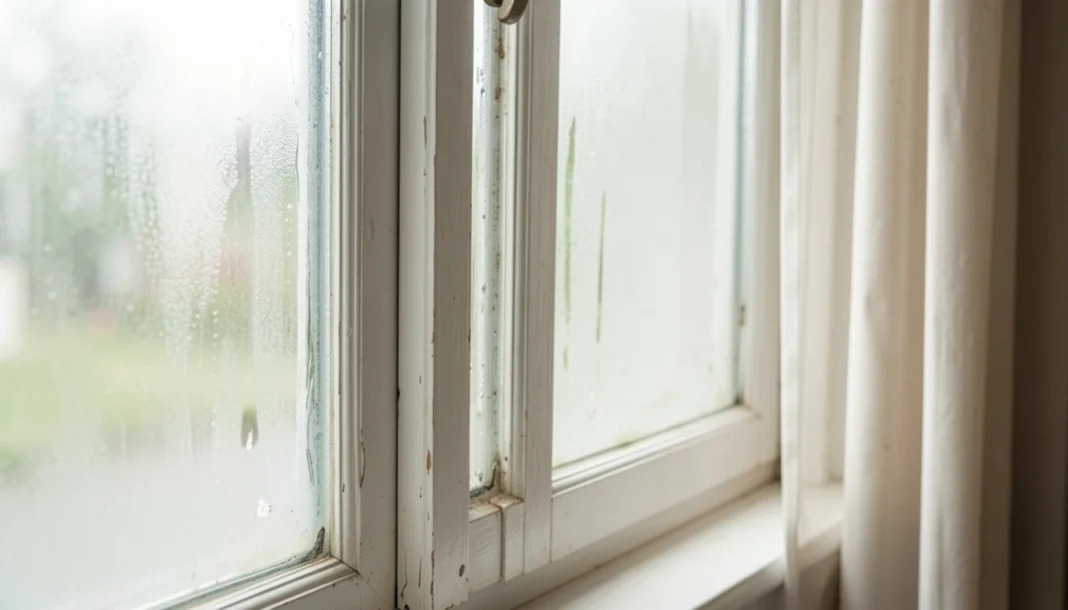
Most homeowners notice a problem before they can name it — a cold draft near a closed window, a heating bill that keeps climbing, or condensation forming between two panes of glass. The question is whether you’re dealing with something fixable or a window that has simply reached the end of its useful life.
Most windows serve you well for 15–30 years — but that timeline shrinks fast if you’ve got cheap vinyl, harsh winters, or a sloppy original install. Age alone doesn’t tell the whole story, but it’s a useful starting point.
Signs That Repair Is Enough
Some window problems are surface-level and don’t require full replacement:
- Broken hardware — Replace a stuck latch, failed crank, or worn balance spring yourself for just $20–$100 in parts — most hardware stores stock universal window hardware repair kits.
- Damaged weatherstripping — If cold air is coming in around the frame (not through the glass), weatherstripping replacement is a quick DIY fix costing under $30.
- Minor wood rot on the frame — Small rot sections can be cut out, treated, and filled with epoxy wood filler if the structural integrity of the frame is still intact.
- Failed caulking — Exterior caulk shrinks and cracks over time. Resealing around the frame costs almost nothing and takes an afternoon.
Signs That Replacement Is the Better Call
Some problems go deeper than surface repairs can address:
- Condensation between glass panes — This means the sealed unit has failed. The insulating gas is gone, and the window is no longer performing thermally. You can sometimes replace just the glass unit (called a sash replacement), but if the frame is also deteriorating, full replacement makes more sense.
- Visible warping or structural damage to the frame — A warped frame lets in air and water regardless of how well you seal around it.
- Persistent drafts despite repeated repairs — When you’ve replaced the weatherstripping, caulked the frame, and it’s still cold beside the window, the window assembly itself is the problem.
- Single-pane glass — If your home still has original single-pane windows, no amount of repair will bring them up to modern thermal performance. Replacement is the only real option.
- Difficulty opening, closing, or locking — Beyond inconvenience, this is a security and safety issue. In older double-hung windows, it often signals that the frame has shifted — a structural problem that repair cannot fix.
Repair vs Replace — A Practical Cost Comparison
The financial case for repair looks obvious at first. A full window replacement runs $300–$1,200 per window installed, while repairs typically cost $75–$350. But the calculation changes when you factor in how often you’ll be repairing the same window and what you’re losing in energy costs each year.
That one drafty window you keep ignoring? It’s quietly adding $15–$30 to your heating bill every single year — multiply that by 10 windows and you’re literally throwing away $150–$300 annually. New ENERGY STAR-certified windows can reduce heating and cooling costs by 12–15% on average, according to estimates from the U.S. Department of Energy.
Here’s the rule we share with clients: if fixing a window costs more than a third of a new one AND it’s already showing other wear, just replace it. You’ll save money and headaches over time.
Quick Decision Framework: Use this rule: if repair costs exceed 30-40% of replacement AND your window is 15+ years old, replacement typically delivers better long-term ROI.
| Scenario | Recommended Action | Estimated Cost |
|---|---|---|
| Broken latch or hardware | Repair | $20–$100 |
| Failed weatherstripping | Repair | $15–$50 |
| Seal failure (fogged glass) | Sash replacement or full replacement | $100–$400 |
| Rotted frame (minor) | Repair with epoxy | $50–$200 |
| Rotted frame (extensive) | Full replacement | $300–$1,200+ |
| Single-pane glass | Full replacement | $300–$900 |
| Drafts despite prior repairs | Full replacement | $300–$1,200+ |
Window Types Explained (And Which Suits Your Home)
Choosing the right window type is about matching function to the room, your local climate, and how you want to use the space. Each style has distinct ventilation, maintenance, and cost characteristics.
Double-Hung Windows
The most common window in American homes. Both the upper and lower sash slide vertically, which means you can open the window from the top for ventilation while keeping the lower half closed — useful in rooms with furniture near the window. They’re easy to clean (many tilt inward) and straightforward to replace. Cost range: $150–$650 per window before installation.
Casement Windows
Casement windows are hinged on one side and swing outward using a crank. They seal tightly when closed, making them one of the better choices for energy performance — the sash presses directly against the frame when shut, reducing air infiltration. They work well in kitchens where you need ventilation but can’t easily reach the window to slide a sash. Cost range: $250–$800 per window.
Sliding Windows
Sliding windows open horizontally along a track. They’re simple, low-maintenance, and well-suited to wide openings in contemporary homes. The trade-off is that only half the window area can open at once, and the track can collect debris over time. Cost range: $150–$600 per window.
Bay and Bow Windows
These extend outward from the wall, creating a small shelf or seating alcove. Bay windows typically combine three panels at angles; bow windows use four or more panels in a gentle curve. They add visual depth to a room and bring in more light, but they’re significantly more expensive to install due to the structural framing involved. Cost range: $1,000–$4,500+ installed.
Picture Windows
Fixed windows that don’t open. Because there’s no moving hardware, they’re the most thermally efficient and least prone to air leakage. They work well in living rooms and dining rooms where ventilation is provided by adjacent operable windows. Cost range: $200–$900 per window.
Frame Materials: Vinyl, Wood, Fiberglass, and Aluminum
The frame material affects thermal performance, maintenance requirements, lifespan, and upfront cost.
Vinyl is the most widely used material in replacement windows, and for good reason. It doesn’t rot, doesn’t need painting, and handles moisture well. Quality varies significantly between manufacturers — mid- and higher-grade vinyl frames with multi-chamber construction perform substantially better than basic builder-grade options. For example, Andersen’s 100 Series offers builder-grade value for budget replacements, while their E-Series delivers premium multi-chamber construction designed for colder climates. Average lifespan: 20–40 years.
Wood offers superior aesthetics and good thermal performance, but requires regular painting or staining to prevent rot. It’s a practical choice for historic homes where appearance matters or where local codes require it. Clad-wood windows (wood interior, aluminum or fiberglass exterior) reduce maintenance while preserving the look. Average lifespan: 30+ years with proper upkeep.
Fiberglass is the most dimensionally stable material — it expands and contracts at nearly the same rate as glass, which reduces seal stress over time. It’s stronger than vinyl, holds paint well, and performs well in extreme climates. The trade-off is higher cost, typically 15–30% more than comparable vinyl windows.
Aluminum is durable and low-maintenance but conducts heat and cold readily, making it a poor thermal performer unless the frame includes a thermal break — a non-conductive barrier within the frame. Common in commercial construction and in mild climates, but generally not recommended for cold-climate residential use.
Energy Efficient Windows — What the Numbers Mean
If you’re replacing windows partly for energy savings, understanding the ratings on the label will help you make a meaningful comparison between products.
U-Factor and SHGC
The U-factor measures how much heat passes through the window. A lower U-factor means better insulation. Before selecting U-factor or SHGC values, check your location on the ENERGY STAR climate zone map — Zone 5 (Chicago, Minneapolis) needs U-factor ≤0.25, while Zone 2 (Miami, Houston) prioritizes SHGC ≤0.25. In mixed or hot climates, 0.30–0.35 may be acceptable.
The Solar Heat Gain Coefficient (SHGC) measures how much solar heat comes through the glass. A lower SHGC blocks more heat — useful in hot climates where you’re fighting summer heat gain. In cold climates, a higher SHGC can actually help during winter by letting in passive solar heat. This is why climate-matching matters.
These ratings are certified by the National Fenestration Rating Council (NFRC) — always look for the blue NFRC label when comparing products to ensure verified performance data.
Low-E Glass and Gas Fills
Low-E (low-emissivity) glass has a microscopically thin metallic coating that reflects heat while still allowing light to pass through. It’s standard on virtually all mid- to upper-grade replacement windows today and makes a measurable difference in thermal performance.
Argon or krypton gas fills between the panes to reduce convection (heat transfer through the air gap). Argon is the standard choice; krypton is denser and performs better in thinner gaps but costs more. Both degrade slowly over time — well-made sealed units retain most of their gas for 20+ years.
ENERGY STAR Certification
ENERGY STAR certification means the window meets or exceeds efficiency thresholds set for your specific climate zone (Northern, North-Central, South-Central, Southern). An ENERGY STAR certified replacement window may also qualify for federal tax credits — as of 2024–2025, homeowners can claim 30% of the cost of qualifying windows up to $600 per year under the Energy Efficient Home Improvement Credit.
Window Replacement Cost Breakdown
Understanding the full cost of window replacement helps avoid budget surprises and makes the repair-vs-replace decision much clearer.
Cost Per Window by Type
These ranges reflect the window unit itself, not including installation:
| Window Type | Budget Range | Mid-Range | Premium |
|---|---|---|---|
| Double-Hung | $150–$300 | $300–$600 | $600–$1,200 |
| Casement | $200–$400 | $400–$700 | $700–$1,500 |
| Sliding | $150–$300 | $300–$550 | $550–$1,000 |
| Picture | $150–$300 | $300–$600 | $600–$1,200 |
| Bay/Bow | $500–$1,000 | $1,000–$2,500 | $2,500–$5,000+ |
Labor and Installation Costs
Professional installation typically adds $150–$350 per window for a standard replacement (inserting a new window into an existing frame opening). Full-frame replacement — where the installer removes the entire frame down to the rough opening — costs more, usually $300–$600 per window, and is necessary when the frame or surrounding structure is damaged.
For a full house with 10–15 windows, total installed costs commonly fall between $4,500 and $15,000, depending on window type, material, and whether full-frame replacement is needed.
Payback Period and Energy Savings
The payback period on replacement windows varies significantly based on what you’re replacing and where you live. Replacing single-pane windows in a cold climate with ENERGY STAR-certified double-pane units can reduce heating and cooling costs by $125–$465 per year (based on U.S. DOE estimates). At those savings rates, payback runs 7–15 years on a typical project.
Replacing already-functional double-pane windows with newer double-pane units produces smaller savings — often $25–$75 per year per window — which means payback can stretch to 20+ years. In those cases, the primary benefit is comfort and reduced maintenance, not energy savings.
DIY vs. Professional Installation — What’s Realistic
Insert-replacement (putting a new window unit into an existing frame) is a manageable DIY project for someone with intermediate carpentry skills, basic tools (pry bar, level, caulk gun, drill), and patience. It typically takes 1–3 hours per window and doesn’t require permits in most jurisdictions.
Full-frame replacement is a different matter. It involves removing exterior trim, siding, and the full frame assembly, then properly flashing and sealing the new frame against the building envelope. Done incorrectly, it creates water infiltration paths that can cause wall rot and mold over time — problems that cost far more to fix than the window itself. Unless you have genuine construction experience, professional installation is worth it for full-frame work.
When to always hire a professional:
- The surrounding wall shows signs of rot or moisture damage
- You’re replacing windows on upper floors without proper equipment
- The new window size differs from the existing rough opening
- The home is older (built before 1978) — confirm your installer holds EPA RRP certification to handle lead-safe work practices legally
Common Mistakes Homeowners Make
- Choosing windows based on price alone. Budget vinyl windows from big-box stores are not equal to mid-grade products from specialty window manufacturers. The difference shows up in seal longevity, hardware quality, and thermal performance — often within 5–8 years.
- Skipping the climate check. A window with a low SHGC that works well in Phoenix will underperform in Minnesota, where solar heat gain in winter is actually a benefit. Always cross-reference the ENERGY STAR climate zone map before buying.
- Ignoring installation quality. A high-quality window installed poorly will underperform a budget window installed correctly. Air sealing, shimming, and proper flashing around the frame matter as much as the product itself.
- Replacing all windows at once without prioritization. If budget is a constraint, start with the windows that face the most weather exposure (typically north and west in North America), windows in rooms you use most, or any window showing active seal failure or frame damage.
FAQs
How long do replacement windows last?
Vinyl windows typically last 20–40 years. Fiberglass and clad-wood windows can last 30–50 years with reasonable care. The sealed glass unit (which determines thermal performance) usually maintains most of its gas fill for 15–25 years.
Do new windows really lower energy bills?
Yes, but the savings depend heavily on what you’re replacing. Swapping single-pane for ENERGY STAR double-pane windows in a cold climate produces meaningful, measurable savings. Replacing already-decent double-pane windows with newer ones provides modest savings that take many years to recoup.
Is a sash replacement a good middle option?
Often, yes. If the frame is structurally sound but the glass seal has failed, replacing just the sash (the movable panel holding the glass) costs significantly less than full window replacement — typically $100–$300 per sash — and restores thermal performance.
What’s the best window type for cold climates?
Casement windows generally perform best in cold climates because they compress tightly against the frame seal when closed, minimizing air infiltration. Pair them with a low U-factor (0.25 or below), low-E glass, and argon fill for best results.
Do replacement windows add home value?
Window replacement recouped about 68–72% of its cost in resale value in recent years, according to Remodeling Magazine’s Cost vs. Value Report. That’s below full cost recovery, meaning windows are better justified by comfort and energy savings than by resale value alone.
Costs cited reflect U.S. market averages as of 2024–2025 and will vary by region, contractor, and material pricing at the time of your project. Always get at least three quotes for larger replacement projects.