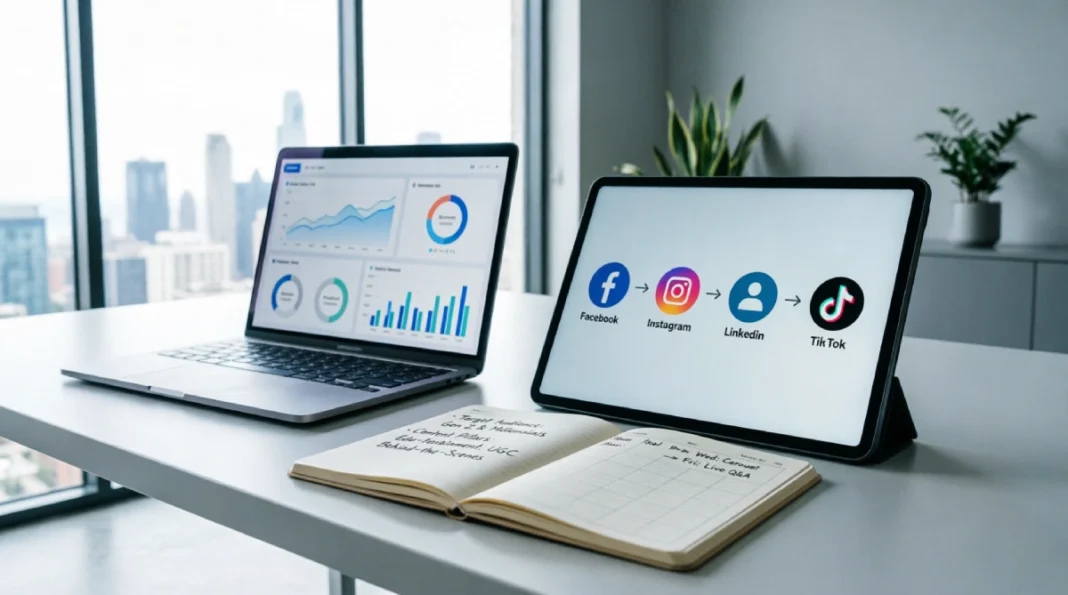
A small e-commerce brand spends three months posting daily on every platform — Facebook, Instagram, TikTok, LinkedIn, and Pinterest. Six months later, traffic is flat, their team is burned out, and they can’t tell which platform, if any, moved the needle. Sound familiar?
This is the most common failure mode in social media marketing for businesses. The problem isn’t effort — it’s strategy. Posting everywhere without a plan is not a social media strategy. It’s just noise.
This guide gives you a clear framework: how to build a social media marketing strategy that fits your business, which platforms actually perform and what they cost, and how to create a content calendar that keeps execution consistent without draining your team.
Why Most Businesses Get Social Media Marketing Wrong
About 96% of American small businesses use social media in 2025, but usage and effectiveness are two very different things. The core mistake is treating all platforms as interchangeable. They aren’t. Each platform has a distinct audience, content format, and cost structure. Mapping your business goals to the right platform is the first decision you need to make — and most businesses skip it entirely.
In 2024, organic social remained the most-used distribution strategy, with 73% of businesses leaning on it to nurture authentic engagement, while just over half paired that with paid social to amplify reach. The businesses getting results aren’t just posting — they’re combining organic content with paid amplification on the platforms where their specific audience actually spends time.
The second mistake is chasing vanity metrics. Follower counts and likes don’t pay invoices. The metrics that matter are reach-to-conversion rate, cost per lead, and revenue attributed to social. If you can’t draw a line from your social activity to a business outcome, the activity needs to change.
How to Build a Social Media Marketing Strategy That Works
A working social media marketing strategy has four components: goal definition, platform selection, content planning, and performance tracking. Each feeds into the next.
1. Define specific goals before choosing platforms. “Build brand awareness” is not a goal. “Generate 50 qualified leads per month from LinkedIn ads at under $120 CPL” is a goal. Specific goals determine which platforms are relevant and which metrics you track.
2. Audit your audience. Where does your target customer spend time online? A B2B software company and a DTC skincare brand have completely different platform priorities. Skip this step, and you’ll be distributing content to the wrong people.
3. Pick two or three platforms and commit. The average person uses about 6.83 different social media platforms every month, but that doesn’t mean your business needs to be on all of them. Depth on fewer platforms produces better results than thin presence everywhere.
4. Mix organic and paid. Organic builds trust and long-term visibility. Paid amplifies what’s already working. Use both, but start organic to find what resonates before spending money.
5. Track the right numbers. For B2C, watch engagement rate, click-through rate, and social commerce conversions. For B2B, watch cost per lead, lead quality, and pipeline influenced by social.
Facebook Marketing: Reach, Ads, and Community
Facebook remains the single largest social platform for US businesses. It has 194.1 million users in the US, with 68% of US adults on the platform. Users access it an average of 8 times daily, spending roughly 17 hours and 20 minutes per month.
The platform’s strength isn’t organic reach — Facebook’s organic reach for business pages has dropped significantly over the years and sits well below 5% on average. Its strength is paid targeting and community features (Groups).
Facebook ads remain the most accessible paid social channel for small and mid-size businesses. You can start a campaign with as little as $5/day, and the targeting options — location, interests, behaviors, lookalike audiences — are among the best available. For B2C brands, paid social was the second-highest ROI channel in 2024, just behind email marketing.
Facebook Groups are an underused organic strategy. Businesses that build or participate in active Groups around their niche can drive genuine community engagement without paying for reach. The trade-off is time — running an active Group requires consistent moderation and content.
Best for: Local businesses, B2C e-commerce, event promotion, community building, retargeting campaigns.
Realistic ad costs: CPC typically ranges from $0.50–$2.00 depending on industry and audience. Budget $300–$1,000/month to test effectively.
Instagram for Business: Visual Content and Shopping
Instagram has matured into a full commerce channel, not just a brand aesthetic platform. It has 3 billion monthly active users globally. Reels made up more than half of all ads shared on Instagram in 2025, and the average user spends around 73 minutes on the app each day.
For product-based businesses, Instagram’s in-app shopping features are a direct revenue driver. 83% of users say they discover new products on Instagram, which makes it one of the most powerful top-of-funnel tools for consumer brands. The catch: Instagram rewards consistent, high-quality visual content. If you can’t produce that reliably, the results will be disappointing.
Reels currently get the highest organic reach on Instagram — significantly more than static posts or carousels. Brands that invest in short-form video see better distribution without paying for it. In 2025, Instagram’s engagement rate edged down to 0.48% overall, but remains more than three times higher than Facebook’s 0.15%.
For paid campaigns, Instagram ads are managed through Meta’s Ads Manager, meaning you get Facebook’s targeting capabilities combined with Instagram’s visual real estate. CPMs on Instagram tend to be higher than Facebook — expect $8–$18 depending on format and audience.
Best for: Consumer brands, fashion, food and beverage, beauty, lifestyle products, and direct-to-consumer e-commerce.
Posting cadence: 4–5 Reels per week for organic growth; 3–4 static posts or carousels.
LinkedIn Advertising: The B2B Revenue Machine
LinkedIn is in a different category from every other platform on this list. It is not a mass awareness channel. It is a precision B2B targeting engine, and the numbers back that up.
80% of B2B leads from social media come through LinkedIn. LinkedIn is responsible for 46% of social media traffic to B2B websites. Four out of five LinkedIn members drive business decisions.
The platform’s targeting is unmatched for B2B. You can reach specific job titles, seniority levels, company sizes, industries, and even people who have engaged with competitor content. This precision is why LinkedIn costs more than other platforms — and why the return justifies it for the right use case.
The average LinkedIn conversion rate is 6.1% in the US, substantially higher than Google Search at 3.75% and Google Display at 0.77%.
Cost reality check: Cost per lead on LinkedIn typically ranges from $60 to $150+, depending on the offer and targeting. For B2B SaaS companies targeting mid-market buyers, $60–$120 per Lead Gen Form submission is competitive. For enterprise deals worth $50,000+, a $200 CPL can still be highly profitable. For new campaigns targeting cold audiences, allocate at least $3,000 per month and plan for a 3–4 month testing phase to evaluate performance.
One tactical note: Lead Gen Forms — native LinkedIn forms — consistently outperform landing page conversions. Less friction means more leads. Use them for any lead generation campaign.
Best for: B2B companies, SaaS, professional services, recruiting, and enterprise sales.
What to avoid: Expecting quick results. LinkedIn B2B cycles are longer. Give campaigns 90 days before concluding.
TikTok Marketing: High Engagement at Lower Entry Cost
TikTok has moved past the “Gen Z dance app” label. As of 2025, 170 million people use TikTok in the US, representing 33% of US adults — up from 21% in 2021. The age distribution is broadening, and so is the commercial intent of users.
The core advantage of TikTok for businesses is engagement. TikTok’s average engagement rate is 3.85–4.1%, nearly 8x higher than Instagram’s 0.45%. That gap in engagement translates directly to lower cost-per-engagement, even if base CPMs are comparable to other platforms.
TikTok ads average around $6.21 CPM, with an average cost per link click of $0.31. The minimum campaign budget is $500, with a $20/day minimum at the ad group level. TikTok delivers an 11x average ROAS, and user-generated content styled ads generate 70% higher ROI than polished brand ads.
That last point is critical for your content strategy. TikTok penalizes ads that look like ads. The platform’s algorithm rewards content that feels native — vertical, fast-moving, conversational, trend-aware. If your team is producing polished brand videos and running them as TikTok ads, you’re likely overspending for underperformance. A mid-quality video made in TikTok’s style will outperform a $10,000 production almost every time.
Around 46% of users turn to TikTok to discover new products, and 57% have made purchases directly influenced by the app. TikTok Shop is now a direct commerce channel, not just a discovery tool.
Best for: Consumer brands, DTC e-commerce, food and beverage, entertainment, and any business targeting users under 40.
What to avoid: Running polished corporate video content. If it doesn’t look like it belongs in someone’s For You feed, it won’t perform.
How to Choose the Right Platforms for Your Business
Use this decision framework before committing resources:
Are you B2B or B2C? B2B companies should prioritize LinkedIn first, with supporting content on YouTube or X, depending on their industry. B2C companies should evaluate Facebook, Instagram, and TikTok based on their product type and target demographic.
What’s your content production capacity? TikTok and Instagram Reels require consistent video output. If your team can produce one quality video per week, that’s workable. If you can’t sustain it, start with Facebook and LinkedIn, which perform better with written content and static images.
What’s your budget?
- Under $500/month: Focus on organic content. Choose one platform and commit.
- $500–$2,000/month: Add paid amplification. Facebook or TikTok ads give the most reach per dollar at this budget.
- $2,000–$5,000/month: Diversify. Run paid on two platforms. LinkedIn if B2B, Meta if B2C.
- $5,000+/month: Full multi-platform strategy with dedicated ad budget per channel.
What’s your sales cycle? Short-cycle consumer purchases (impulse buys, low-ticket items) perform well on TikTok and Instagram. Long-cycle B2B deals require LinkedIn’s sustained visibility and trust-building content over weeks or months.
Building a Social Content Calendar (Step-by-Step)
A content calendar isn’t a creative document — it’s an operational tool. Its job is to prevent last-minute posting, ensure content variety, and align output with business goals.
Step 1: Set your posting frequency per platform. Be realistic about what your team can produce consistently. Inconsistency kills organic reach faster than low frequency.
Step 2: Define your content mix. A common working breakdown is: 40% educational content (how-to, industry insights), 30% brand/culture content (behind-the-scenes, team), 20% promotional content (products, services, offers), 10% curated or user-generated content. Businesses that post 80%+ promotional content see rapidly declining engagement.
Step 3: Build a 30-day template. Map out each week’s posts by type and platform. Use a simple spreadsheet: date, platform, content type, topic, format (video/image/text), status. Keep it simple enough that your team will actually use it.
Step 4: Batch your content creation. Produce content in blocks — one day of filming, one day of writing — rather than scrambling daily. Batching reduces production time by 40–60% and improves consistency.
Step 5: Schedule and monitor. Use a scheduling tool (Buffer, Hootsuite, Later, or Meta’s native scheduler) to publish in advance. Review performance weekly, not daily. Look for patterns in what earns engagement and adjust your next batch accordingly.
Step 6: Build in campaign windows. Leave flexibility for promotions, product launches, and trending moments. A rigid calendar that has no room for timely content misses opportunities.
Common Mistakes That Kill Results
- Skipping the strategy and jumping straight to posting. Content without goals is just activity. Define what you want each platform to do for your business before creating a single post.
- Treating all platforms the same. Copy-pasting the same post across every platform signals to both algorithms and users that you don’t understand where you are. Each platform has its own language and format expectations.
- Ignoring paid entirely or going paid too early. Organic content tells you what resonates. Paid amplifies what’s already working. Spending money on unproven content is throwing the budget at guesswork.
- Not responding to comments and messages. 76% of customers now expect companies to offer customer service via social media, and 76% of consumers who have had a good social media experience with a brand are likely to recommend it to others. Social is a two-way channel. Businesses that broadcast without engaging lose trust faster than those that say nothing.
- Measuring the wrong things. Likes and follower counts are not business outcomes. Track clicks, leads, cost per acquisition, and revenue attributed to social. If your analytics can’t connect social activity to revenue, fix your tracking before spending more on content.
FAQs
Q. How many social media platforms should a small business use?
Start with one or two. Master them before expanding. Most businesses see better results from consistent execution on two platforms than scattered presence on five.
Q. What is the minimum budget to run effective social media ads?
For Facebook and Instagram, $300–$500/month is a workable starting point for testing. For LinkedIn, budget at least $3,000/month and plan for a 90-day testing phase. For TikTok, the minimum campaign spend is $500.
Q. How long does it take to see results from social media marketing?
Organic results typically take 3–6 months of consistent posting before you see compounding growth. Paid campaigns can show results in 2–4 weeks, but meaningful optimization data takes 30–90 days, depending on volume.
Q. Is TikTok worth it for small businesses?
Yes, for the right type of business. If you sell consumer products and can produce authentic short-form video, TikTok’s engagement rates and lower CPMs make it one of the most efficient platforms right now. If you’re B2B or can’t produce consistent video content, invest elsewhere.
Q. What type of content gets the highest engagement on social media?
Short-form video formats offer the highest ROI of all social content formats, according to 35% of social media marketers. Video consistently outperforms static content across all major platforms.
Q. How do I measure ROI from social media marketing?
Track these metrics by goal: brand awareness (reach, impressions, follower growth), engagement (likes, comments, shares, saves), traffic (clicks, sessions from social), leads (form submissions, cost per lead), and revenue (social-attributed conversions in your analytics platform).
Q. Should I use the same content across all platforms?
No. Repurpose the idea, not the format. A blog post can become a LinkedIn article, a series of Instagram carousel slides, a short TikTok, and a Facebook post — but each should be reformatted and rewritten to match the platform’s style and audience expectation.