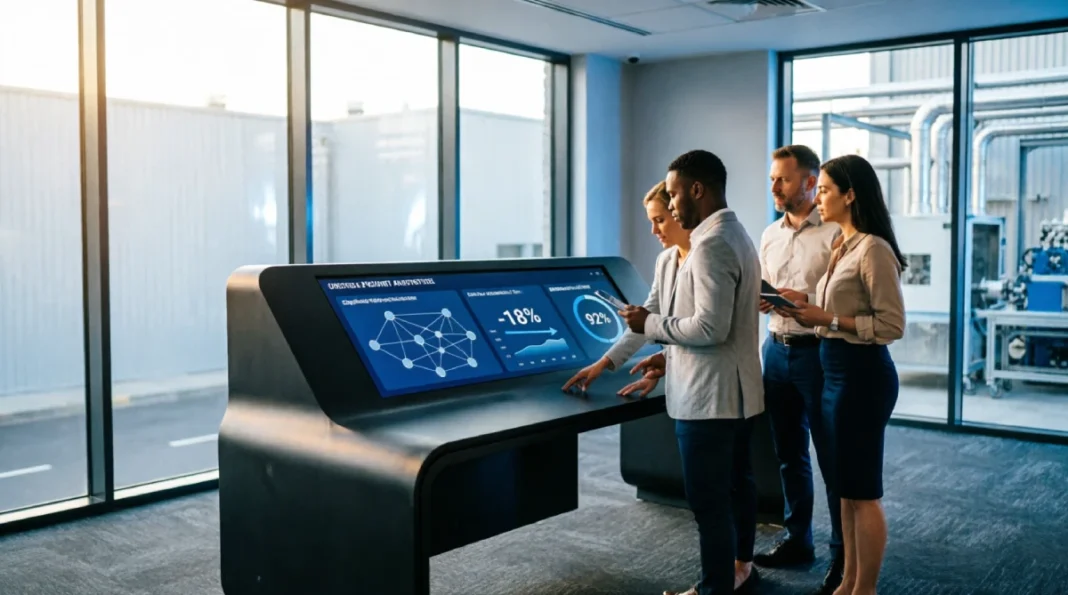
A mid-sized manufacturer in Ohio automated three procurement workflows using AI agents last quarter. Two failed within weeks — not because the technology was wrong, but because the company’s data infrastructure wasn’t ready, and no one owned the oversight process. Meanwhile, a competitor using simpler, well-integrated AI tools quietly cut procurement costs by 18%.
That gap between chasing trends and actually acting on them defines the business landscape in 2026. This is not a year for watching. It’s a year for deciding which forces are real, which are still maturing, and where inaction carries a measurable cost.
Here is a clear-eyed look at the trends that matter and what each actually demands from leaders.
Why 2026 Is a Different Kind of Inflection Point
For years, emerging technologies moved from exploration to adoption on a predictable timeline. That timeline is compressing. What feels early-stage today can become a competitive necessity almost overnight.
Global economic growth is expected to come in at 2.7% in 2026, slightly below 2025 estimates and well below the pre-pandemic average. Growth and risk are distributed unevenly — advanced economies are recovering, but over a quarter of emerging market economies still have per capita incomes below 2019 levels.
The implication: margin for error is thin. Companies that spread resources across too many initiatives and treat every trend as equal will make no meaningful progress in any. The businesses that are pulling ahead are making fewer, more committed bets — and executing with precision.
AI Moves From Experiment to Infrastructure
The most important shift in AI this year is not a new model or capability. It’s organizational.
AI is no longer an experiment on the side. It’s rewiring how work gets done, shifting from isolated tools that people can choose to adopt or ignore to platforms that sit at the center of workflows, decisions, and customer journeys.
Companies that have seen real returns from AI share a common pattern: senior leadership picks focused investment areas, identifying specific workflows where payoffs are large, rather than allowing a ground-up free-for-all of small, scattered initiatives that rarely drive transformation.
The infrastructure gap is one of the clearest blockers. The architecture built for cloud-first strategies cannot handle AI economics. Processes designed for human workers do not work for agents. Security models built for perimeter defense do not protect against threats operating at machine speed. This means many companies are not running AI on top of their existing systems — they are rebuilding those systems to support AI.
What this means for you:
- If AI still reports to IT rather than business leadership, that’s a structural problem affecting ROI
- Only 39% of companies have implemented AI in production at scale — up from 24% last year — which is a prerequisite for generating substantial value
- Scattered adoption without a central platform is expensive and produces noise, not results
Agentic AI: Real Promise, Overstated Readiness
Agentic AI — systems that take autonomous actions across workflows with limited human input — is the most hyped concept in enterprise technology right now. It deserves both attention and skepticism.
About a third of organizations are now prioritizing agentic AI implementation over more widely adopted generative AI tools, and 63% expect agentic AI to free employees for more strategic and creative work.
The ambition is legitimate. The readiness is not always there. Research from Anthropic, Carnegie Mellon, and others has found that AI agents still make too many errors for businesses to rely on them for high-stakes processes. Cybersecurity vulnerabilities, particularly prompt injection, remain a serious concern, along with agents’ tendency to become misaligned with intended objectives.
The companies getting real results from agentic AI are those with a centralized deployment platform, a shared library of pre-tested agents, clearly defined human oversight steps, and built-in monitoring — including agents checking each other’s work on higher-risk tasks.
The practical position for most businesses in 2026: pilot agentic AI on low-stakes, well-defined workflows. Do not deploy it where errors are expensive or irreversible without robust oversight structures in place.
Digital Transformation: From Adoption to Rebuilding
Most companies have digitized surface-level processes. The harder — and more valuable — work is using technology to fundamentally change how decisions are made, not just how tasks are executed.
Most AI implementations so far have aimed at improving existing workflows. Using AI to fundamentally reorganize how decisions happen is the emerging frontier.
Technologies once considered experimental — AI-powered copilots, smart factories, digital twins — are reshaping how companies make decisions, engage with customers, and design products. What feels “early stage” today can become a competitive requirement almost overnight.
One concrete example: Amazon has deployed its millionth robot, with its DeepFleet AI coordinating the entire fleet and improving warehouse travel efficiency by 10%. BMW’s factories now have cars driving themselves through kilometer-long production routes. These are not pilot programs — they are operational infrastructure.
For companies not yet at this stage, the gap is primarily about foundations: data quality, governance, and leadership willingness to redesign workflows rather than automate bad ones.
Sustainability Becomes a Financial Obligation
Sustainability is no longer primarily a values or PR decision. In 2026, it’s a regulatory and financial one.
The EU’s Carbon Border Adjustment Mechanism (CBAM) moved from reporting to real financial impact on January 1, 2026. Companies exporting to Europe now face actual costs, not just disclosure requirements.
Supply chains are an immediate flashpoint. Coffee prices surged 40% in 2024 due largely to extreme weather, while cocoa prices have climbed 400% in recent years as climate-driven conditions in West Africa worsen. Gaps between commodity costs and retail prices are closing, and consumers will absorb more of those increases.
For businesses in most markets, 2026 demands a direct link between sustainability strategy and industrial resilience, energy costs, and productivity — not just reporting compliance. Companies that treat it as a box-checking exercise will find themselves behind on both cost control and investor scrutiny.
The energy dimension is particularly complex: AI’s rapid buildout is putting enormous strain on power grids, which directly conflicts with corporate carbon commitments. Companies can prepare by integrating carbon scheduling into their AI architecture and diversifying energy sources, with renewables often representing the most cost-effective long-term option.
E-Commerce: The New Competitive Floor
Global e-commerce retail sales will surpass $3.8 trillion in 2026, with projections exceeding $4.9 trillion by 2030. This growth brings opportunity and acute competitive pressure in equal measure.
The defining shift is that e-commerce excellence is no longer a differentiator — it’s a baseline. Customers expect fast delivery, frictionless checkout, consistent cross-channel experience, and personalized recommendations. Brands that can’t deliver this are losing ground to those that can.
Several specific forces are reshaping the space this year:
- AI-driven personalization is moving from marketing emails to real-time pricing, product recommendations, and dynamic storefronts. Organizations report that 70% have seen measurable improvement in personalization metrics over the past three years, alongside gains in lead generation and customer retention.
- Augmented reality (AR) is solving the “can’t touch it before buying” problem. The global AR in e-commerce market is projected to grow from $5.8 billion in 2024 to $38.5 billion by 2030, at a compound annual growth rate of around 36%.
- Cross-border complexity is rising. The EU has moved toward a minimum €3 fee on low-value e-commerce imports under €150, which historically had been customs-exempt. This takes effect mid-2026 and represents an immediate cost shift for brands selling into Europe.
The Workforce Equation
Remote and hybrid work are now table stakes in most knowledge-work industries. In a competitive talent market, remote and hybrid flexibility has become a baseline expectation that shapes employee retention — companies that pull back risk talent churn and higher recruiting costs.
The more pressing issue is skills. Automation and AI are projected to displace 92 million roles by 2030, while creating 170 million new ones — but the transition requires deliberate investment in workforce upskilling, not passive adjustment.
The leadership requirement for 2026 is clear: every employee needs enough AI and digital fluency to use tools, ask good questions, interpret outputs, and redesign their own work. That’s not optional — it’s a minimum capability threshold for organizations that want to compete.
Companies treating AI literacy as a “nice to have” training program are making a strategic error. The gap between AI-fluent teams and those without will compound quickly over the next 18 months.
Geopolitical Risk and Supply Chain Regionalization
The world is seeing its highest number of armed conflicts since World War II. Shifting trade blocs, new strategic alliances, and escalating geopolitical pressure are creating operational complexity for businesses with globally distributed supply chains.
The corporate response is regionalization. Driven by policies like the US Inflation Reduction Act, the EU Chips Act, and the China+1 strategy, companies are restructuring value chains to reduce exposure to single-country dependencies. Around 78% of manufacturers have implemented or plan to invest in supply chain planning software to manage this complexity.
This is not a cost-neutral move. Regionalizing supply chains typically increases short-term costs. The tradeoff is resilience — and after the disruptions of the past five years, most companies are willing to pay a premium for it.
Cybersecurity: No Longer an IT Problem
The average cost of a data breach is $4.44 million. Cybersecurity ranks fourth among the top 34 short-term global risks identified by the World Economic Forum.
The threat environment is changing structurally. AI-powered attack tools are faster and more adaptive than traditional defenses. Quantum computing advances are beginning to threaten encryption standards that underpin current security architecture.
For 2026, businesses cannot rely on IT teams to absorb this risk alone. Resilience must be built into product design, supply chains, customer-trust communication, and compliance processes — not treated as a back-office function. Cyber insurance rates are rising by up to 5% or more, depending on incident history, and this cost will continue climbing.
Emerging Markets: The Leapfrog Opportunity
While advanced economies grow at around 1.5%, emerging market and developing economies are projected to expand above 4% in 2026, representing the fastest-growing pool of new customers and business opportunities globally.
The interesting dynamic here is that some emerging markets are not repeating the legacy infrastructure buildout that slowed adoption in developed economies. Regions undergoing rapid development have the opportunity to build context-aware, locally fluent AI and digital systems from the ground up — bypassing the legacy constraints that slow transformation in established markets.
For businesses with international ambitions, this means the entry calculus for emerging markets has changed. Digital infrastructure gaps are closing faster than expected. Payment, logistics, and customer acquisition models that worked five years ago need to be re-evaluated.
What Separates Companies That Win From Those That Fall Behind
The common thread running through every trend above is not technology — it’s decision quality. Success with AI and digital transformation has been concentrated in companies that spread fewer, more focused bets, where senior leadership sets priorities from the top down rather than crowdsourcing initiatives that never cohere into a strategy.
The organizations most likely to succeed will not necessarily be those with the most advanced technology. They will be those with the discipline to connect every investment to business outcomes, and the speed to execute before the window closes.
The trends above are not equally urgent for every business. The framework for prioritizing them:
- Act now: AI infrastructure, cybersecurity, sustainability compliance (especially CBAM if you sell into Europe), supply chain resilience
- Build toward: Agentic AI (with appropriate governance), AR in commerce, workforce AI literacy
- Monitor closely: Emerging market expansion, geopolitical risk to specific supply chain nodes, cross-border e-commerce regulation
The risk in 2026 is not moving too fast. It’s fragmenting attention across too many fronts and making meaningful progress in none of them.
FAQs
Q: What is the single most important business trend in 2026?
AI moving from experimentation to infrastructure — specifically, the shift to top-down, enterprise-wide AI programs that are tied to measurable business outcomes rather than scattered pilot projects.
Q: Is agentic AI ready for business use in 2026?
Not broadly. It is useful in narrow, well-defined, low-stakes workflows with human oversight built in. For high-stakes, high-cost processes, the error rates and security vulnerabilities are still too significant for most organizations to rely on.
Q: How does sustainability affect business strategy in 2026 beyond reporting?
The EU’s Carbon Border Adjustment Mechanism now creates direct financial penalties. Supply chain disruptions tied to climate events — coffee, cocoa, commodity price shocks — are translating into real cost pressure. Sustainability is now a risk management and cost control issue, not just a communications exercise.
Q: What should companies do about the AI skills gap?
Treat AI literacy as a baseline operational requirement, not a training program. Every function — finance, marketing, operations, HR — needs enough fluency to work with AI tools, interpret their outputs, and redesign their own workflows. Companies that wait for a “readiness moment” will find the gap has compounded.
Q: How should businesses handle supply chain risk in 2026?
Regionalization is the dominant response — reducing single-country dependency and building more distributed networks. The short-term cost is real. The alternative, a disruption-driven emergency restructuring, is more expensive.
Q: What does digital transformation actually mean in 2026?
It means rebuilding decision processes, not just digitizing existing ones. The most valuable applications of AI and technology in 2026 are those that change how decisions are made — not just how fast the same decisions get executed.