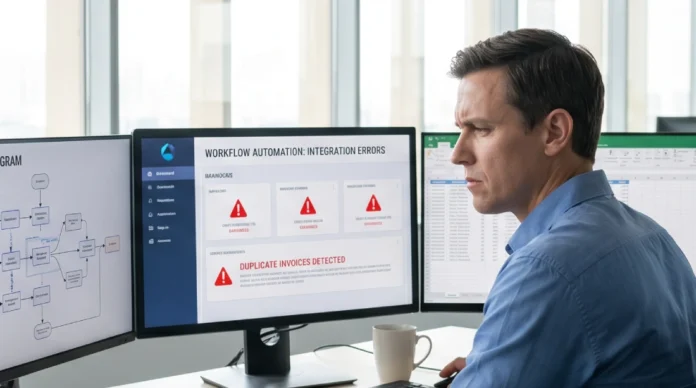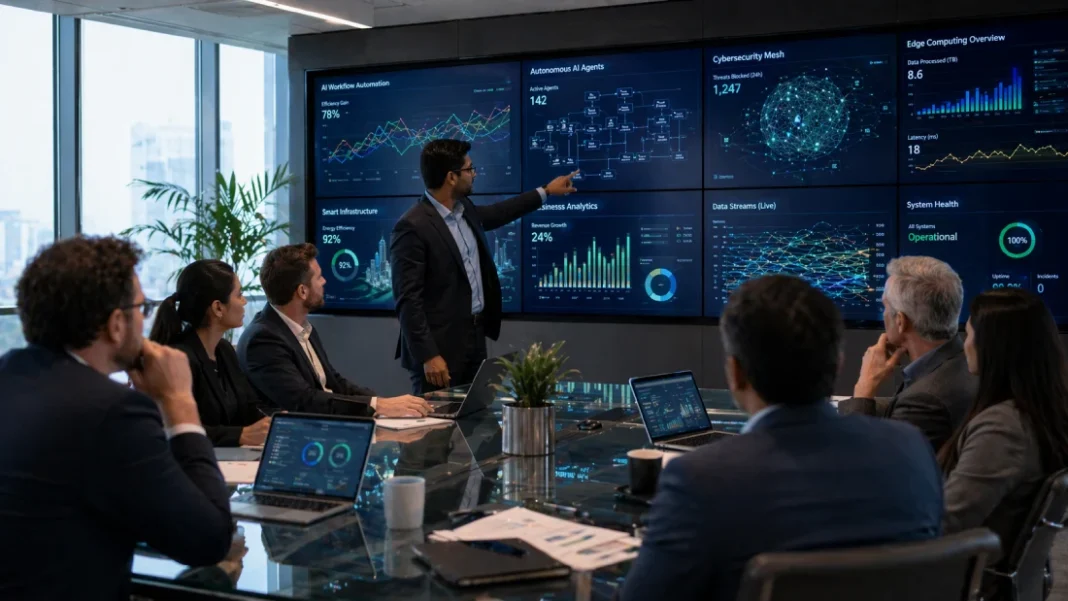
A competitor in your industry quietly deploys autonomous AI agents to handle supplier negotiations, customer escalations, and compliance checks — without a human in the loop. Six months later, their cost base is 18% lower than yours. You heard about AI agents and emerging technology trends at a conference in 2024. You filed it under “watch list.” That gap between awareness and action on the 10 technology trends reshaping business in 2026 is exactly what this article closes before Q4 planning locks in.
These are the ten technology trends in 2026 that are moving from pilot programs into mainstream business operations. For each one, you’ll get a clear picture of what it actually is, where it’s being deployed, and what you should be thinking about before Q4 planning locks in.
1. Autonomous AI Agents: Workflow Automation Trends for Business Leaders in 2026
Most organizations spent 2023–2024 experimenting with generative AI for writing and summarization. That era is over. In 2026, the conversation has shifted to AI agent systems that don’t just generate content but take multi-step actions: browsing, deciding, executing, and reporting back.
Here’s the practical difference: while a chatbot waits for your question, an autonomous agent proactively books flights, verifies policy compliance, spots contract red flags, and syncs your CRM — all without you clicking ‘next’. Frameworks like Microsoft AutoGen or LangChain enable developers to orchestrate these multi-step agent workflows, while platforms like CrewAI simplify deployment for non-technical teams.
Early deployment is concentrated in:
- Financial services (fraud detection, loan pre-screening)
- Legal and compliance (document review, regulatory monitoring)
- Customer operations (escalation routing, resolution automation)
Early adopters report 15-25% reductions in operational costs when deploying autonomous agents for rule-based workflows (McKinsey, 2025 industry benchmarks).
What leaders need to assess: Which workflows in your organization are rule-based, repetitive, and high-volume? Those are your agent candidates. The question isn’t whether to deploy — it’s which processes to target first and how to manage the handoff between agent and human judgment.
2. Spatial Computing Is Moving Off the Headset
Spatial computing — the ability to blend digital information with physical space — is no longer a consumer novelty. After years of failed mass-market attempts, the business case is finally clarifying around specific industrial use cases rather than general consumer adoption.
The real traction in 2026 is in:
- Manufacturing and maintenance: Technicians use AR overlays to see live equipment data, fault diagnostics, and repair instructions without leaving their workstation or opening a manual.
- Architecture and construction: Clients walk through buildings before they’re built. Change orders drop because everyone is reacting to the same spatial model.
- Training: High-risk industries (oil and gas, surgery, aviation) are replacing expensive physical simulations with spatial environments.
Forget consumer headsets — the real business value is in purpose-built spatial tools designed for specific jobs, like AR glasses for factory technicians or 3D walkthroughs for construction clients. If you’re in a sector with complex physical operations, spatial computing deserves a real budget conversation — not just a demo.
3. Green Tech Has Become a Capital Allocation Question
Sustainability technology in 2026 is no longer a PR exercise. Three forces have converged to make green tech a hard financial decision:
- Regulatory pressure (particularly the EU’s CSRD and similar reporting mandates in other regions) now requires documented emissions data, not estimates
- Energy costs have made efficiency technology, smart HVAC, intelligent building management, and renewable procurement economically attractive on their own merits
- Institutional investors are pricing ESG risk into valuations with increasing precision
The practical implication: companies that treat green tech as a compliance cost are paying twice — once for the tech, once for the inefficiency of doing it reactively. Those treating it as an infrastructure decision are finding genuine operating cost reductions.
Where to look first: energy monitoring systems, carbon accounting software like Watershed or Persefoni, smart building management via Salesforce Net Zero Cloud, and supply chain emissions tracking. These have the clearest ROI and the shortest payback windows.
4. Edge AI Is Solving the Latency Problem
Cloud-based AI is powerful but slow for time-sensitive decisions. Edge AI running machine learning models directly on local devices, rather than sending data to a central server, is becoming the standard for any application where milliseconds matter. Platforms like NVIDIA Jetson for on-device inference, AWS IoT Greengrass, or Azure Edge Zones make deploying these local models operationally feasible for enterprise IT teams.
Real-world deployments in 2026:
- Quality control cameras on factory floors that flag defects in real time
- Retail systems that analyze foot traffic and shelf inventory without sending video to the cloud
- Healthcare monitors that detect anomalies in patient data locally, triggering alerts without relying on network connectivity
Beyond speed, edge AI addresses a serious problem that cloud-first AI created: data sovereignty. Many organizations can’t or won’t send sensitive operational data to third-party servers. Edge models keep that data on-site.
If your team makes time-sensitive decisions on unreliable networks — think factory floors, remote sites, or patient monitoring — edge AI deserves a real pilot project, not just another vendor deck.
5. Cybersecurity Has Shifted to a Mesh Architecture
The old model of cybersecurity — build a wall around your network — stopped working when cloud adoption, remote work, and third-party integrations dissolved the concept of a perimeter. In 2026, the leading approach is cybersecurity mesh architecture (CSMA), a distributed model where security is applied at the identity level, not the network boundary.
What this means in practice:
- Every user, device, and application is treated as a potential entry point
- Security policies follow the identity, not the location
- Threat detection is continuous and behavioral, not checkpoint-based
The driving force is simple: breaches now most commonly enter through third-party vendors, compromised credentials, or misconfigured cloud services — none of which a perimeter wall catches. Organizations still running legacy perimeter security are structurally exposed.
Q4 planning signal: If your last security audit was more than 18 months ago, or if your model hasn’t accounted for your cloud and SaaS footprint, that’s a gap that needs attention before the budget cycle closes.
6. Quantum Computing Is Entering the “Prepare Now” Phase
Quantum computing is not yet a mainstream business tool. But 2026 marks the point where “it’s coming eventually” has shifted to “specific industries need to prepare now.” The reason is a cryptographic vulnerability.
Current encryption standards, the ones protecting your financial data, health records, and communications, are solvable by sufficiently powerful quantum computers. The cybersecurity community calls this the Q-Day risk. The timeline is uncertain, but major governments (US, EU, China) are already mandating migration to post-quantum cryptography standards.
For most organizations, the immediate action isn’t deploying quantum computers. It’s:
- Auditing which systems rely on encryption that will eventually be vulnerable
- Beginning migration planning to post-quantum cryptographic standards, starting with NIST’s finalized CRYSTALS-Kyber algorithm or IBM Quantum’s PQ3 Initiative for financial services
- Watching quantum use cases in your specific industry (logistics optimization, drug discovery, materials science) for competitive implications
Industries with long infrastructure cycles — defense, healthcare, finance- need to start this conversation now, not when Q-Day becomes imminent.
7. Generative AI Is Maturing Into Boring Infrastructure
Generative AI was a spectacle in 2023. By 2026, it’s becoming invisible in the same way that cloud storage became invisible — it’s just part of how software works. This maturity phase has important strategic implications.
The spectacle-chasing phase is over. Organizations that are still evaluating whether to use generative AI are behind. The competitive question now is integration depth — how tightly is AI embedded in your actual workflows versus sitting as a standalone tool that employees use inconsistently?
Signs of immature integration:
- AI tools adopted at the individual level with no organizational standards
- No clear policy on what data employees can feed into external AI systems
- Productivity gains are unmeasured and unattributed
Signs of mature integration:
- AI embedded directly into core systems (CRM, ERP, document management)
- Clear governance policies covering data, outputs, and accountability
- Measurable time and cost savings tracked at the process level
If your organization is in the first category, the gap is growing — not shrinking.
8. Smart Infrastructure Is Connecting Physical and Digital Operations
Smart infrastructure — the use of sensors, connectivity, and data analytics to manage physical assets — is expanding beyond smart cities into enterprise operations. In 2026, the convergence of cheap sensors, reliable connectivity (including 5G private networks), and better analytics platforms has made this accessible to mid-size organizations, not just large enterprises.
Practical applications:
- Predictive maintenance across equipment fleets, reducing unplanned downtime by 30-50% with ROI typically realized in 6-12 months for mid-size manufacturers
- Smart energy management in commercial real estate and industrial facilities
- Connected logistics — real-time tracking of assets, vehicles, and inventory with automatic rerouting and alerting
The business case is straightforward: unplanned downtime is expensive, energy waste is measurable, and inventory visibility directly affects working capital. The technology has reached a point where the ROI calculation is clear enough for most CFOs.
9. The Human-AI Workforce Model Is Forcing Org Design Changes
This is the trend most leaders are underestimating. The conversation about AI and jobs has been dominated by “will AI replace workers?” — which is largely the wrong question. The more immediate and practical issue is: how do you design an organization where humans and AI systems work together effectively?
What’s emerging in 2026:
- New roles focused on AI output oversight, quality control, and exception handling — jobs that didn’t exist three years ago
- Existing roles are changing faster than training programs can keep up
- Workforce planning models that don’t account for AI capacity are producing staffing miscalculations
Smart leaders aren’t siloing AI in IT — they’re weaving it into workforce planning from day one, asking ‘How does this change who we hire, train, and deploy?’ not just ‘What can this tool do?’ The ones getting it wrong are running AI projects in IT while their HR function plans headcount as if AI doesn’t exist.
The hard question to ask: Does your workforce planning model currently account for AI-augmented productivity? If not, your headcount projections are probably wrong in both directions.
10. Platform Consolidation Is Ending the Era of Fragmented Tech Stacks
Over the past decade, most organizations accumulated software tools faster than they could integrate them. The average mid-size enterprise runs dozens of SaaS applications, many of which overlap in function and none of which talk to each other cleanly. In 2026, platform consolidation is one of the dominant tech buying trends — driven by cost pressure, integration fatigue, and the need for clean data pipelines to feed AI systems.
AI systems need good data. Fragmented stacks produce bad data. This is accelerating consolidation decisions that cost and complexity alone hadn’t forced.
What this looks like in practice:
- Organizations rationalizing from 4–5 point solutions to 1–2 integrated platforms per function, like consolidating HR tools onto ServiceNow or customer operations onto Microsoft Power Platform
- Vendor contracts are being restructured around platform deals rather than individual tool licenses
- IT priorities are shifting from “add new tools” to “consolidate and integrate existing ones.”
Be honest: does your tech stack feel like a patchwork of tools bought at different times? Before Q4 budgets lock, audit what’s actually driving value, where tools duplicate effort, and which integration gaps are burning hours on manual data fixes.
How to Use This List Before Q4
Not every trend is equally relevant to every industry. Here’s how to prioritize:
Act now (high maturity, clear ROI):
- AI agents for workflow automation
- Cybersecurity mesh architecture
- Platform consolidation
Plan and budget (mid-maturity, building ROI case):
- Edge AI for real-time operations
- Smart infrastructure and predictive maintenance
- Generative AI integration depth
Monitor and prepare (early maturity, future exposure):
- Spatial computing (if you have complex physical operations)
- Quantum cryptography readiness
- Human-AI org design
The worst outcome in Q4 planning is treating technology trends as a uniform list to react to. The useful exercise is mapping each trend against your specific operations, identifying where you’re exposed or behind, and building that into budget and roadmap decisions — before your competitors do it first.
FAQs
Q1: What’s the real difference between an AI chatbot and an autonomous AI agent for business workflows in 2026?
A chatbot responds to questions. An AI agent takes multi-step actions — like reviewing a contract, updating a system, and flagging exceptions — without needing a human to prompt each step.
Q2: Is spatial computing only useful for large enterprises?
No, but it’s currently most practical for industries with complex physical operations — manufacturing, construction, and high-risk training environments. Consumer-facing use cases are still underdeveloped.
Q3: Why is green tech now a financial decision rather than a PR one?
Regulatory mandates now require documented emissions data, energy costs make efficiency tech economically attractive, and investors are pricing ESG risk into valuations — making reactive compliance more expensive than proactive investment.
Q4: How does edge AI solve latency and data sovereignty issues that cloud AI can’t address for enterprise operations?
Speed and data control. Edge AI processes data locally, making real-time decisions without network dependency and keeping sensitive operational data off third-party servers.
Q5: What is cybersecurity mesh, and why does the old perimeter model fail?
Mesh applies security at the identity level, not the network boundary. The perimeter model fails because modern breaches enter through cloud misconfigurations, compromised credentials, and third-party vendors — none of which a network wall catches.
Q6: Do most businesses need to act on quantum computing right now?
Not on deployment — but yes on preparation. The immediate priority is auditing encryption systems and beginning migration toward post-quantum cryptography standards before vulnerability windows open.
Q7: How do you know if your generative AI integration is immature?
If employees are using AI tools individually with no organizational standards, no data governance policy, and no measured productivity outcomes, your integration is shallow, and the competitive gap is widening.
Q8: What is driving platform consolidation in 2026?
Three things: cost pressure from running redundant tools, integration fatigue from fragmented stacks, and the need for clean data pipelines that AI systems require to function reliably.
Q9: How should leaders prioritize these ten trends?
By maturity and relevance to your operations. AI agents, cybersecurity mesh, and platform consolidation warrant immediate action. Edge AI and smart infrastructure need budget planning. Spatial computing and quantum readiness are monitoring priorities for most organizations.
Q10: What is the most underestimated trend in this list?
Human-AI workforce design. Most organizations are running AI projects in IT while HR plans headcount as if AI doesn’t exist — producing staffing models that are wrong in both directions.