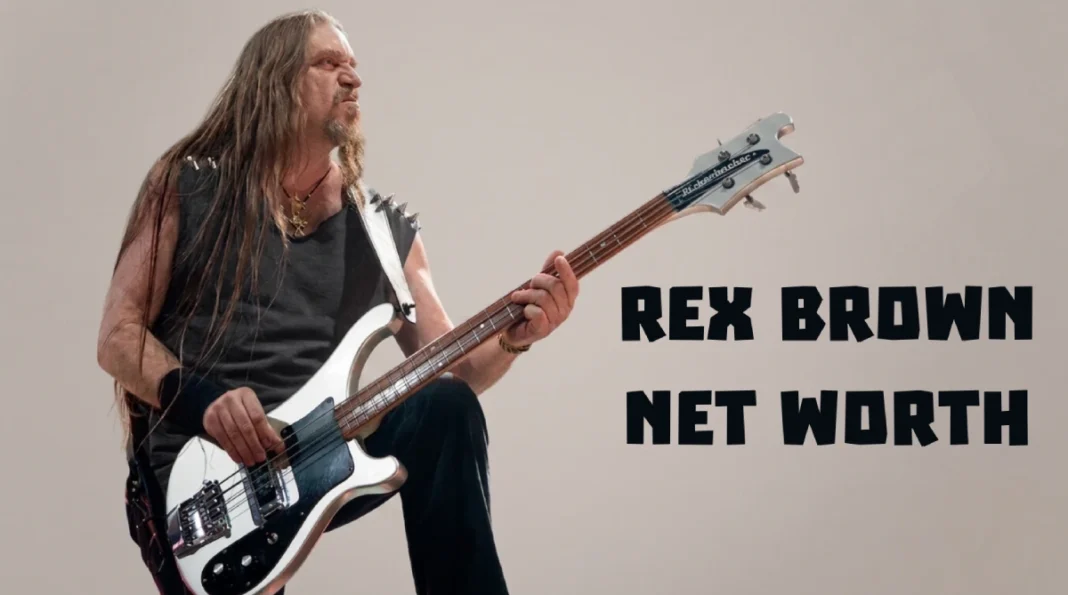
While many 1990s metal stars saw their fortunes vanish, Rex Brown did the unthinkable: he turned grit, consistency, and a killer bass tone into a $5 million net worth that’s still growing. Here’s exactly how he did it—and what you can learn from his playbook
As the longtime bassist for Pantera — one of the most commercially successful metal bands of the 1990s — Brown built his wealth through album royalties, consistent touring, endorsement partnerships, and a career that has never fully stopped moving.
This is not a story of one record deal or one good era. It is a story of staying active across multiple bands, income streams, and decades.
Rex Brown Net Worth at a Glance
Rex Brown’s net worth is estimated at $5 million. This figure reflects income accumulated across Pantera’s catalog, multiple band projects, reunion touring, a solo album, endorsement deals, and a published autobiography.
To put that number in context, here is how Brown’s estimated wealth compares to that of other Pantera members:
| Member | Estimated Net Worth | Status |
| Rex Brown | $5 Million | Active |
| Phil Anselmo | $4 Million | Active |
| Dimebag Darrell | $5 Million (at death) | Died 2004 |
| Vinnie Paul | $6 Million (at death) | Died 2018 |
Among the surviving members, Brown’s wealth is broadly comparable to Phil Anselmo’s. The late Vinnie Paul — Pantera’s drummer and one of its founding members — was the wealthiest of the group at the time of his death in 2018.
Early Life and Musical Foundation
Rex Robert Brown was born on July 27, 1964, in Graham, Texas. His introduction to music did not begin with a bass guitar or a metal record — it began with his grandmother, who taught him to play the piano as a child and introduced him to ragtime music and the compositions of Scott Joplin.
As a teenager, Brown became a fan of ZZ Top, Def Leppard, Rush, Black Sabbath, and Led Zeppelin. He began playing bass at age twelve. His development was fast enough that the University of North Texas offered him a jazz scholarship — which he declined in order to pursue rock music professionally.
Brown also achieved the rank of Eagle Scout in the Boy Scouts of America, a detail that is easy to overlook but tells you something about how he approaches commitment. That same consistency shows up throughout his career.
The Pantera Years: Building the Foundation
Pantera was formed in Arlington, Texas, in 1981. Brown joined the band in 1982 as a replacement for original bassist Tommy D. Bradford. He performed under the stage name “Rex Rocker” and appeared on the band’s first four independent albums before being credited under his real name starting with Cowboys from Hell.
Early Albums (1983–1988)
The first four Pantera albums — Metal Magic (1983), Projects in the Jungle (1984), I Am the Night (1985), and Power Metal (1988) — were released independently and reflect the band’s glam metal phase. These records generate minimal ongoing royalty income but established Brown as a professional bassist years before Pantera broke through commercially.
The Commercial Breakthrough (1990–2000)
Pantera signed with Atco Records and released Cowboys from Hell in 1990. From that point, Brown was credited under his real name. The records that followed drove the bulk of his wealth:
- Vulgar Display of Power (1992) — certified 2x Platinum by the RIAA (2+ million U.S. units); global sales estimated higher
- Far Beyond Driven (1994) — debuted at No. 1 on Billboard 200; certified Platinum (1+ million U.S. units); global sales significantly higher
- Cowboys from Hell — sold over 1.16 million copies worldwide
- The Great Southern Trendkill (1996) — over 1.1 million copies
- Reinventing the Steel (2000) — over 1 million copies
These albums continue to generate income through streaming, physical sales, and sync licensing — placements in films, television, and video games. Pantera also received four Grammy nominations for Best Metal Performance: for “I’m Broken,” “Suicide Note Pt. I,” “Cemetery Gates,” and “Revolution Is My Name.”
Pantera went on an indefinite hiatus in 2001 and officially disbanded in 2003. The deaths of Dimebag Darrell in December 2004 and Vinnie Paul in June 2018 made a complete reunion impossible — but the catalog never stopped generating royalties.
Post-Pantera Career: Multiple Bands, Sustained Income
Down (2001–2011)
During Pantera’s hiatus, Brown joined the supergroup Down, formed alongside Phil Anselmo. He played on Down II: A Bustle in Your Hedgerow (2002) and Down III: Over the Under (2007). The latter was made during a period when Down toured as the opening act for Metallica. Brown left Down in 2011.
Kill Devil Hill (2011–2013)
Brown formed Kill Devil Hill with a lineup that included drummer Vinny Appice (Black Sabbath, Heaven and Hell, Dio), guitarist Mark Zavon, and vocalist Dewey Bragg. The band released their self-titled debut in May 2012 and followed it with Revolution Rise in 2013.
Solo Work (2017)
Brown released his debut solo album, Smoke on This…, in July 2017 through Entertainment One. It was significant because it was the first time in his career that Brown appeared not only as a bassist but also as lead vocalist and guitarist. The album demonstrated that his commercial identity did not depend entirely on Pantera’s legacy.
Collaborations and Side Projects
Across his career, Brown has contributed to a wide range of outside projects:
- Jerry Cantrell — played bass on five tracks from Cantrell’s 1998 solo album Boggy Depot, including “Dickeye,” “My Song,” “Keep the Light On,” “Satisfy,” and “Hurt a Long Time.”
- Crowbar — contributed bass work on Lifesblood for the Downtrodden (2005)
- Cavalera Conspiracy — played on “Ultra-Violent” from the debut album Inflikted (2008)
- Rebel Meets Rebel — a 1999 project with Dimebag Darrell, Vinnie Paul, and country artist David Allan Coe; the self-titled album was released in 2006 on Vinnie Paul’s Big Vin Records label
- Elegant Weapons — played bass on the 2023 debut album Horns for a Halo for this metal supergroup
The 2023 Pantera Reunion Tour
In July 2022, it was announced that Brown and Phil Anselmo would join Zakk Wylde (filling in for Dimebag Darrell) and Charlie Benante (filling in for Vinnie Paul) for Pantera’s first major tour in over 22 years. The 2023–2024 Pantera reunion tour commanded premium ticket prices from a fanbase that had waited two decades—with 2024 dates selling out arenas including Madison Square Garden, proving the enduring commercial power of the catalog. For legacy acts of Pantera’s standing, reunion tours represent the highest per-show earning period of their careers.
Where Rex Brown’s Income Actually Comes From
Catalog Royalties
Pantera’s major label discography has sold over 8 million copies worldwide in total. These albums continue generating income through physical sales, streaming platforms, and sync licensing — placements in films, TV shows, and video games. Royalties from a catalog this size do not stop; they pay out quarterly regardless of Brown’s current activity. This passive income layer is the most durable part of his net worth.
Touring Revenue
Brown has toured with virtually no significant gaps across multiple bands for over four decades. Live performance income — show guarantees, touring fees, and backend revenue splits — has been his most active and consistent income source. The Pantera reunion tour generated the kind of payday that comes when nostalgia meets scarcity: a major band, a devoted audience, and no realistic prospect of another opportunity.
Endorsement Deals and Gear Royalties
Brown’s endorsement history spans the full length of his career and multiple manufacturers:
- Charvel — used during the Cowboys from Hell and Vulgar Display of Power era
- Jackson and Fernandes — mid-career endorsements
- Spector bass guitars — eventually became his primary endorsed brand; in 2011, Stuart Spector personally built him a custom RXT prototype
- Gibson — in July 2022, Gibson introduced the Rex Brown Signature bass, based on the Gibson Thunderbird but with a slimmer neck profile and a built-in drop-D tuning extender
- Kemper Profiler — his live setup
Signature instrument deals generate royalties on each unit sold. For a player of Brown’s reputation, those deals continue paying without requiring active promotion every quarter.
In 2019, Brown auctioned over 70 pieces of personal studio and stage gear on Reverb.com, including the Spector RXT prototype. Vintage musician equipment — particularly gear tied to specific albums and eras — sells at significant premiums.
Published Autobiography
Brown published Official Truth, 101 Proof in April 2013 — a memoir covering Pantera’s formation, peak years, internal tensions, and disbandment. The book generated an advance, ongoing sales royalties, and a wave of press attention that renewed public interest in his work. In 2015, he also contributed the foreword to Greg Prato’s book Survival of the Fittest: Heavy Metal in the 1990s.
Discography at a Glance
| Year | Project | Album / Release |
| 1983–2000 | Pantera | Metal Magic, Projects in the Jungle, I Am the Night, Power Metal, Cowboys from Hell, Vulgar Display of Power, Far Beyond Driven, The Great Southern Trendkill, Reinventing the Steel |
| 2002–2010 | Down | Down II: A Bustle in Your Hedgerow, Down III: Over the Under, Diary of a Mad Band |
| 2006 | Rebel Meets Rebel | Rebel Meets Rebel (with Dimebag Darrell, Vinnie Paul, David Allan Coe) |
| 2012–2013 | Kill Devil Hill | Kill Devil Hill (self-titled), Revolution Rise |
| 2017 | Solo | Smoke on This… |
| 2023 | Elegant Weapons | Horns for a Halo |
The Musical Identity That Sustains His Brand
Brown is known for his distinctive walking basslines beneath Dimebag Darrell’s guitar solos — a technique that made him an identifiable presence rather than a background player. Tracks like “Floods,” “Walk,” “5 Minutes Alone,” “Cowboys from Hell,” “This Love,” and “I’m Broken” are reference points for bass players studying the genre.
Technically, Brown typically plays with a pick and tapes the fingertips of his fretting hand to protect against skin wear from his heavy use of slides. These details matter for his long-term earning power: a bassist with a distinct, respected playing style sells signature instruments, attracts endorsements, and keeps a fanbase that will pay for concert tickets and merchandise.
Personal Life
Brown married his longtime girlfriend Elena Henrard in June 2023. He has maintained a relatively private personal life compared to many musicians of his profile.
In August 2009, Brown was removed from a Down tour due to acute pancreatitis. He underwent surgery to remove his gallbladder and pancreatic polyps. His bandmate Pepper Keenan commented at the time that Brown had been through a serious ordeal but returned to full health. Health complications of that severity can carry significant financial consequences for a touring musician — Brown returned to performing without an extended break.
In 2012, Brown dealt with an IRS tax lien, a problem that has destroyed the finances of numerous musicians who failed to manage their tax obligations during high-earning years. Brown resolved the IRS lien through structured payments and continued touring income. While the $449,567 liability was significant, his diversified revenue streams—catalog royalties, endorsements, and live performance—allowed him to stabilize without asset liquidation.
What $5 Million Means for a Metal Musician?
Most musicians from the 1990s metal era did not come out financially intact. Many saw their wealth erode through bad contracts, excessive touring costs, substance dependency, or simply stopping at the wrong time. Brown kept working — through Pantera’s collapse, through two bandmates’ deaths, through health complications, through a tax dispute — and the Pantera catalog kept paying in the background the entire time.
His $5 million net worth is not the result of one windfall. It is the product of four decades of professional consistency: multiple active bands, a published book, a steady endorsement track record, and a commercially durable catalog that earns royalties without requiring anything from him.
For the genre he spent his career in, that is an above-average financial outcome — and a direct result of never fully stopping.