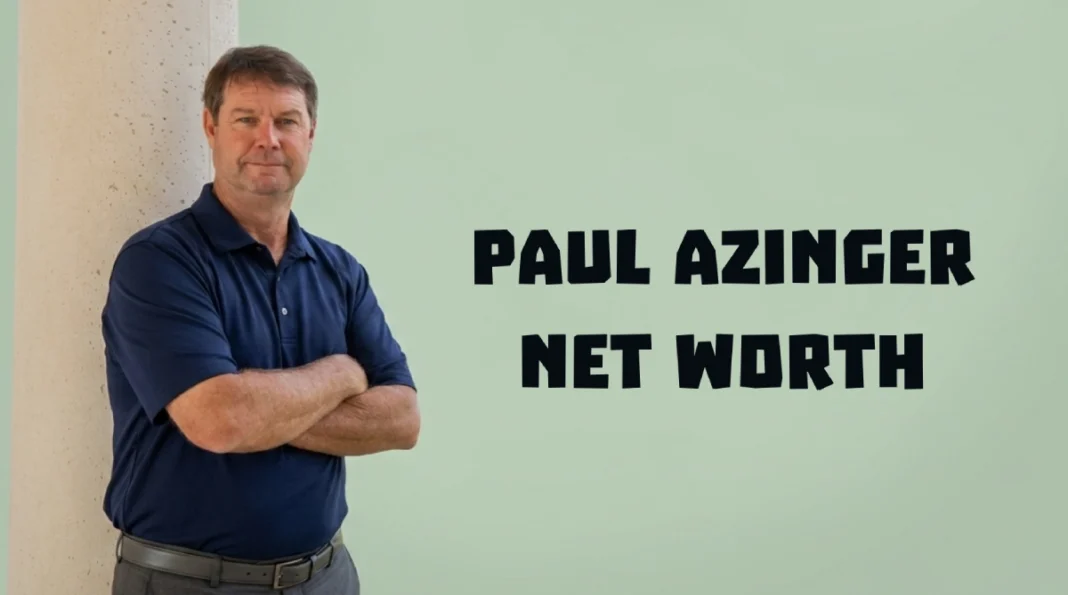
Paul Azinger is one of golf’s most recognizable figures — a former PGA Tour winner, 1993 major champion, 2008 U.S. Ryder Cup captain, and long-serving television analyst. Born on January 6, 1960, in Holyoke, Massachusetts, and raised in Sarasota, Florida, Azinger built his wealth across two distinct careers: two decades competing at the highest level of professional golf, followed by nearly two decades behind the microphone at ESPN, ABC, Fox Sports, and NBC Sports.
Paul Azinger’s net worth is consistently estimated at ~$20 million across multiple financial and golf industry sources. That figure reflects career PGA Tour prize money exceeding $14 million, long-term broadcasting contracts, book royalties, speaking engagements, and endorsement income — accumulated steadily over more than 40 years in the sport.
Key Facts at a Glance
| Full Name | Paul William Azinger |
| Date of Birth | January 6, 1960 |
| Birthplace | Holyoke, Massachusetts |
| Raised In | Sarasota, Florida |
| Estimated Net Worth | ~$20 million |
| PGA Tour Wins | 12 (including 1 Major) |
| Career Prize Money | Over $14.4 million |
| World Ranking Peak | No. 4 (August 1993) |
| Broadcasting Career | ESPN/ABC (2005–2015), Fox Sports (2016–2019), NBC/Golf Channel (2018–2023); returned to broadcast booth as lead analyst for PGA Tour Champions |
| Ryder Cup | 4× player; 2008 U.S. Captain (winning) |
| Spouse | Toni Azinger (married 1982) |
| Notable Award (2025) | PGA TOUR Payne Stewart Award |
Paul Azinger Net Worth
Most reliable estimates place Paul Azinger’s net worth at around $20 million. This figure is not publicly confirmed — no financial disclosures exist for private individuals — but it aligns consistently across multiple sources that examine his career earnings, broadcasting tenure, and investment history.
The number itself is less interesting than what produced it. Azinger is one of the cleaner examples in professional golf of an athlete who built durable financial security not through a single enormous contract but through the compounding effect of multiple income streams over a long career — prize money, television, books, speaking, and real estate.
From Holyoke to the PGA Tour
Azinger’s father, Ralph, served as a navigator in the U.S. Air Force and later opened a marina in Sarasota after retiring as a lieutenant colonel. Paul grew up around the water, working summers pumping gas and painting boats — a decidedly ordinary upbringing for someone who would later become one of golf’s most decorated analysts.
He began playing golf at age five and attended Brevard Community College before earning a golf scholarship to Florida State University in Tallahassee, where he also met his future wife, Toni. He turned professional in 1981.
His early years on tour were lean. He and Toni drove a used 1983 Vogue motorhome from tournament to tournament while he established himself. The financial breakthrough came in 1987 — his first breakout season.
Playing Career and Prize Money
The 1987 Breakthrough
Azinger won three PGA Tour events in 1987 and finished second at The Open Championship at Muirfield, one stroke behind Nick Faldo after making bogey at the 71st and 72nd holes. That season earned him PGA Player of the Year honors and established him among the best players in the world.
Between 1988 and 1994, he spent nearly 300 weeks ranked in the top 10 of the Official World Golf Ranking, peaking at World No. 4 in August 1993 — the same month he captured his major championship.
The 1993 PGA Championship
The defining moment of Azinger’s playing career came on August 15, 1993, at Inverness Club in Ohio. He defeated Greg Norman in a sudden-death playoff to win the PGA Championship — his only major title. The win confirmed what his ranking already showed: at that point, he was one of the best players in the game.
Four months later, in December 1993, he was diagnosed with non-Hodgkin lymphoma in his right shoulder blade. The sequencing matters and is frequently misreported — he won the major first, then received the diagnosis. The cancer battle that followed defined the next chapter of his life, not the one before it.
Cancer, Recovery, and Comeback
Treatment required six months of chemotherapy and five weeks of radiation. During recovery, he began working in television for the first time — NBC analyst Johnny Miller recruited him as an on-course reporter in 1995, including coverage of the Ryder Cup singles match between Tom Lehman and Seve Ballesteros.
Azinger’s rivalry with Ballesteros had become one of golf’s most heated, dating back to a controversial ball-compression incident at the 1991 Ryder Cup. His 1995 reporting assignment — covering Ballesteros at his final Ryder Cup — had obvious narrative weight.
In 2000, seven years after his last PGA Tour win, Azinger returned to competitive golf and won the Sony Open in Hawaii by seven strokes. The comeback earned him the PGA Tour Comeback Player of the Year award and added the final chapter to a career that by then included 12 PGA Tour victories and 3 European Tour titles.
Career Prize Money Summary
Azinger’s official PGA Tour earnings total just over $14.4 million — ranked 187th all-time. That figure does not include international tournaments, European Tour events, team competitions, or unofficial money, all of which added to his playing-era income. His 12 PGA Tour wins, combined with frequent top-10 finishes in major championships across two decades, generated a reliable income base before the broadcasting contracts began.
2008 Ryder Cup Captain
Azinger captained the U.S. team to victory over Europe at Valhalla Golf Club in Louisville, Kentucky — the first American victory on home soil since 1999. His unconventional approach to team building became the main story of that week.
Rather than treating the team as a single unit, he divided players into smaller groups — the Pod System — based on compatibility and psychological profiling conducted with Ron Braund, a corporate team-building psychologist. The strategy, which he later outlined in his book Cracking the Code: The Winning Ryder Cup Strategy, encouraged genuine team bonds rather than forced camaraderie. Most analysts credit the system as a significant factor in the American win.
Azinger remains the last U.S. captain to win the Ryder Cup on American soil (2008 at Valhalla).
Broadcasting Career and Income
ESPN and ABC (2005–2015)
After returning to the PGA Tour following cancer treatment, Azinger transitioned to full-time broadcasting in 2005. He joined ESPN and ABC as their lead golf analyst, initially sharing duties with his former rival and Ryder Cup opponent Nick Faldo. The pairing worked: their mutual competitive history gave the broadcasts genuine tension. Faldo left for CBS after 2006, and Azinger continued alongside host Mike Tirico.
Fox Sports (2016–2019)
When ESPN and ABC lost their U.S. Open and Open Championship rights, Azinger moved to Fox Sports in 2016 as its head golf analyst — replacing Greg Norman. His tenure at Fox coincided with a transitional period for that network’s golf coverage.
NBC Sports and Golf Channel (2018–2023)
In October 2018, NBC Sports and Golf Channel named Azinger their lead golf analyst, succeeding Johnny Miller — the same analyst who had first brought him into broadcasting during his cancer recovery 23 years earlier. He served as NBC’s lead golf analyst through the 2023 season.
In late 2023, Azinger parted ways with NBC after reportedly declining a pay cut during contract negotiations. His departure ended a five-year tenure as one of the sport’s most prominent broadcast voices.
Broadcasting as an Income Source
Television analysts at Azinger’s level and seniority command substantial annual contracts. While exact contracts are private, industry reports suggest lead golf analysts at major networks earn $300K–$1M+ annually depending on tenure and exclusivity — often significantly more, depending on contract length and exclusivity terms. Azinger held lead analyst roles continuously from 2005 to 2023, an 18-year run that represents the most reliable and consistent income source of his career.
Other Sources of Income
Books
Azinger has written two books that continue to generate royalty income. Zinger chronicles his battle with lymphoma and his perspective on faith, competition, and recovery. Cracking the Code details the psychological and strategic approach behind his 2008 Ryder Cup captaincy, co-authored with Ron Braund. Both books maintain a steady readership within the golf audience and serve as a source of passive income alongside his professional profile.
Endorsements
During his playing career, Azinger was sponsored by Nike, among other brands. Equipment and apparel deals were standard for a player of his ranking and profile. Some commercial relationships continued into his broadcasting years, though post-playing endorsements are generally smaller in scale than active player contracts.
Corporate Speaking
His cancer survival story, combined with the leadership narrative of the 2008 Ryder Cup, makes Azinger a natural fit for corporate speaking circuits. Business events and golf industry gatherings regularly feature him for motivational and leadership presentations. Speaking fees for a figure of his profile typically fall within a range that makes these engagements worthwhile but not a primary driver of wealth.
Wealth Growth Over Time
- 1981–1986 — Early Career: Minimal earnings. He and Toni lived modestly while establishing a tour presence. Financial stability was not guaranteed during this period.
- 1987–1993 — Peak Playing Years: Three wins in 1987, consecutive top-10 world rankings, and the 1993 PGA Championship pushed career earnings past $10 million. Endorsement income — including Nike — added meaningfully during this period.
- 1993–2000 — Cancer and Recovery: Tournament income dropped significantly during treatment. The early broadcasting work with NBC in 1995 introduced a new income stream. The 2000 Sony Open win closed the chapter with one final tournament payday.
- 2005–2023 — Broadcasting Era: Eighteen consecutive years as a lead golf analyst at major networks (ESPN/ABC, Fox, NBC) provided stable, predictable income — structurally more reliable than prize money. This period likely accounts for the largest share of his current net worth.
- 2024–Present: Post-NBC, Azinger remains active in golf media. In 2025, he received the PGA TOUR’s Payne Stewart Award, which recognizes character, sportsmanship, and charitable commitment — a recognition that reflects his standing in the sport rather than a financial event.
Assets and Investments
Real estate forms the most visible component of Azinger’s asset base. and Toni reside in the Bradenton/Sarasota, Florida area, where they’ve owned waterfront property for decades that has benefited from Florida’s sustained real estate appreciation over the past two decades. The home reflects his personal interests: fishing, boating, and time on the water, consistent with his upbringing near his father’s marina in Sarasota.
Beyond real estate, athletes of Azinger’s generation and income profile typically hold diversified portfolios of stocks, bonds, and funds. Specific holdings are private, as is standard for non-public figures. His 18-year broadcasting career provided a steady income that would have allowed for consistent investment over time — a structural advantage over athletes who rely solely on tournament earnings.
Personal Life
Azinger is a Christian and has spoken publicly about his faith throughout his career, particularly in the context of his cancer diagnosis and recovery. He is politically conservative — a position he has not hidden, including his initial hesitation over a White House visit after the 1993 Ryder Cup.
He and Toni met at Florida State University and married in 1982. They have two daughters, Sarah Jean Collins and Josie Azinger Mark. Family has remained a constant priority across his career transitions.
Away from golf, Azinger is an avid poker player — he competed in the main event at both the 2006 and 2008 World Series of Poker. He is also known among colleagues for his enthusiasm for foosball, seeking out tables while traveling for broadcasts.
He was a close friend of Payne Stewart, who died in a plane crash in 1999. Azinger delivered the eulogy at Stewart’s memorial service. Two of his managers and close friends, Robert Fraley and Van Ardan, also died in that crash — a loss that had both personal and professional dimensions for him.
Payne Stewart Award 2025
In 2025, Azinger received the PGA TOUR’s Payne Stewart Award — an honor given to a player whose character, sportsmanship, and charitable commitment reflect the legacy of the late Payne Stewart.
The award is a fitting recognition for someone whose public career has long been defined by conduct as much as competition, and whose friendship with Stewart was among the most documented in professional golf.
Conclusion
Paul Azinger’s estimated $20 million net worth is the product of a career that never relied on a single income source for long. Prize money built the foundation. Broadcasting sustained and grew it across nearly two decades. Books, speaking, and real estate added layers that don’t require him to be in front of a camera to produce returns.
What’s notable about his financial profile is the discipline of the arc — from motorhome to major champion, from cancer treatment to network lead analyst, from Ryder Cup captain to award recipient. Each transition came with new income, and he managed them without the financial collapses that derail many athletes once their playing income stops. That consistency, more than any single contract or win, explains where the money came from.