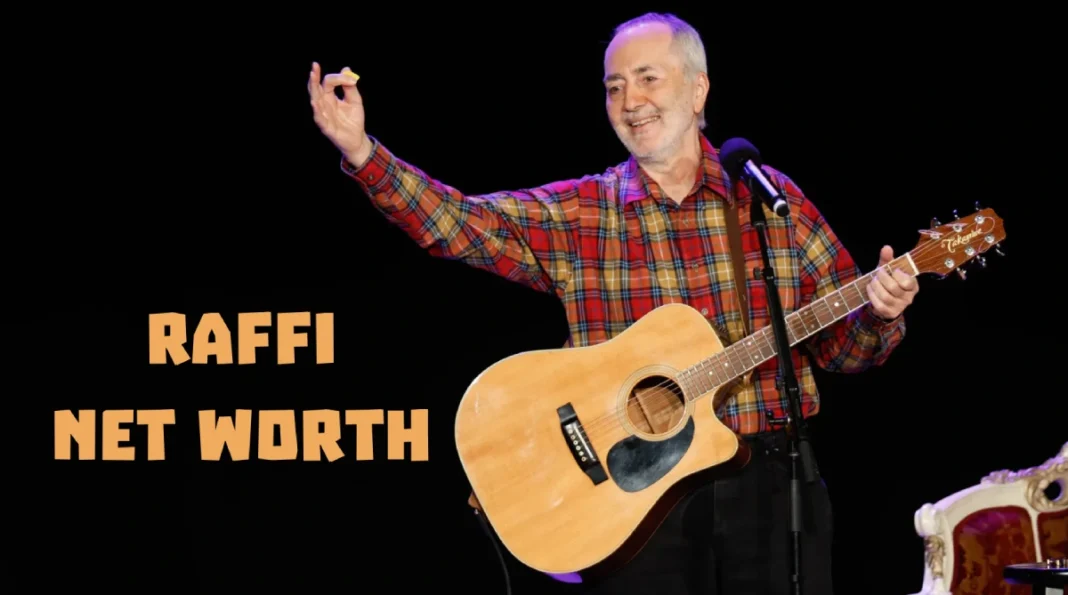
Raffi Cavoukian — known to the world simply as Raffi — has spent five decades writing songs that parents still hum long after their children have grown up. The Armenian-Canadian singer-songwriter is estimated to be worth between $10 million and $12 million, a fortune built steadily across a career that has touched three generations of families in North America.
What makes his story unusual is not the number but the method. Raffi built his wealth while turning down many of the most lucrative offers available to a figure of his profile: stadium concerts, merchandise deals, corporate endorsements, and cartoon licensing. His net worth reflects principled accumulation rather than a single commercial windfall.
What Is Raffi’s Net Worth?
Raffi’s net worth is estimated at $10–12 million. Celebrity Net Worth places the figure at $10 million; other entertainment finance sources cite $12 million. Neither figure has been independently verified, and both predate a significant financial event: the 2024 sale of his Salt Spring Island property in British Columbia, which he had owned since 2008. That sale likely increased his liquid assets, making the higher end of the range more plausible at present.
His wealth comes from several streams: album royalties accumulated over nearly 50 years, live performances, book sales, speaking engagements, and real estate. Crucially, Raffi has never sold his music catalog — meaning royalties from songs like “Baby Beluga” and “Bananaphone” continue to flow to him directly.
Early Life and Family Background
Raffi Cavoukian was born on July 8, 1948, in Cairo, Egypt. His parents were Armenian Christians who had fled Turkey during the Armenian genocide. His mother, Lucie Cavoukian, named him after the celebrated 19th-century Armenian novelist Raffi — a connection to a literary tradition that predated his musical one by over a century.
The family left Egypt in 1952, living briefly in Jerusalem and then Syria before immigrating to Canada in 1958 and settling in Toronto. His father, Arto (Artin) Cavoukian, ran a well-regarded portrait photography studio on Bloor Street. Growing up in a household where art was treated as serious work shaped Raffi’s instincts long before he had a career.
He was not the only sibling to make a public mark. His older brother, Onnig Cavoukian — known professionally as Cavouk — became a noted portrait photographer in his own right. His younger sister, Ann Cavoukian, served three terms as Ontario’s Information and Privacy Commissioner and became internationally recognized for her Privacy by Design framework. The family has an unusual concentration of people who turned their work into a lasting influence.
Raffi grew up in Toronto’s diverse, culturally active environment during the folk revival of the 1960s and early 1970s — a setting that would define the kind of musician he became.
Career Beginnings: From Folk Coffeehouses to Children’s Music
The Toronto Folk Scene
In the early 1970s, Raffi frequented a guitar shop called Millwheel, near Yonge and Wellesley in Toronto. There he met other developing musicians, including Canadian folk guitarist John Lacey from Oakville, Ontario, who helped him refine his fingerpicking. He also crossed paths with David Wilcox and others who were part of the emerging Toronto folk scene.
He went on to perform in coffeehouses across Toronto and Montréal, building his stage presence and repertoire. In 1972, he hitchhiked to Vancouver in search of a larger audience, though success did not come immediately. He also visited Soviet Armenia that year, deepening his connection to his heritage.
How He Found Children’s Music
Raffi’s move into children’s music was, by his own account, largely accidental.
His first performance for children came in 1974, at a nursery school run by his mother-in-law. His first album, released in 1975, was a folk-country record called Good Luck Boy — it was not a children’s album. The shift into children’s music came through his then-wife, Deborah Pike, a kindergarten teacher who invited him to perform for her class. That visit led to more school engagements through a program supported by the Mariposa Folk Festival.
During one of those early classroom sessions, something changed for him. As he described in his autobiography, standing in front of thirty children, he suddenly saw each child as a distinct individual rather than a group — and said he “never again missed the individual child within the group.” He has called children’s music his “accidental career,” but it became the most deliberate and consistent work of his life.
Recording Career and Major Albums
In 1976, Raffi released Singable Songs for the Very Young — the album that established him. Songs like “Down by the Bay,” “Robin in the Rain,” and “The Sharing Song” became staples in daycares, family cars, and primary school classrooms across Canada and the United States. The album was produced in a friend’s basement and shaped by three educators, including Deborah Pike.
More Singable Songs followed in 1977, and The Corner Grocery Store in 1979. That same year, Raffi wrote “Baby Beluga” after visiting the Vancouver Aquarium and meeting a female beluga whale named Kavna. The song was released on the Baby Beluga album in 1980, alongside “Day-O (The Banana Boat Song)” and “All I Really Need.”
The 1980s brought consistent output: Rise and Shine (1982), Raffi’s Christmas Album (1983), One Light, One Sun (1985), and Everything Grows (1987). His 1989 concert album charted on the RPM Top 100 Albums. Early albums featured contributions from Toronto-area folk musicians, including Ken Whiteley, Bruce Cockburn, and The Honolulu Heartbreakers. Raffi also wove world music elements throughout, including “Sambalele” (1977) and “Anansi” (1979).
In 1990, Evergreen Everblue marked a deliberate turn: an environmentally themed album aimed at an older audience. Raffi on Broadway followed in 1993, and Bananaphone in 1994 — the title track of which became one of his most widely recognized songs and introduced him to a new generation.
After a recording hiatus from 1995 to 2002, he returned with Let’s Play, followed by Where We All Belong (2003) and Communion (2009). He paused touring between 2003 and 2013 to focus on writing and advocacy. Later albums include Love Bug (2014), Owl Singalong (2016), Dog on the Floor (2018), and Nursery Rhymes for Kinder Times (2022), a collaboration with Lindsay Munroe. His most recent release, Penny Penguin (2024), was recorded with the Canadian trio The Good Lovelies.
Complete Studio Discography
- Good Luck Boy (1975)
- Singable Songs for the Very Young (1976)
- Adult Entertainment (1977)
- More Singable Songs (1977)
- The Corner Grocery Store (1979)
- Baby Beluga (1980)
- Rise and Shine (1982)
- Raffi’s Christmas Album (1983)
- One Light, One Sun (1985)
- Everything Grows (1987)
- Raffi in Concert with the Rise and Shine Band (1989)
- Evergreen Everblue (1990)
- Raffi on Broadway (1993)
- Bananaphone (1994)
- Raffi Radio (1995)
- Let’s Play (2002)
- Where We All Belong (2003)
- Communion (2009)
- Love Bug (2014)
- Owl Singalong (2016)
- Dog on the Floor (2018)
- Nursery Rhymes for Kinder Times — with Lindsay Munroe (2022)
- Penny Penguin — with The Good Lovelies (2024)
Selected Compilations
- The Singable Songs Collection (1996)
- Raffi’s Box of Sunshine (2000)
- Best of Raffi (2017)
The Business of Children’s Music
Why the Catalog Holds Its Value
Children’s music ages differently from mainstream pop. Parents play the same albums for multiple children across many years, and those children often return to the same songs with their own families a generation later. A catalog of well-known children’s songs generates royalties long after the original release — a model closer to a nursery rhyme publisher than a typical recording artist.
Raffi’s catalog benefits from this dynamic. “Baby Beluga,” “Bananaphone,” and “Down by the Bay” have been in continuous rotation for over 40 years. Streaming platforms have added a new revenue layer to an already durable catalog, bringing his music to families who would never have browsed a physical record store.
Troubadour Music Inc.
In 1975, Raffi founded Troubadour Music Inc. as his label and production vehicle. He has described it as a triple-bottom-line company — one that accounts for social and environmental impact alongside financial performance. Owning his own label has meant retaining control over his master recordings and the royalties that flow from them — a position many artists wish they had secured earlier in their careers.
Commercial Deals He Declined
Raffi’s financial choices are inseparable from his philosophy about children’s welfare. He turned down a performance at Madison Square Garden — which would have drawn an estimated 18,000 attendees — because the scale would undermine the experience for young children. He declined to license his name and music for toys, candy, cartoons, and merchandise. He turned down a film proposal for Baby Beluga because the funding model relied on exploitative advertising. He has never marketed directly to children through commercial sponsorship.
In 2005, he sent an open letter to Ted Rogers of Rogers Wireless, urging the company to stop marketing mobile phones to children. In 2006, he was presented with the Fred Rogers Integrity Award by the Campaign for a Commercial-Free Childhood, recognizing his consistent refusal to exploit his young audience.
These decisions reduced his earning ceiling. They also made him one of the most trusted figures in family entertainment, which sustained consistent demand for his work across five decades.
Income Sources
Raffi’s income comes from several distinct streams, though precise annual figures are not publicly disclosed.
Album royalties from a catalog spanning nearly five decades form the foundation of his income. Children’s classics maintain steady demand as new families discover them each generation, and streaming has added a meaningful supplement to traditional royalty income.
Live performances provide a secondary but significant source. Raffi limits his touring deliberately — choosing small theaters suited to families with young children, typically under 2,000 seats. Ticket prices for these intimate family concerts tend to command a premium given the format.
Book sales contribute a third stream. His “Raffi Songs to Read” picture book series and adult titles have sustained their own sales history across decades (detailed in the Books section below).
Speaking engagements at educational conferences and child advocacy events provide additional income aligned with his values. He has spoken on child development, commercial-free childhood, and the risks of social media for young people.
Net Worth Growth Over Time
Raffi’s wealth has accumulated gradually rather than through any single commercial peak.
The 1976 release of Singable Songs for the Very Young established his financial foundation. The 1980s brought consistent royalty income as his catalog expanded and earlier albums continued selling to successive generations of families. The 1990s marked a strong period, with Bananaphone reaching a mainstream audience and generating significant advances and royalties alongside an established back catalog.
After his recording hiatus in the late 1990s and touring break in the 2000s, income stabilized rather than grew dramatically. Streaming in the 2010s provided a new layer of revenue on top of an already long-running catalog.
The 2024 sale of his Salt Spring Island property — owned since 2008 — is the most recent financial event of note. The move appears to reflect a shift toward greater mobility and simplified living rather than financial necessity.
Books
Adult Titles
For adult readers, Raffi published The Life of a Children’s Troubadour (2000), his autobiography. In 2013, he published Lightweb Darkweb: Three Reasons to Reform Social Media Before it Re-forms Us, examining the structural risks of social media for children and young people. He also co-edited Child Honouring: How to Turn This World Around (2006) with Dr. Sharna Olfman — an anthology featuring a foreword by the Dalai Lama and contributions from thinkers including Penelope Leach, Fritjof Capra, Riane Eisler, Joel Bakan, Graça Machel, and Barbara Kingsolver.
Children’s Books
His “Raffi Songs to Read” series translates his most popular songs into illustrated picture books. Published titles include:
- Down by the Bay (1987)
- Shake My Sillies Out (1987)
- Everything Grows (1989)
- Baby Beluga (1992)
- Spider on the Floor (1996)
- This Little Light of Mine (1997)
- The Wheels on the Bus (1998)
- Five Little Ducks (1999)
- Thanks a Lot (2021)
The series has maintained consistent sales as each new generation of parents discovers Raffi’s songs and seeks the companion books for young readers.
Advocacy and Activism
Environmental Work
Raffi’s environmental commitment dates to 1989. The Evergreen Everblue album (1990) addressed climate change and ecological degradation through music targeted at an older audience. Even the original “Baby Beluga” carried environmental awareness — the song was written after meeting Kavna, a beluga whale whose wild relatives were part of a population that had declined sharply in St. Lawrence waters.
In 2007, he wrote and recorded “Cool It,” a rockabilly call to action on global warming featuring Dr. David Suzuki in the chorus. The track served as the theme song for Suzuki’s national climate change tour across Canada.
Child Honouring Philosophy
In 1997, Raffi developed the philosophy of “Child Honouring” — a vision he described in 2021 as a social-change framework with the universal human child at its center. The Covenant for Honouring Children outlines its core principles: treating all children with dignity, protecting them from commercial exploitation, and redesigning social structures around their developmental needs.
The adults who grew up with his music — whom he calls “Beluga Grads” — form a key part of his advocacy audience, invited to translate childhood values into real-world action.
Digital Safety and the Red Hood Project
In 2012, following the online bullying and subsequent suicide of British Columbia teenager Amanda Todd, Raffi co-founded the Red Hood Project with Sandy Garossino and Mark Busse. Launched in November 2012, the project advocates for consumer protection for children online and pushes for regulatory and industry reform around children’s digital exposure.
His 2013 book Lightweb Darkweb extended this work into a broader public argument about the structural dangers social media poses to young people.
Political and Social Advocacy
Raffi’s advocacy has extended into direct political engagement. In 2004, he released “Salaam Shalom,” calling for peace in the Israeli-Palestinian conflict. In 2016, “Wave of Democracy” expressed support for Bernie Sanders’ presidential campaign. In 2019, “Young People Marching” honored climate activist Greta Thunberg.
In August 2020, he released “For All You Do,” featuring Lindsay Munroe and cellist Yo-Yo Ma, as a tribute to frontline workers during the COVID-19 pandemic. Proceeds went to Direct Relief to support healthcare workers globally. He is a member of Artists Against Racism, a Canadian charitable organization.
Personal Life
Raffi married Deborah Pike, a kindergarten teacher and former high school classmate, in 1975 — the same year he released his first album. She was a direct influence on his transition into children’s music. They divorced in 1991. He has not remarried.
Despite spending his entire career creating music for children, Raffi has no biological children of his own. He became a vegetarian in 1980. He owned a home on Salt Spring Island, British Columbia, from 2008 until 2024. He has been an outspoken critic of Donald Trump, particularly on the effects of his administration’s policies on children and youth.
At 76, he continues to perform, record, and speak publicly on the issues he has championed for decades.
Awards and Recognition
Raffi’s honors span five decades and reflect both his cultural impact and his advocacy work. Key awards and recognitions include:
- Order of Canada (1983)
- 125th Anniversary of the Confederation of Canada Medal (1992)
- Named “the most popular children’s singer in the English-speaking world” — The Washington Post (1992)
- Order of British Columbia (2001)
- Queen Elizabeth II Golden Jubilee Medal (2002)
- SOCAN Special Achievement Award (2000)
- Fred Rogers Integrity Award, Campaign for a Commercial-Free Childhood (2006)
- Top 25 Canadian Immigrant Award (2010)
- Queen Elizabeth II Diamond Jubilee Medal (2012)
- Honorary Doctor of Music — University of Victoria
- Honorary Doctor of Letters — University of British Columbia
- Honorary Doctor of Letters — Wilfrid Laurier University
- Honorary Doctor of Letters — Vancouver Island University (2014)
- Companion of the Order of Canada (2025) — an upgrade from his 1983 appointment, one of Canada’s highest civilian honors
Conclusion
Raffi’s estimated $10–12 million net worth is the result of nearly five decades of consistent, values-driven work. He built it without stadium shows, without merchandise, without selling his catalog, and without commercial advertising.
What sustained his financial position over the long term was the nature of children’s music itself — songs that resist trends, travel across generations, and reach entirely new audiences without a single promotional push. Streaming has extended that longevity in ways that physical distribution never could.
His story is also a practical illustration of how trust compounds over time. Raffi’s refusal to exploit his audience for short-term commercial gain built a level of credibility with parents that made his catalog a permanent fixture in family life — and in turn, a durable source of income. The two are not in conflict. For Raffi, they were never meant to be.
Note: All net worth figures are estimates drawn from publicly available entertainment finance sources. Raffi has not publicly disclosed precise financial information, and figures should be treated as informed approximations rather than verified data.