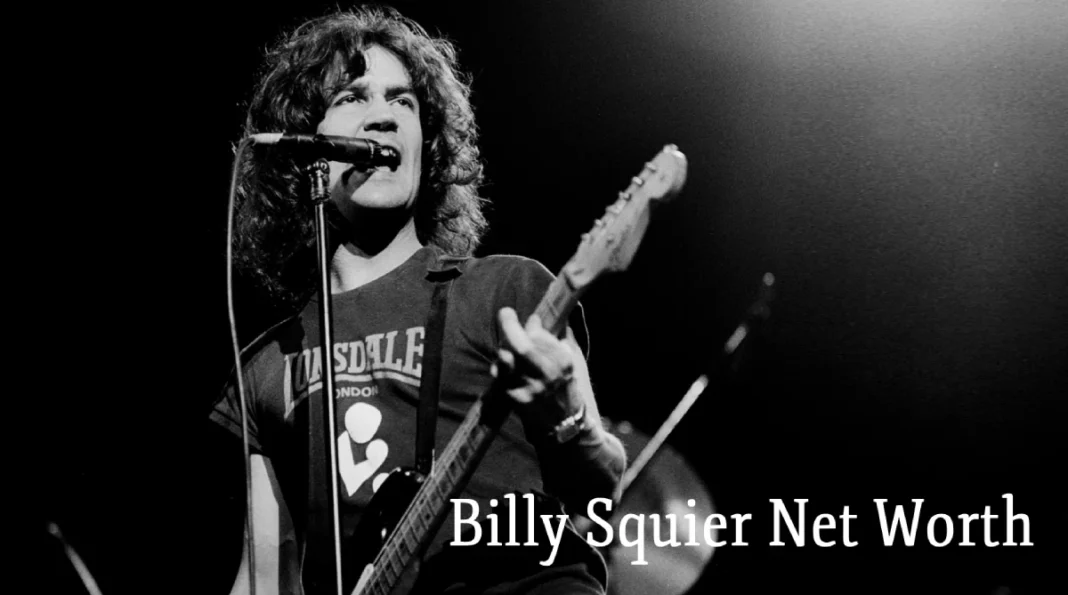
Billy Squier’s net worth sits between $40 million and $80 million — with most industry estimates clustering toward the higher end. His wealth comes from three decades of album sales, arena touring, smart publishing deals, and an unusually lucrative position as one of the most sampled musicians in hip-hop history.
What makes Squier’s financial story interesting is not the peak of his fame, but what happened after it. His commercial popularity faded by the late 1980s, yet his income kept growing.
Understanding why requires looking at how he structured his career — not just how he performed during it.
Billy Squier’s Net Worth at a Glance
| Detail | Info |
|---|---|
| Estimated Net Worth | $40M–$80M |
| Primary Income Sources | Sampling royalties, publishing rights, catalog streaming, and real estate |
| Most Valuable Asset | Music catalog (estimated $40–50M alone) |
| Record Label | Capitol Records (solo career) |
| Most Sampled Song | “The Big Beat” (1980) |
Different sources report different figures — CelebrityNetWorth places him at $80 million, while sites like TheRichest cite $40 million. The gap exists because Squier keeps his finances private, and estimates vary based on whether analysts include his publishing rights, real estate, and sampling income alongside straightforward album and touring revenue.
Early Life and Path to Music
Billy Squier was born William Haislip Squier on May 12, 1950, in Wellesley, Massachusetts. He began playing guitar and piano as a teenager but didn’t commit to music seriously until he discovered Eric Clapton — first through Clapton’s work with John Mayall & the Bluesbreakers, then with Cream.
He formed his first band, the Reltneys, at age 14 and performed publicly for the first time in 1968 at Boston’s Psychedelic Supermarket — the same club where he once saw Clapton play. In 1971, he briefly attended the Berklee College of Music before returning to New York to pursue a full-time music career.
Throughout the early 1970s, Squier played in several New York and Boston bands, including a group called Magic Terry & the Universe that combined music with poetry, a New York outfit called Kicks (which included future New York Dolls drummer Jerry Nolan), and a Boston group called the Sidewinders.
Piper and the First Record Deal
The major step forward came with Piper, the band that finally earned Squier a recording contract. Signed to A&M Records, Piper released two albums — a self-titled debut in 1976 and Can’t Wait in 1977. Circus magazine called the debut “the greatest debut album ever produced by a US rock band.” Piper opened for Kiss during their 1977 tour.
When Piper broke up, Squier signed with Capitol Records as a solo artist in 1979 — a relationship that would define his commercial career.
The Career That Built the Fortune
Solo Debut and the Breakthrough Album
Squier’s debut solo record, The Tale of the Tape (1980), reached #169 on the Billboard 200 — a modest start. What followed changed everything.
“Don’t Say No” (1981) reached #5 on the Billboard 200, went 3× Platinum in the United States, and produced four charting singles: “The Stroke,” “In the Dark,” “Lonely Is the Night,” and “My Kinda Lover.” Both “The Stroke” and “In the Dark” hit the top 10 on the Billboard Mainstream Rock chart.
This album is the financial foundation of everything that followed. Its songs never stopped generating income — through radio play, catalog streaming, licensing, and extensive hip-hop sampling.
Peak Commercial Years (1982–1984)
Emotions in Motion (1982) matched “Don’t Say No” at #5 on the Billboard 200 and went 2× Platinum in the US. The single “Everybody Wants You” reached #1 on the Billboard Mainstream Rock chart.
Signs of Life (1984) peaked at #11 on the Billboard 200 and was certified Platinum. Its single “Rock Me Tonite” also hit #1 on the Mainstream Rock chart. The same year, Squier’s song “Shake Down” appeared on the Grammy-nominated soundtrack for St. Elmo’s Fire. In 1986, Squier earned a Grammy nomination for Best Album of Original Score Written for a Motion Picture or Television for that soundtrack.
The “Rock Me Tonite” Turning Point
The music video for “Rock Me Tonite” (1984) proved deeply damaging to Squier’s rock credibility. The video — featuring Squier dancing in a pink tank top — was widely mocked in rock circles and is considered one of the most career-damaging videos in MTV history. His popularity declined sharply from that point.
Later albums — Enough Is Enough (1986), Hear & Now (1989), Creatures of Habit (1991), and Tell the Truth (1993) — performed with steadily decreasing commercial returns. His final album on Capitol was Tell the Truth (1993); his last studio album to date, Happy Blue, was released on the independent label J-Bird Records in 1998.
In February 2023, Squier released a new single — his first new music in roughly 25 years — initially teased as “Molly” and later released under the title “Harder on a Woman.”
The Freddie Mercury Connection
Enough Is Enough (1986) added an unusual footnote to Squier’s catalog: Freddie Mercury contributed backing vocals to the single “Love Is the Hero” and co-wrote the track “Lady With a Tenor Sax.” The collaboration with the Queen frontman added both prestige and a lasting cultural reference point to an album that otherwise underperformed commercially.
Major Income Sources
1. Sampling Royalties — The Biggest Money Maker
Billy Squier’s most important financial asset has nothing to do with his chart positions. It is the fact that hip-hop producers fell in love with his drum tracks, particularly “The Big Beat” (1980) and “The Stroke” (1981).
Rick Rubin — who produced both Jay-Z’s The Black Album and Eminem’s The Marshall Mathers LP 2 — sampled “The Big Beat” for Jay-Z’s “99 Problems” and “The Stroke” for Eminem’s “Berserk.”
The extent of Squier’s royalty demands became public through Mickey Avalon, who sampled “The Stroke” for his 2009 song “Stroke Me.” Avalon revealed that Squier requested and received 75% of all royalties generated by the sample. Whether Squier commands this rate consistently across all deals is unknown — but it illustrates the negotiating leverage he holds over producers who want his music.
CelebrityNetWorth estimates his song catalog at $40–50 million based on sampling income alone.
Known “The Big Beat” samples include:
- Jay-Z — “99 Problems”
- Kanye West and Pusha T — “Looking for Trouble”
- Dizzee Rascal — “Fix Up, Look Sharp”
- Nas feat. will.i.am — “Hip Hop Is Dead”
- Puff Daddy — “Can’t Nobody Hold Me Down”
- A Tribe Called Quest — “We Can Get Down”
- Big Daddy Kane — “Ain’t No Half Steppin’,” “Get Down,” and others
- Ice Cube — “Jackin’ for Beats”
- Alicia Keys — “Girl on Fire”
- Grandmaster Flash and the Furious Five — “Magic Carpet Ride”
- Run-DMC — “Here We Go (Live at the Funhouse)” (1983)
Known “The Stroke” samples include:
- Eminem — “Berserk”
- Mickey Avalon — “Stroke Me”
- Company Flow — “Wurker Ant Uprise”
2. Publishing Rights
Many musicians sign away their publishing rights early in their careers in exchange for upfront advances — and spend years trying to buy them back. Squier avoided this. By retaining ownership of his songwriting catalog, he collects royalties every time his music is played on the radio, streamed online, licensed for film or television, or sampled.
This decision, more than any other, explains the sustained growth of his net worth decades after his commercial peak.
His IMDb profile lists more than 100 soundtrack credits, including Fast Times at Ridgemont High (1982), Billy Madison (1995), Scary Movie (2000), Blades of Glory (2006), We’re the Millers (2013), and Girls Trip (2017).
3. Album Sales and Streaming
During his peak years between 1981 and 1984, Squier sold over 12 million albums worldwide. His most commercially successful albums by units sold:
| Album | Year | US Sales | Revenue Estimate |
|---|---|---|---|
| Don’t Say No | 1981 | ~3.08M copies | ~$4M |
| Emotions in Motion | 1982 | ~1.04M copies | ~$1.23M |
| Signs of Life | 1984 | ~2.08M copies | ~$2.7M |
| Enough Is Enough | 1986 | ~300K copies | ~$390K |
Streaming has extended the catalog’s income. Songs like “The Stroke,” “Lonely Is the Night,” and “In the Dark” continue to accumulate plays on Spotify, Apple Music, and YouTube — and that income flows directly to Squier because of his publishing ownership.
4. Real Estate
Squier has lived for over 30 years in the San Remo, an ultra-exclusive co-op building on Manhattan’s Upper West Side overlooking Central Park. Celebrity residents over the years have included Bono, Steve Martin, Steve Jobs, Steven Spielberg, Demi Moore, and Bruce Willis.
He also owns a 1-acre property in Bridgehampton, a wealthy enclave on Long Island.
Real estate in both locations has appreciated substantially over the decades. Demi Moore’s South Tower penthouse at the San Remo — purchased with Bruce Willis in 1990 — sold for $45 million in 2017, giving some indication of how the building’s values have moved.
The Bono Dispute at the San Remo
One of the more unusual chapters in Squier’s financial life involves a neighbor dispute that ended with him losing access to his own fireplace.
In 2003, Bono purchased a unit in the San Remo from Steve Jobs for $14.5 million. Shortly after moving in, he noticed that smoke from the lower units’ fireplaces was entering his penthouse. Of the building’s 135 units, only 40 have fireplaces. After Bono complained, the building’s co-op board ordered all fireplace-owning residents to stop using them.
Squier was one of those residents. He fought the co-op board and Bono vigorously over the decision — and lost. He still owns his Bridgehampton property, which does have a fireplace.
Billy Squier Net Worth (2016–2026) – Over the Years
Billy Squier keeps his finances private, so net worth figures are third-party estimates that have evolved as catalog value and streaming income are better assessed.
- 2016–2019: $35M–$50M — Based on album sales, early streaming, and sampling income.
- 2020–2021: $40M–$55M — Boosted by increased classic rock streaming and rising music catalog valuations.
- 2022–2024: $60M–$80M — Reflecting higher royalties, catalog demand, and renewed interest from his 2023 single “Harder on a Woman” (first new music in 25 years).
- 2025–2026: $40M–$80M — Wide range due to valuation uncertainty; $80M (CelebrityNetWorth) is the most cited figure.
Note: All figures are estimates; actual net worth is not publicly disclosed.
Personal Life
Billy Squier married Nicole Schoen, a professional soccer player, in 2002. Unlike many celebrity marriages, it has remained stable — an outcome that matters financially, given how many musicians from his era lost significant wealth through divorce settlements.
Squier is also a committed volunteer with the Central Park Conservancy, personally responsible for the care of roughly 20 acres of the park. He described the work in a 2009 interview: “I love landscaping and gardening, so this has been very rewarding. I think as a performer, it is important to discover things outside of your profession that help you learn about who you are as a person.”
His lifestyle is conspicuously restrained for someone with his net worth. He has not chased new hits, avoided public scandals, and largely stepped back from the commercial machinery of the music industry after the mid-1990s. This has helped preserve his wealth rather than drain it.
Why His Net Worth Keeps Growing Without New Albums
Three structural reasons explain why Squier’s income continues despite 25+ years of minimal commercial activity:
- Streaming is still growing globally. His catalog gets passive exposure to new listeners through playlist algorithms and recommendation systems — with no marketing cost.
- Hip-hop sampling continues. “The Big Beat” and “The Stroke” are embedded in tracks that remain in active rotation. Every time a major artist’s song containing a Squier sample gets streamed, he earns money.
- Classic rock has a loyal, aging demographic. Advertisers pay premium rates to reach this audience, which means licensing his songs for commercials, TV, and film remains commercially attractive.
Conclusion
Billy Squier’s $40–80 million net worth is the result of a specific set of business decisions made during a career that peaked commercially more than 40 years ago. He kept his publishing rights. He maintained control of his catalog. He held firm on royalty demands when hip-hop producers came calling. And he avoided the financial mistakes — bad deals, excessive spending, costly divorces, legal problems — that stripped wealth from many of his contemporaries.
His story is relevant not just as a celebrity finance curiosity but as an illustration of how musical assets compound over time when managed carefully. “The Big Beat” earns money every time a new song samples it. His publishing rights earn money every time a film producer licenses “The Stroke.” None of this requires him to tour, record, or promote.
For a musician who largely stepped back from public life in the 1990s, his financial position in 2025 is, by any measure, a strong one.