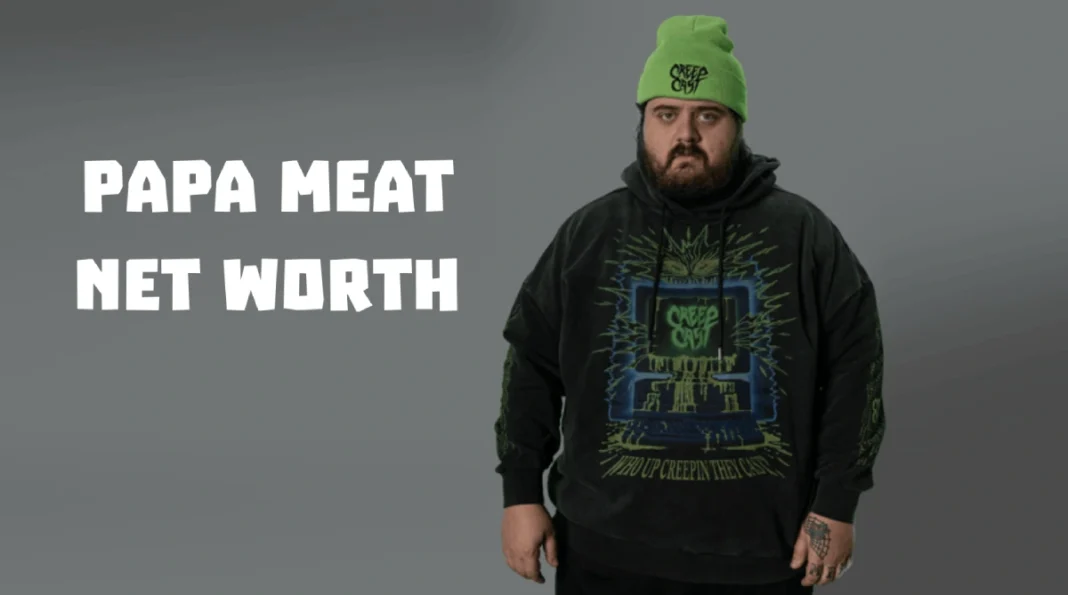
Hunter August Hancock — better known online as Papa Meat and through his YouTube channel MeatCanyon — has carved out one of the most distinctive careers in digital animation. His deliberately unsettling, darkly comedic style has attracted a following that few independent animators ever reach.
This article breaks down his estimated net worth, every income stream that drives it, and the business logic behind his financial success.
At a Glance
| Field | Detail |
|---|---|
| Real Name | Hunter August Hancock |
| Date of Birth | December 30, 1982 |
| Main YouTube Channel | MeatCanyon |
| Second Channel | Papa Meat |
| Subscribers (Main) | ~8.9 million (April 2026) |
| Total Views | 1.5 billion+ |
| Channel Category | Film & Animation |
| MeatCanyon Channel Created | September 6, 2015 |
| First Video Uploaded | January 27, 2017 |
| Papa Meat (2nd Channel) Launched | 2020 |
| Instagram Followers | 881,000+ |
| Patreon Members | 25,000+ paid subscribers |
| Patreon Ranking | Top 10–25 video creators globally (Graphtreon) |
| Est. Net Worth (2026) | $5M – $7.2M+ (all income streams) |
| Est. Monthly YouTube Income | $25,500 – $35,000 (March 2026, HypeAuditor) |
| Country | United States |
Note: Net worth and Patreon income figures are estimates based on publicly available data from YouTube analytics tools, Graphtreon, HypeAuditor, Net Worth Spot, and Social Blade.
What Is Papa Meat’s Net Worth in 2026?
Papa Meat’s estimated net worth sits in the range of $5 million to $7.2 million, with the higher end more likely once Patreon income is factored in. Net Worth Spot projects the figure at around $5.1 million from YouTube alone, rising to $7.2 million when additional revenue streams are included.
Most net worth estimates you’ll find online only account for YouTube ad revenue — a significant undercount for a creator whose Patreon following rivals some mid-size streaming platforms.
To understand why that range is plausible, you need to look at the full income picture:
- YouTube ad revenue averages roughly $25,500–$35,000 per month as of early 2026
- Patreon income from 25,000+ paid members is estimated at $125,000–$250,000 per month (assuming a $5–$10 average monthly pledge — conservative for a top-25 Patreon video creator)
- Merchandise, sponsorships, and Instagram brand deals add further income on top
Even at the conservative end of the Patreon estimate, that is over $1.5 million per year from fan subscriptions alone — before any ad revenue or merchandise. The combined picture puts the $5M–$7.2M net worth range in credible territory, though without audited financials, any figure remains an estimate.
MeatCanyon YouTube Channel Statistics
MeatCanyon was created on YouTube on September 6, 2015, with the first video published on January 27, 2017. It has grown into one of the most recognised independent animation channels on the platform. A separate second channel, Papa Meat, launched in 2020 and originally featured behind-the-scenes content before becoming a commentary and live-action channel.
- ~8.9 million subscribers on the main MeatCanyon channel (April 2026)
- 1.5 billion+ total video views
- Categorised under Film & Animation on YouTube
- Engagement rate of 6.56% in April 2026 — rated “Excellent” compared to similar channels (HypeAuditor)
- Average 1.7K comments per video
Those engagement numbers are notable. A 6.56% engagement rate significantly exceeds the platform average for channels of this size, suggesting a highly loyal audience that returns repeatedly rather than casual one-time viewers. That engagement profile directly translates to higher ad rates and stronger Patreon conversion.
How Papa Meat Makes Money: Every Income Stream Explained
1. Patreon — The Largest Single Source
Patreon is almost certainly Papa Meat’s biggest revenue driver, yet it receives the least attention in most articles about him. MeatCanyon ranks in the global top 10–25 Patreon video creators according to Graphtreon, which tracks Patreon earnings across all creator categories.
With 25,000+ paid members, the monthly Patreon income estimate depends on the average pledge level. Most Patreon creators in this tier offer tiers at $3, $5, $10, and $25+. Assuming a blended average of $5–$10 per member per month:
- Conservative estimate ($5 avg): $125,000/month or ~$1.5M/year
- Moderate estimate ($10 avg): $250,000/month or ~$3M/year
Even the conservative figure dwarfs his YouTube ad income. This is why net worth estimates that rely only on YouTube data miss the mark entirely for Papa Meat.
2. YouTube Ad Revenue
YouTube is the front door to his entire brand. With 1.5 billion+ total views and strong daily engagement, ad revenue is substantial — but it is not his primary income source. As of March 2026, HypeAuditor estimates his monthly YouTube earnings at $25,500 to $35,000, with a projected annual range of $306,000 to $420,000 if that rate holds.
Animation channels typically attract higher CPMs (cost per 1,000 views) than general entertainment because the audience skews older and more engaged — both factors advertisers pay a premium for.
Beyond standard ad revenue, YouTube offers additional income layers:
- Channel memberships — recurring monthly fees in exchange for exclusive perks and badges
- Super Chat and Super Stickers — direct fan payments during live streams
- YouTube Premium revenue — a share of subscription fees from Premium viewers who watch his content
3. Merchandise
Papa Meat sells branded merchandise through his online store, including apparel, prints, and items featuring his original characters and animation art. Merchandise works particularly well for creators whose aesthetic is as distinct as MeatCanyon’s — the visual style translates directly into wearable and collectible products that fans treat as identity markers, not just purchases.
While exact figures remain private, animation-heavy channels at his tier typically pull 12–18% from merch, with margin rates of 60–75% on print-on-demand and direct-to-fan drops.
4. Sponsorships and Brand Deals
Papa Meat’s audience demographics make him an attractive partner for brands targeting 18–35-year-old males. Sponsorship integrations have featured brands like NordVPN, Manscaped, and BetterHelp across channel-wide reads and series-specific placements (e.g., ‘Bun Bun’ and ‘Tasty Tim’ runs), with tiered payouts scaling from $15K–$50K per activation.
Sponsorship rates for a channel of his size typically range from $15,000 to $50,000 per dedicated integration, depending on deliverables and exclusivity.
5. Instagram Monetisation
With 881,000 Instagram followers, Papa Meat has a secondary monetisation channel beyond YouTube. Instagram brand deals at this follower count, assuming engagement rates above 2%, typically generate $2,000–$10,000 per sponsored post. This is a secondary revenue stream rather than a major income driver, but it adds diversification and reach for his primary platforms.
Monthly YouTube Earnings Breakdown (April 2024 – March 2026)
The figures below are estimated YouTube ad revenue by month, sourced from publicly available analytics tools including HypeAuditor and Social Blade. These figures cover YouTube ads only and do not include Patreon, merchandise, or sponsorship income.
| Month | Est. YouTube Revenue | Context / Notable |
|---|---|---|
| March 2026 | $25,500 – $35,000 | HypeAuditor live estimate |
| April 2025 | $21,300 | Strong recovery; above-average month |
| March 2025 | $24,700 | Near-peak YouTube performance |
| February 2025 | $22,200 | Consistent mid-range output |
| January 2025 | $30,800 | Highest month in 13-month window |
| December 2024 | $9,670 | Holiday dip; typical ad-rate trough |
| November 2024 | $17,400 | Post-peak normalisation |
| October 2024 | $23,900 | Strong autumn performance |
| September 2024 | $24,800 | One of the best months in the period |
| August 2024 | $27,200 | Summer peak; high ad CPM |
| July 2024 | $20,000 | Solid mid-year showing |
| June 2024 | $24,200 | Consistent high earner |
| May 2024 | $20,600 | Steady output |
| April 2024 | $6,460 | Low outlier — possible algorithm impact |
A few patterns stand out. January 2025 was his strongest month at $30,800, driven by post-holiday ad CPM recovery and high audience engagement. December 2024 was the weakest at $9,670 — a pattern common across YouTube because advertisers spend heavily in November before pulling back in December.
The key takeaway: his YouTube income is volatile month-to-month, swinging by as much as 4x between best and worst months. This is precisely why Patreon matters so much — subscription income is predictable regardless of what YouTube’s algorithm does in any given month.
Understanding Income Volatility in the Creator Economy
Four main forces drive MeatCanyon’s earnings swings:
- Ad CPM seasonality — advertisers spend the most in Q1 and Q4. December is a consistent outlier because ad budgets are already depleted by mid-month, which explains the December 2024 dip to $9,670 without any corresponding drop in viewership.
- YouTube algorithm distribution — the platform’s recommendation system can dramatically amplify or suppress a video’s reach within days of publication. A single widely-distributed video can double monthly earnings; a stretch without a breakout video has the opposite effect.
- Upload frequency — animation is time-intensive. A slower production month translates directly into fewer monetised hours on the platform.
- Content moderation flags — dark or mature content, which MeatCanyon’s animation often qualifies as, can trigger limited ad serving, cutting the effective CPM on affected videos.
Papa Meat’s response to this volatility is the right one: build income streams that do not depend on the algorithm. Patreon subscribers pay monthly regardless of whether a video performs well or gets flagged. That diversification is what separates creators who build lasting careers from those who collapse when a single platform changes its rules.
Why MeatCanyon Videos Go Viral
An Immediately Recognisable Visual Identity
MeatCanyon’s art style is distinctive enough that viewers identify it from a thumbnail before reading the title. The exaggerated proportions, uncanny facial expressions, and deliberately unsettling character design create an aesthetic that cannot be confused with any other channel. In a platform flooded with content, instant visual recognition is a compounding advantage — every new video benefits from the brand equity built by every previous one.
Cultural Parody With an Unexpected Angle
His most-shared videos take recognisable pop culture figures — cartoon characters, celebrities, mascots — and reframe them in ways that feel both logical and deeply wrong. This works because it triggers two emotional responses simultaneously: familiarity (audiences already know the source material) and surprise (the reframing is nothing like what they expected). That combination drives comment sections and shares far more effectively than straightforward content.
Community Engagement Beyond the Platform
Papa Meat is active across Reddit communities and social platforms, which builds the kind of direct creator-audience relationship that converts casual viewers into paying Patreon members. Audience retention is significantly higher for creators who feel accessible and responsive, and that retention feeds directly into their subscription numbers.
Production Quality That Justifies the Wait
Animation is slow to produce. Many animation channels lose momentum because they cannot maintain a consistent upload schedule without sacrificing quality. MeatCanyon resolves this tension by setting audience expectations around quality rather than frequency — viewers understand that a new MeatCanyon video is worth waiting for. His 2025–2026 move toward longer, more elaborate short films (including a nearly 30-minute production released in April 2026) reinforces this positioning.
What Makes His Business Model Sustainable
Three specific characteristics explain why Papa Meat’s financial structure is more resilient than most creators of a similar size:
- Platform independence through Patreon — with Patreon likely generating 5–10x his YouTube ad income, he is not financially dependent on YouTube’s algorithm or monetisation policies. Most creators at his subscriber level are almost entirely YouTube-dependent. He is not.
- A non-replicable style — his visual style and content angle are hard to copy convincingly. Channels built on genuinely distinctive creative identities retain audience loyalty better than trend-followers, because there is no substitute product for the audience to migrate to.
- Audience willingness to pay directly — 25,000+ people paying monthly on Patreon represents an audience that has moved beyond passive viewership. That level of financial commitment signals deep brand loyalty rather than casual entertainment habits.
What’s Next for Papa Meat’s Career and Net Worth?
Several factors will shape the direction of Papa Meat’s income over the next few years:
- Streaming platform deals — YouTube animators at his scale have increasingly attracted interest from streaming services. A licensing or commissioned deal with a platform like Netflix, Adult Swim, or Amazon would represent a significant jump in both income and audience reach.
- Patreon growth ceiling — at 25,000+ members, he is already in global top-tier territory. Further growth likely depends on continued YouTube performance, driving new audiences into his Patreon funnel.
- Platform policy changes — YouTube continues adjusting its approach to mature content. Any policy shift that affects monetisation of dark or adult-themed animation would impact his ad revenue, though his Patreon buffer means it would not be existential.
- Brand expansion into long-form film — his April 2026 release of a nearly 30-minute short film with elaborate sets and puppetry suggests a deliberate push toward higher-production creative work, which could open doors to licensing, festival distribution, and studio interest.
Final Thoughts
Papa Meat’s financial story is more interesting than most net worth articles give it credit for. The YouTube ad revenue numbers are real, but they are the smallest part of the picture. The more significant story is a creator who built a Patreon following large enough to rank globally — a feat that most multi-million-subscriber channels never accomplish — while maintaining a creative identity so specific that no competitor can credibly imitate it.
For anyone studying the creator economy, MeatCanyon is a useful case study in what platform independence actually looks like in practice. It is not about abandoning YouTube. It is about building income structures deep enough that no single platform’s algorithm or policy change can collapse the business. Papa Meat has done exactly that.