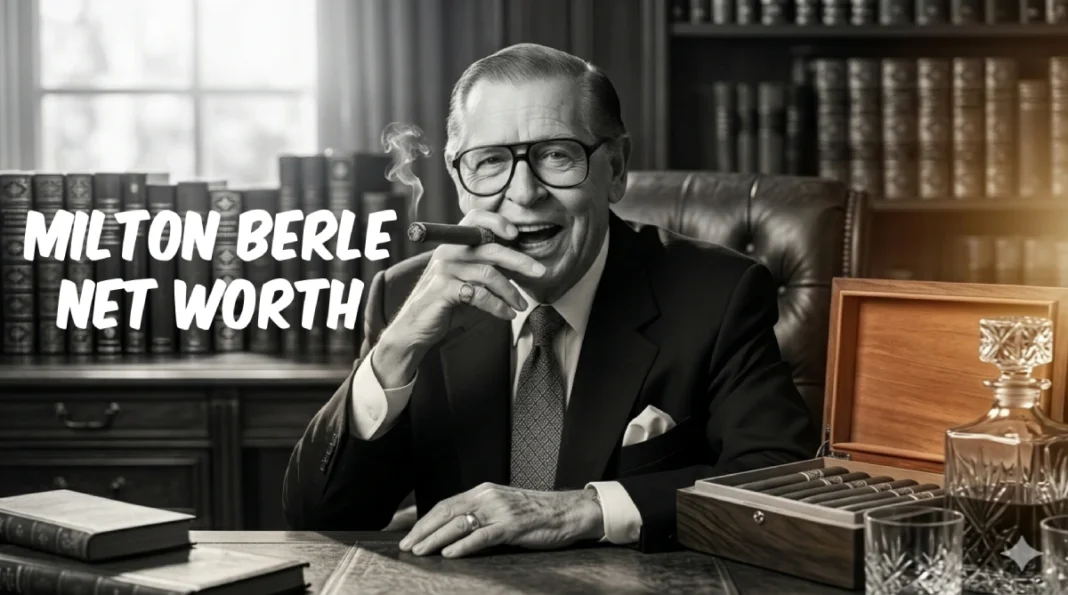
When Milton Berle died on March 27, 2002, his estate was worth approximately $2 million. For a man who held one of the most lucrative television contracts in American history and dominated the airwaves for nearly a decade, that number demands explanation.
This is a story about what happens when enormous earning power meets gambling, divorce, and the reality that fame has a shelf life.
Milton Berle’s Net Worth at Death
Milton Berle’s net worth at death was approximately $2 million (~$3.5M in 2024 dollars, per Celebrity Net Worth and multiple estate reports). That figure is striking not because it is small in absolute terms, but because of what it represents relative to his peak years.
At his peak (1951-1955), Berle’s estimated net worth reached ~$5 million in 1950s dollars (~$60M today), fueled by his unprecedented NBC contract and merchandising dominance. The gap between those two numbers is what makes his financial story worth examining.
| Net Worth at Death | $2 million (approx. $3.5M in 2024 dollars) |
| Peak Net Worth | ~$5M in 1950s dollars (~$60M today) |
| Date of Death | March 27, 2002 (age 93) |
| Cause of Death | Colon cancer |
| Primary Wealth Sources | Television contracts, film, radio, and live shows |
| Main Wealth Drains | Gambling (horse racing), multiple divorces |
From Harlem to Vaudeville: The Early Years
Milton Berle was born Mendel Berlinger on July 12, 1908, in the Harlem neighborhood of Manhattan. His father, Moses Berlinger, worked as a paint and varnish salesman. His mother, Sarah (later Sandra) Berle, was the driving force behind his career and pushed him into entertainment from early childhood.
At age five, he won a Charlie Chaplin look-alike contest and began working as a child model and actor. He appeared in silent films during the 1910s, including productions alongside Mary Pickford and Douglas Fairbanks. In 1916, he enrolled at the Professional Children’s School in New York City — a school built for working child performers.
By age 12, he made his stage debut in a Broadway revival of the musical Florodora. By 16, he was working as a master of ceremonies in vaudeville, eventually becoming a regular at venues across the country. His stage persona was built on slapstick, sharp timing, and a willingness to do anything for a laugh — including routines in dresses and wigs that became one of his most recognizable trademarks. In 1932, he starred in Earl Carroll’s Vanities on Broadway, cementing his reputation as one of vaudeville’s most dependable comic performers.
Vaudeville never made him wealthy, but it gave him a complete live performance toolkit — crowd work, physical comedy, costume bits — that he would bring directly to television fifteen years later.
Radio Stardom Before Television (1934–1948)
Before Berle became Mr. Television, he spent over a decade building a national audience on radio. This period is often overlooked in his financial story, but it mattered: it gave him name recognition in every American home before television sets existed in most of them.
From 1934 to 1936, he appeared frequently on The Rudy Vallee Hour and became a regular on The Gillette Original Community Sing on CBS. In 1939, he hosted Stop Me If You’ve Heard This One, a format in which panelists finished jokes sent in by listeners.
He followed that with Three Ring Time (sponsored by Ballantine Ale) in the early 1940s, then Let Yourself Go (1944–1945), a slapstick audience participation program. From March 1947 to April 1948, he hosted The Milton Berle Show on NBC, scripted by writers Nat Hiken and Aaron Ruben, with comedian Arnold Stang as a regular cast member. Berle later called it “the best radio show I ever did.” It ran concurrently with the early weeks of his television career before radio gave way entirely.
These fourteen years of radio work provided a steady income and, more importantly, built one of the most recognizable comedic voices in the country — the audience that would make his television ratings possible.
The Making of Mr. Television (1948–1953)
On June 8, 1948, Berle hosted NBC’s Texaco Star Theatre for the first time. He was initially part of a rotating group of hosts — comedian Jack Carter filled in during August — but NBC named him permanent host that fall. The decision changed American television.
Texaco Star Theatre aired on Tuesday nights at 8 PM. At its peak in 1949, the show captured a 97% share of the television viewing audience. Restaurants reported empty tables. Movie theaters saw attendance drop sharply on Tuesdays. In Detroit, an investigation was launched after city water reservoir levels dropped between 9 and 9:05 PM every Tuesday — viewers had been waiting until the show ended before using the bathroom.
Television set sales more than doubled after the show debuted, reaching two million units in 1949 alone. Berle’s name became synonymous with the medium.
One moment this period is less remembered for: in 1950, Berle threatened to walk off the show at 10 minutes to airtime when Texaco’s advertising agency tried to block Black performers — specifically the dance group the Four Step Brothers — from appearing.
He sent word: if they don’t go on, I don’t go on. They went on. He later said the incident opened the door for booking Bill Robinson and Lena Horne without resistance.
That same year, Berle hosted the first charity telethon in television history, raising funds for the Damon Runyon Cancer Research Foundation. He would eventually earn a Guinness World Record for the most charity performances by a show business entertainer — more total shows than Bob Hope, though with far less fanfare.
The NBC Contract That Should Have Set Him for Life
In 1951, NBC signed Berle to an unprecedented 30-year exclusive television contract. The deal included a guaranteed retainer — widely reported as over $1 million — with additional compensation due for any work performed as an actor, producer, writer, or director. At the time, it made Berle one of the most financially secure entertainers in America, whether he worked or not.
$1 million in 1951 carries the purchasing power of roughly $12 million today. A 30-year income guarantee at that level should have preserved his wealth indefinitely. It didn’t.
The contract also included bonuses, profit-sharing arrangements, and merchandising rights. Berle’s face appeared on lunch boxes, toys, and comic books throughout the early 1950s. Every Tuesday was effectively branded as Berle Night across the country.
What Berle didn’t do — and what cost him significantly — was push successfully for filmed episodes rather than live broadcasts. He asked NBC to switch to film, which would have generated residual income from reruns. NBC refused. He was also offered a 25% ownership stake in the TelePrompTer Corporation by inventor Irving Berlin Kahn in exchange for using the device on his program.
He declined a 25% ownership stake in TelePrompTer Corporation from inventor Irving Berlin Kahn—a decision that likely cost him millions, as the company later became a cable television powerhouse.
How His Wealth Changed Over Time
| 1948–1950 | Texaco Star Theatre launches. Berle earns solid fees, but the main financial payoff is still ahead. The show makes him a household name across America. |
| 1951–1955 | The NBC contract kicks in. Merchandising peaks. Estimated net worth reaches ~$5M in 1950s dollars (~$60M today). His most financially productive years. |
| 1953–1956 | Texaco pulls sponsorship. Buick takes over, but ratings keep falling. The Phil Silvers Show, created by Berle’s former writer Nat Hiken, airs opposite him on CBS and accelerates the decline. NBC cancels the show. |
| 1958–1966 | Berle hosts Kraft Music Hall (NBC, 1958–59), then Jackpot Bowling (1960). ABC gave him a new variety show in 1966; it was canceled within two months. Income is steady but far below his peak. |
| 1960s–1980s | Las Vegas shows at Caesars Palace, the Sands, and the Desert Inn provide consistent income. Guest appearances on dozens of TV series keep him visible. An Emmy nomination for The Dick Powell Show (1962) shows he has range beyond comedy. |
| 1980s–2002 | Late-career guest roles on Fresh Prince of Bel-Air (1992) and Beverly Hills, 90210 (1995) earn him Emmy nominations. Final acting role in 2000 on Kenan & Kel. Retires due to health. Net worth by this point has settled near $2M. |
Where His Money Actually Came From
1. Television
Television was the foundation. Texaco Star Theatre and its successor formats were his primary income during peak years. Syndication and residuals provided income afterward, though far less than they would have generated had NBC agreed to film episodes.
2. Film
Film contributed throughout his career, from silent pictures in the 1910s through to It’s a Mad, Mad, Mad, Mad World (1963), Broadway Danny Rose (1984), and over fifty productions in between. He was never a major box office draw, but consistent film work added meaningfully to his overall earnings across five decades.
3. Radio (1934–1948)
Radio (1934–1948) provided a solid income before television, and name recognition that made his television success possible.
4. Live performance
Live performance — vaudeville, comedy clubs, Las Vegas, Broadway — remained a revenue source throughout his life. His Broadway appearance in Herb Gardner’s The Goodbye People in 1968 was critically noted. Las Vegas paid well during the 1960s and 1970s, with Berle working some of the most prestigious rooms on the Strip.
5. Merchandising and licensing
Merchandising and licensing were meaningful during his 1950s peak. His image appeared on consumer products while his television dominance was total, though the deals were far less organized than modern celebrity endorsement contracts.
What Drained His Fortune
Gambling
Berle was a documented lifelong horse racing gambler. Colleagues and biographers consistently cited this habit as a primary factor in his wealth erosion, though exact losses remain private. The exact losses are not a matter of public record, but those close to him attributed a significant portion of his wealth erosion to betting. His proclivity for gambling, according to documented accounts, may have been the primary reason he never equaled the accumulated wealth of many of his contemporaries.
Divorces
Berle was legally married three times to two women (Joyce Mathews twice, Ruth Cosgrove, and Lorna Adams), with additional long-term relationships.
He married showgirl Joyce Mathews in 1941, divorced in 1947, remarried in 1949, and divorced again in 1950. He married publicist Ruth Cosgrove in 1953; she died of cancer in 1989. He married fashion designer Lorna Adams in 1992. Each divorce — particularly the two from Mathews — involved property division, alimony, and legal fees that cut into his accumulated wealth.
Missed Equity Opportunities
Berle’s financial decisions around ownership were consistently poor. He turned down filmed reruns and walked away from 25% of TelePrompTer Corporation. Lucille Ball, by contrast, used her television success to build Desilu Productions into a serious production business. Her estate was worth considerably more at death — partly because she made ownership-oriented decisions while Berle focused on performance fees.
Life After His TV Peak
Berle’s post-television career is often underestimated. He remained a working entertainer for more than four decades after the Texaco Star Theatre ended.
In Las Vegas, he filled showrooms at Caesars Palace, the Sands, and the Desert Inn. His live show — still built on the cross-dressing bits and vaudeville slapstick he developed decades earlier — worked reliably with audiences who had grown up watching him.
In 1979, he guest-hosted Saturday Night Live in an episode that became famous for the wrong reasons. Writer Rosie Shuster later described it as “watching a comedy train accident in slow motion.” Berle inserted old material, mugged through other performers’ sketches, and arranged an unsanctioned standing ovation for his closing performance of “September Song.” Producer Lorne Michaels banned him from hosting again. The episode was barred from rebroadcast until 2003.
His 1992 appearance on The Fresh Prince of Bel-Air opposite Will Smith relied heavily on improvisation. His 1995 arc on Beverly Hills, 90210 — playing an aging comedian with Alzheimer’s disease — earned him another Emmy nomination. He remained active in front of cameras almost until his retirement in 2000.
Awards and Honors
- Emmy Award for Most Outstanding Kinescoped Personality (1950)
- Emmy Award: Texaco Star Theatre named Best Kinescope Show (1950)
- Emmy nominations for dramatic acting — The Dick Powell Show (1962) and Beverly Hills, 90210 (1995)
- Special Emmy Award titled “Mr. Television” (1979)
- Two stars on the Hollywood Walk of Fame — one for television, one for radio (February 8, 1960)
- Television Hall of Fame, founding inductee class (1984)
- California Hall of Fame inductee (2007, posthumously, inducted by Governor Arnold Schwarzenegger)
- Guinness World Record: most charity performances by a show business entertainer
The Final Net Worth in Context
Berle died of colon cancer on March 27, 2002 — the same day as actors Dudley Moore and Billy Wilder. He was 93. After a malignant colon tumor was discovered in April 2001, he declined surgery, expecting slow growth. It didn’t cooperate.
His estate was distributed according to his will, with the bulk going to his surviving wife, Lorna Adams. He had three children: an adopted daughter with Joyce Mathews, an adopted son with Ruth Cosgrove, and a biological son with showgirl Junior Standish.
The $2 million figure is verified—but understanding why it’s so low reveals critical wealth-building lessons. Berle earned at a level during the early 1950s that very few entertainers had reached before him. The contract, the merchandising, the live shows — the money was there. Berle’s legacy proves a vital truth: earning millions requires talent; keeping them requires strategy.
What His Financial Story Actually Shows
Berle’s case sits in a specific category of high earners who failed to convert peak income into lasting wealth. The reasons are clear:
- Gambling created consistent, untracked losses over five decades
- Multiple divorces produced expensive legal and financial settlements
- He declined equity opportunities (filmed reruns, TelePrompTer) in favor of performance fees
- His post-peak income was steady but never recovered to 1950s levels
- He prioritized performance fees over equity ownership—a strategic difference that impacted long-term wealth vs. peers like Lucille Ball.
The NBC contract that guaranteed Berle’s income for 30 years was extraordinary by any measure. The fact that it still wasn’t enough to preserve his wealth points to lifestyle and decision-making, not to any failure in earning. He made the money. Keeping it was the problem he never solved.
Conclusion
Milton Berle’s $2 million estate isn’t a cautionary tale about earning too little—it’s a masterclass in why wealth retention matters more than wealth creation.
Berle proved you could dominate an entire industry, command unprecedented contracts, and become a cultural icon… and still watch your fortune slip away. His story delivers three actionable takeaways for anyone building wealth today:
✅ Ownership beats fees: Berle earned performance pay but walked away from residual income and equity stakes. Lucille Ball built Desilu; Berle collected checks.
✅ Habits compound: One gambling bet seems harmless. Fifty years of horse racing losses? That’s a fortune evaporated.
✅ Protect your peak: Berle’s 1950s earnings were extraordinary—but without strategic planning, even “guaranteed” income can disappear.
Want to avoid Berle’s mistakes? Start tracking your net worth today, prioritize assets that generate passive income, and treat every financial decision like the compound interest machine it is. Because earning like a star means nothing if you don’t keep like one.
👉 Ready to build lasting wealth? Download our free “Celebrity Wealth Checklist” to audit your own financial strategy.