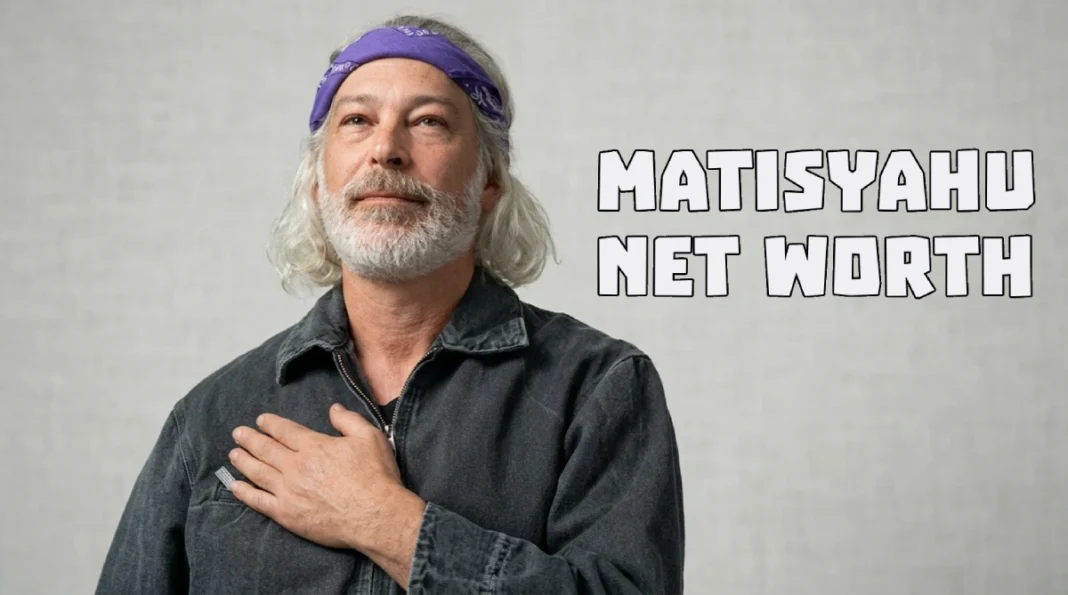
Matthew Paul Miller — known professionally as Matisyahu — is one of the most distinctive voices in modern American music, with an estimated net worth of $8–10 million built through two decades of genre-blending artistry. A Jewish-American reggae singer, rapper, beatboxer, and alternative rock musician, he built a career on a sound no one had heard before: Orthodox Jewish spirituality woven into reggae rhythms and hip-hop flow.
You’ll see Matisyahu’s net worth listed anywhere from $4 million to $12 million online — here’s why the $8–10 million range makes the most sense.
Quick Facts at a Glance
| Category | Details |
| Full Name | Matthew Paul Miller |
| Stage Name | Matisyahu |
| Date of Birth | June 30, 1979 |
| Place of Birth | West Chester, Pennsylvania, USA |
| Nationality | American |
| Genres | Reggae, Hip-Hop, Alternative Rock, Beatboxing |
| Active Since | 2004 |
| Net Worth (est.) | $4 million – $12 million (commonly cited ~$8–10M) |
| Primary Income | Touring, streaming, album sales, merchandise |
| Marital Status | Married (Talia Dressler, since 2019) |
| Notable Works | “King Without a Crown,” “One Day,” Youth (2006), Matisyahu (2022) |
Who Is Matisyahu?
Born on June 30, 1979, in West Chester, Pennsylvania, and raised in White Plains, New York, Matisyahu grew up in a Reconstructionist Jewish household. He attended Hebrew school at Bet Am Shalom but began rebelling as a teenager — dropping out of high school and following the rock band Phish on tour while experimenting with drugs, particularly psychedelics.
A turning point came in 1995, when he attended a two-month program at Alexander Muss High School in Israel, which deepened his connection to Judaism. After returning to the United States, he eventually completed high school at a wilderness expedition school in Bend, Oregon, where he began performing music under the name MC Truth — blending his Jewish identity with reggae and hip-hop.
Back in New York, he immersed himself in Orthodox Judaism, regularly attending services at The Carlebach Shul synagogue and studying at The New School. He adopted the Hebrew version of his name, Matisyahu, and signed with JDub Records in 2004 — launching one of the more unexpected careers in modern music.
Career Overview
Discography and Commercial Milestones
Matisyahu’s debut album, Shake Off the Dust… Arise (2004), laid the groundwork for a dedicated fanbase. His breakthrough arrived with the live album Live at Stubb’s (2005), which achieved Gold certification from the RIAA. The studio album Youth (2006) was his commercial peak — reaching #4 on the Billboard 200, earning a Grammy nomination, and going Gold with over 500,000 copies sold in the United States alone.
Subsequent releases continued to chart:
- Light (2009) — #19 on Billboard 200; featured the crossover hit “One Day,” used by NBC for the 2010 Olympics
- Spark Seeker (2012) — #19 on Billboard 200
- Akeda (2014) — #36 on Billboard 200; a more stripped-down sound
- Undercurrent (2017) — #60 on Billboard 200
- Matisyahu (2022) — self-titled return to his roots; blends introspective lyrics with modern production
Notable Collaborations and Projects
Beyond his solo work, Matisyahu has collaborated with a wide range of artists, including Akon, Wyclef Jean, Trevor Hall, P.O.D., Shyne, Travis Barker, and Ariana Grande. His track “U R What You Eat” appeared on the Songs for a Healthier America compilation — a project chaired by former First Lady Michelle Obama. His live shows frequently featured his backing band, Dub Trio, known for their ability to blur the lines between reggae, rock, and dub.
Film and Documentary Work
In 2007, he appeared in the documentary “Unsettled,” which won the Grand Jury Prize for Best Documentary Feature at the Sundance Film Festival. In 2012, he stepped into acting, playing the role of Tzadok in the supernatural horror film The Possession, which earned over $85 million at the worldwide box office — a notable addition to his career profile and a separate income stream most fans overlook.
Matisyahu Net Worth: What the Numbers Actually Say
While CelebrityNetWorth cites $4 million and other trackers suggest up to $12 million, the $8–10 million range best accounts for Matisyahu’s touring revenue, catalog royalties, and verified real estate transactions — factors often excluded from automated valuations.
The gap reflects the difficulty of estimating a career built heavily on live performance revenue, which is far less transparent than album sales data. A figure in the $8–10 million range is the most defensible estimate when accounting for real estate holdings, two decades of catalog royalties, and consistent touring income.
For comparison: Sean Paul’s net worth exceeds $20 million, while Shaggy’s sits near $15 million. Matisyahu occupies a respectable position as a niche crossover artist who reached mainstream heights without fully becoming a pop act.
| Year | Estimated Net Worth | Key Driver |
| 2005 | ~$500,000 | Live at Stubb’s success |
| 2007 | ~$2 million | Youth album, Billboard #4 |
| 2010 | ~$4 million | Touring peak, Light release |
| 2013 | ~$6 million | Spark Seeker + continued touring |
| 2017 | ~$7 million | Undercurrent release |
| 2024-current | ~$8–10 million | Catalog royalties, active touring |
Income Sources: Where His Money Comes From
Matisyahu’s earnings are diversified across six primary channels. The breakdown below reflects estimated proportions based on industry norms for artists at his career stage:
| Income Source | Share of Earnings | Notes |
| Concert & Touring | ~60% | 50–80 shows/year; booking fee $40K–$150K per show |
| Streaming & Digital | ~18% | Spotify, Apple Music, YouTube Content ID |
| Album Sales & Catalog | ~8% | Physical + digital; vinyl reissues add margin |
| Publishing Royalties | ~8% | Songwriting rights, sync licensing |
| Merchandise | ~4% | Tour merch + online store |
| Acting / Other Ventures | ~2% | Film residuals, brand partnerships |
For context, touring typically represents 40–70% of income for mid-tier legacy artists; Matisyahu’s ~60% aligns with peers who prioritize live performance over streaming dependence
- Concert revenue is the dominant driver. His booking fee is estimated at $40,000 to $150,000 per show, depending on the venue and event. With 50–80 shows per year, this alone generates substantial income relative to his catalog’s streaming performance.
- Publishing royalties are a quietly important piece. Sync licensing — where his music appears in ads, films, or TV — provides high-margin passive income. The NBC Olympics campaign for “One Day” is the most high-profile example, but smaller placements continue to accumulate.
- Acting work through The Possession (2012) added film residuals to his income profile. While not a recurring revenue stream, it diversified his financial base and demonstrated cross-industry appeal.
Streaming Earnings
Matisyahu’s catalog performs consistently across platforms, with notable spikes during Jewish holidays — a predictable seasonal pattern that adds revenue regularity.
| Track | Spotify Streams (approx.) | Estimated Lifetime Earnings |
| One Day | 40M+ | $120,000 – $200,000 |
| King Without a Crown | 30M+ | $90,000 – $150,000 |
| Youth | 20M+ | $60,000 – $100,000 |
| Full Catalog (annual) | — | $100,000 – $150,000/year |
Estimates based on industry-standard $0.003–$0.005 per Spotify stream; actual payouts vary by territory, listener tier, and rights ownership.
YouTube monetization adds an estimated $15,000–$25,000 annually through his official channel and Content ID matches on user-uploaded videos. While these figures fall well short of his peak physical sales era, streaming provides reliable passive income that grows gradually as catalog discovery continues.
Album Sales Breakdown
Physical album sales have declined industry-wide, but Matisyahu’s back catalog continues to sell steadily.
- Live at Stubb’s (2005) and Youth (2006) — both Gold certified (500,000+ units each in the US). Estimated lifetime royalty earnings from these two titles: $1–1.5 million.
- Light (2009) — approximately 150,000 copies sold.
- Spark Seeker, Akeda, Undercurrent — 25,000–50,000 copies each, consistent with niche artist sales volumes.
- Vinyl reissues of earlier titles generate a small but higher-margin revenue stream, with stronger unit economics than standard digital sales.
Real Estate Holdings
Property forms a meaningful portion of Matisyahu’s net worth. In January 2016, he purchased a home in Nyack, New York, for $1.77 million. He listed it in September 2019 and sold it in March 2021 for $1.795 million — a modest but stable return on a five-year hold. His real estate holdings represent roughly 20–25% of his total estimated net worth, in line with a conservative asset allocation approach.
Personal Life
Matisyahu married Tahlia Silverman in August 2004, after being introduced through a rabbi. Together, they had three sons: Laivy, Shalom, and Menachem Mendel. The marriage ended in divorce in 2012.
He has additional children from other relationships, and in May 2019, he married Talia Dressler in a private backyard ceremony. They welcomed a daughter in 2020 and a son in 2022.
Religiously, he was affiliated with the Chabad-Lubavitch Hasidic community from 2001 to 2007, before publicly stepping away from that specific affiliation. His 2011 decision to shave his beard drew widespread attention — for his original fanbase, it symbolized a shift in his religious observance; for wider audiences, it reinforced his image as someone who evolves on his own terms.
Unlike many celebrities, Matisyahu keeps a low-key lifestyle — no flashy cars or mansion tours — a choice that reflects his spiritual roots and smart, long-term financial planning.
What Comes Next
Matisyahu’s financial outlook is stable, with moderate growth potential tied to a few identifiable opportunities:
- Legacy reissues and anniversary editions of Youth and Live at Stubb’s — both catalog titles that have proven long-term demand
- The 2022 self-titled album opens the door for new sync licensing opportunities and touring cycles that his earlier catalog already supports
- International market expansion, particularly in markets with growing reggae and world music audiences
- Production, mentorship, or collaborative roles that generate income without full touring commitments
What the trajectory shows clearly is that his financial security does not depend on recapturing mainstream chart success. His $8–10 million net worth is the product of career longevity, diversified income, and a dedicated fanbase — three things that are harder to build than a viral hit, and far more durable.
Matisyahu’s story is a rare one in the music industry: an artist who found a genuinely original sound, converted it into mainstream attention at his peak, and then built a sustainable career on catalog depth and live performance rather than chasing pop trends. By any metric — Spotify streams, packed venues, or a diverse portfolio across music, film, and property — Matisyahu proves you can build lasting wealth without selling out your sound.