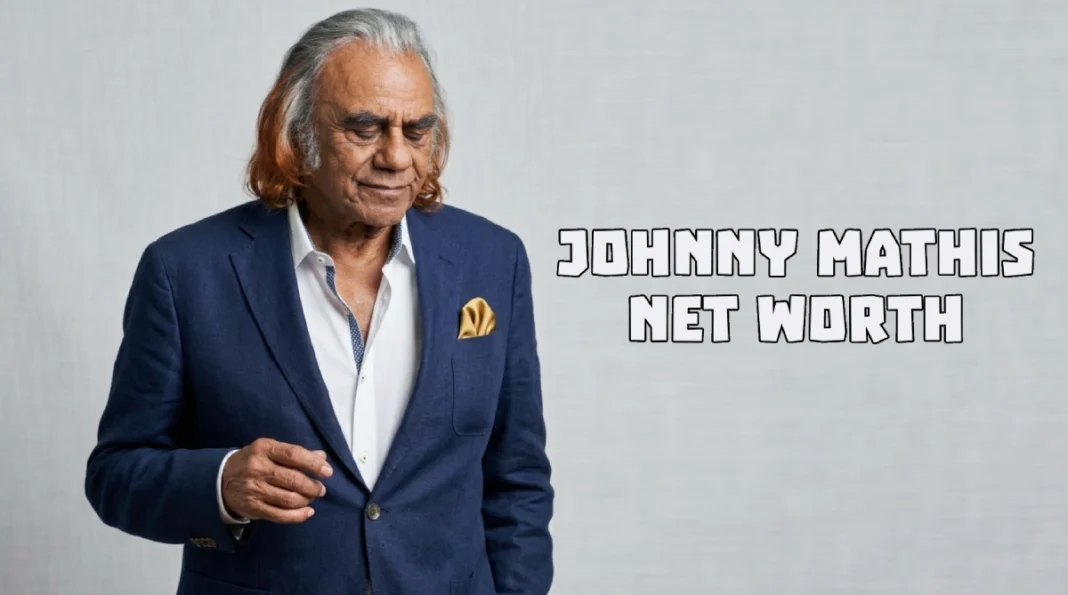
Johnny Mathis spent nearly seven decades building one of the most financially durable careers in American music. Known for his distinctively smooth, romantic tenor, he amassed a fortune that most artists never approach — not through one blockbuster contract or viral moment, but through consistent output, shrewd property investments, and a 69-year relationship with Columbia Records that stands as one of the longest in the label’s history.
| Net Worth | $200 Million |
| Date of Birth | September 30, 1935 |
| Birthplace | Gilmer, Texas, USA |
| Nationality | American |
| Career Span | 1956 – 2025 (69 years) |
| Label | Columbia Records (longest-tenured artist) |
| Records Sold | Over 350 million worldwide |
| Albums Charted | 73 on Billboard charts |
| Retirement | May 2025 (final show: Bergen PAC, NJ) |
What Is Johnny Mathis’s Net Worth?
Johnny Mathis has an estimated net worth of $200 million. This figure comes from multiple financial publications, including Celebrity Net Worth, and is consistent with reporting that followed his retirement announcement in March 2025.
Some older sources have placed the number as high as $400 million. The gap exists because private investment portfolios and real estate holdings are difficult to verify publicly, and earlier estimates were made before accounting for the estate costs and tax obligations of a career that ran from the mid-1950s to 2025. The $200 million figure represents the most widely cited and conservative estimate based on current reporting.
For context, his contemporary Tony Bennett had an estimated net worth of approximately $150 million, while Andy Williams was worth around $45 million at the time of his passing in 2012. Among vocalists of his generation, Mathis stands out as one of the most financially successful.
Early Life
Johnny Mathis was born John Royce Mathis on September 30, 1935, in Gilmer, Texas — the fourth of seven children born to Clem and Mildred Mathis. The family moved to San Francisco, settling in the Richmond District, where his father, who had worked in vaudeville, recognized his son’s musical ability and encouraged it early.
At 13, Mathis began working with voice coach Connie Cox, studying with her for six years. He learned classical and operatic technique alongside popular styles — a training foundation that would later give his voice its unusual range and control. At George Washington High School, he was also a standout athlete, and he enrolled at San Francisco State College on an athletic scholarship, intending to become a teacher.
His athletic career came close to intersecting with the 1956 Olympics as a high jumper. When Columbia Records called with a recording opportunity at the same moment, he chose music. That decision, as it turned out, built a $200 million career.
Career Highlights
Breakthrough and the Billboard Record
Mathis entered the music industry at 19, spotted at a jam session by Helen Noga, a nightclub owner who became his first manager. She helped him land a deal with Columbia Records, and his debut LP was released in 1956.
His early singles moved slowly until his appearance on The Ed Sullivan Show in June 1957 shifted his commercial trajectory. That same year, “Wonderful! Wonderful!” and “It’s Not for Me to Say” established his signature sound, and “Chances Are” became his second million-selling single.
“Wild is the Wind,” released in November 1957 for the film of the same name, earned an Academy Award nomination for Best Original Song. He received a second Oscar nomination the following year for “A Certain Smile,” which appeared in the 1958 film of the same title. Two nominations within 12 months confirmed his crossover power beyond the pop charts.
His 1958 compilation, Johnny’s Greatest Hits, spent an unprecedented 490 consecutive weeks — nearly nine and a half years — on the Billboard 200 chart, including three weeks at number one. It held the record for most weeks on that chart for 15 years, until Pink Floyd’s Dark Side of the Moon reached 491 weeks in 1983. That record alone drove album sales exceeding three million copies and generated decades of residual royalties.
His holiday album Merry Christmas, also released in 1958, has sold over five million copies and continues to generate revenue every holiday season — a passive income stream that has run for more than 60 years.
The Late 1970s Resurgence and Duet Era
After the British Invasion shifted radio programming in the mid-1960s, Mathis stepped back from pop singles. In 1964, he established Jon Mat Records, incorporated in California, to produce his own recordings — an early example of artist ownership that helped protect his financial interests.
His commercial comeback arrived in the late 1970s. In 1978, his duet with Deniece Williams, “Too Much, Too Little, Too Late,” reached number one on the Billboard Hot 100 and was certified Gold in the United States. It was his first chart-topper since 1957. The success of that pairing led to a series of duets with artists including Dionne Warwick, Natalie Cole, and Gladys Knight, each adding catalog depth and expanding his audience.
At his commercial peak, he had five albums simultaneously on the Billboard charts — a feat matched in his era only by Frank Sinatra and Barry Manilow. Over his career, he released more than 200 singles, with over 70 charting globally, and taped 12 television specials with over 300 guest appearances.
Final Chapter: Retirement at 89
In March 2025, Mathis announced his retirement from live performance, citing age and accelerating memory issues. His final show took place on May 18, 2025, at the Bergen Performing Arts Center in Englewood, New Jersey — a sold-out event accompanied by a full 30-piece orchestra.
The evening featured tributes from Darlene Love, Dee Dee Bridgewater, Valerie Simpson, Gerald Alston, and Regina Belle. A tribute video played before the concert included messages from Barbra Streisand, Patti LaBelle, Chaka Khan, Whoopi Goldberg, Lionel Richie, Nile Rodgers, and Billy Porter, among others. BergenPAC honored him with a plaque on their Walk of Fame and announced a performing arts scholarship in his name.
Record Sales and Royalty Income
With over 350 million records sold worldwide across 73 charted albums, Mathis ranks among the highest-selling artists of the 20th century. Key sales milestones include:
- Johnny’s Greatest Hits: over 3 million copies sold
- Merry Christmas: over 5 million copies sold
- Chances Are: over 2 million singles sold
- Too Much, Too Little, Too Late (with Deniece Williams): Gold-certified in the US
Columbia Records, recognizing his consistent commercial performance, rewarded him with progressively better royalty terms throughout his career. Where early 1950s contracts typically gave artists only a few cents per album, his negotiating position strengthened with each decade of proven sales. His 69-year tenure with Columbia — rivaled historically only by Barbra Streisand, Bruce Springsteen, and Bob Dylan — gave him institutional stability that most artists never experience.
As streaming took hold, his catalog transferred well. His romantic ballads and Christmas recordings perform consistently on Spotify, Apple Music, and Pandora year-round, generating passive royalty income that continues into retirement.
Real Estate Investments
Property investments played a significant role in Mathis’s long-term wealth. His most notable holding is his Hollywood Hills residence, which he has owned since 1964. The hilltop estate was originally built in 1946 by aviator and industrialist Howard Hughes and sits above Los Angeles with sweeping city views. Purchased for approximately $100,000 in 1964, the property is now valued at several million dollars. A 2015 fire damaged portions of the home but did not diminish the location’s value.
Beyond his primary residence, Mathis made strategic property acquisitions, including a Manhattan apartment building purchased in the 1960s, when New York real estate was far more accessible, and commercial properties such as a Midwest post office building that provided steady rental income over decades.
His real estate philosophy mirrored his broader financial approach: long-term appreciation and reliable income over speculative risk. Music industry analysts note that he largely avoided the stock market’s volatility, a conservative stance that protected him during the financial downturns that wiped out many of his contemporaries.
Awards and Recognition
Mathis received multiple Grammy nominations throughout his career and was inducted into the Grammy Hall of Fame for his recordings. In 2003, the Recording Academy presented him with a Grammy Lifetime Achievement Award — one of the organization’s highest honors. In 2014, he was inducted into the Great American Songbook Hall of Fame, recognizing his contribution to the classic American popular music canon.
He also received two Academy Award nominations for Best Original Song — for “Wild is the Wind” (1957) and “A Certain Smile” (1958) — a detail that underscores how far his influence reached beyond recording studios.
Personal Life
Outside of music, Mathis is an avid golfer — a lifelong pursuit he has described as a genuine passion rather than a hobby. He has recorded nine holes-in-one and has hosted charity golf tournaments in both the US and the UK. Since 1985, he has run an annual charity tournament in Belfast.
In 1982, he published a cookbook titled Cooking for You Alone, reflecting his interest in food and solo living. In 2017, he confirmed publicly to US Magazine that he is gay — a disclosure he described as unremarkable given how long it had simply been part of his private life.
Mathis has also spoken openly about undergoing rehabilitation for alcohol and prescription drug dependency. He has supported a range of charitable causes over the decades, including the American Cancer Society, the March of Dimes, the YWCA and YMCA, the Muscular Dystrophy Association, and the NAACP. His philanthropic giving, like his financial management, appears to have been consistent and long-term rather than performative.
Net Worth Growth Timeline
Mathis’s wealth accumulated gradually across seven decades rather than through sudden windfalls:
- 1950s: Modest early earnings. Royalty terms favored Columbia Records, as was standard for the era. Album sales began building, but Mathis saw limited upfront income.
- 1960s–1970s: Financial security established. Concert fees grew substantially as his reputation solidified. Real estate purchases during this period, including the Howard Hughes estate and the Manhattan building, laid the foundation for long-term asset appreciation. He was touring up to 200 nights annually at peak.
- 1980s–1990s: New releases received less radio play, but his back catalog — particularly Christmas recordings — generated consistent annual income spikes. The Merry Christmas album alone became a perennial revenue driver.
- 2000s–2010s: Digital distribution opened new royalty channels for his extensive catalog. He scaled touring back to roughly 50 concerts per year while maintaining premium ticket prices in the $75–$250 range. Streaming platforms added another passive income layer.
- 2020s: Focus shifted to wealth preservation and legacy planning. Streaming royalties continue in retirement. Real estate holdings appreciate passively. Catalog licensing for films, advertising, and media remains a viable future income stream.
Challenges and Setbacks
Mathis was not immune to financial setbacks. The 2015 fire that damaged his Hollywood Hills home destroyed decades of personal memorabilia and belongings, and repair costs were substantial.
Touring at scale also carries significant overhead. Travel, a supporting orchestra, wardrobe, and staff expenses reduced gross concert revenue considerably. During his busiest periods, production costs could reach millions annually.
Tax obligations compounded this. Performing during eras when top marginal tax rates exceeded 70%, Mathis — like most high earners of his generation — directed a large share of income to federal and state taxes. His ability to absorb these costs while still building $200 million in wealth reflects how diversified and durable his income streams were.
What Happens to His Wealth in Retirement?
Retirement ends concert revenue, which was still generating meaningful income from 30–50 dates annually in his final years. However, the financial engine that built his fortune does not require him to perform.
Ongoing royalties from over 350 million records sold, streaming income from a catalog covering more than 70 albums, real estate appreciation across multiple properties, and potential licensing deals for his music in film, television, and advertising all continue to generate returns. His catalog rights alone are estimated by music industry analysts to be worth tens of millions of dollars.
Mathis has been characteristically private about estate planning. What is clear is that his wealth was built through consistency, diversification, and a conservative approach to risk — a model that is, in many ways, the opposite of how most entertainment careers unfold.