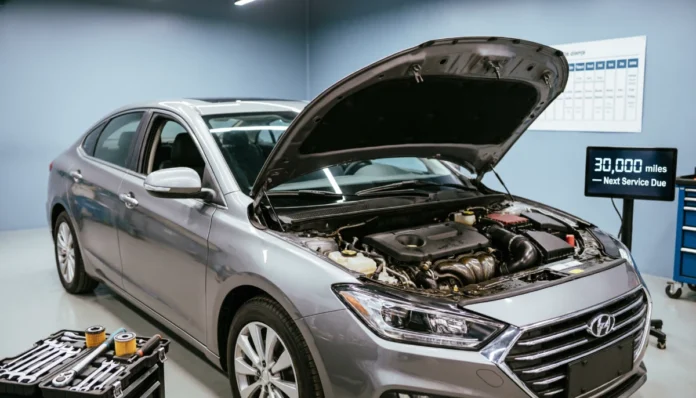
Wondering how often you should change engine oil under real-world conditions? You pull into a quick-lube shop for a routine oil change. The technician hands you a sticker for your windshield: “Next change: 3,000 miles.” But your owner’s manual says 7,500. Your car’s oil life monitor still reads 40%. Now you’re not sure who to trust.
This confusion costs drivers millions in unnecessary oil changes every year — and occasionally, real engine damage when they swing too far the other way. There’s no universal oil change number that fits every driver. Your ideal interval shifts based on three things: what you drive, what oil you use, and whether your commute is stop-and-go city traffic or open-highway cruising.
The 3,000-Mile Rule Is Outdated — Here’s Why
The 3,000-mile interval made sense decades ago, when engines had looser tolerances and conventional oil broke down much faster. Modern engines are built to much tighter specifications, and modern oils — especially full synthetics — are chemically engineered to last far longer.
CalRecycle (California’s Department of Resources Recycling and Recovery) has labeled the 3,000-mile rule a persistent myth for years, citing that it leads to tens of millions of gallons of unnecessarily recycled oil annually. Quick-lube shops still push it because more frequent visits mean more revenue. That’s a business interest, not a maintenance recommendation.
If your car was built after 2010 and uses synthetic oil, you almost certainly don’t need a change every 3,000 miles.
What Car Manufacturers Actually Recommend
The people who built your engine have tested it extensively. Their recommendation — found in your owner’s manual — is your most reliable baseline.
Most manufacturers now recommend intervals between 5,000 and 10,000 miles for conventional oil, and 7,500 to 15,000 miles for full synthetic. Toyota recommends 10,000 miles for most Camry and Corolla models using 0W-20 synthetic. Honda’s Maintenance Minder on the Civic adjusts dynamically based on engine load and temperature, often pushing past 7,500 miles. Ford recommends 7,500-mile intervals for the F-150 with its EcoBoost engines using 5W-30 synthetic blend.
Checking Your Owner’s Manual
Open your glove box and look for two things: the recommended oil viscosity (e.g., 5W-30, referencing the SAE J300 viscosity grading system where ‘W’ indicates winter cold-start performance) and the service interval. Many manuals also distinguish between normal and severe driving conditions — a distinction that matters more than most drivers realize.
How Your Driving Conditions Change Everything
Here’s what most generic advice misses: the same car can need an oil change at 5,000 miles or 10,000 miles, depending entirely on how it’s driven. Manufacturers build this into their recommendations, but rarely explain it clearly.
City Driving vs Highway Driving
City driving is hard on oil. Short trips under 10 minutes don’t allow the engine to reach full operating temperature, which means fuel and moisture accumulate in the oil rather than burning off. Stop-and-go traffic puts the engine under constant load changes. Over time, this accelerates oil degradation even if the odometer hasn’t moved much.
Highway driving is the opposite. The engine runs at a steady temperature, oil circulates properly, and combustion byproducts burn off cleanly. If you primarily drive long highway stretches, your oil lasts closer to its maximum rated life. If your commute is 5 miles of city traffic each way, drop your interval by 20–30% from whatever the manufacturer lists.
Extreme Temperatures and Short Trips
Cold-weather starts are particularly rough on oil. When temperatures drop below freezing, oil thickens and takes longer to circulate through the engine. Most engine wear happens in the first 30 seconds after a cold start. If you’re in a climate with harsh winters and doing mostly short trips, treat your interval as “severe,” which typically means cutting it by roughly one-third.
Extreme heat does the opposite: it accelerates oil oxidation, breaking down the oil’s protective properties faster. Desert climates with temperatures above 100°F regularly in summer warrant the same conservative approach.
Synthetic Oil vs Conventional Oil — The Interval Difference
This is where the biggest practical difference lives. Conventional oil is refined from crude oil with fewer additive packages. It starts breaking down chemically around 3,000–5,000 miles under normal conditions, which is where that old rule came from.
Full synthetic oil
Full synthetic oil isn’t just refined — it’s built from the ground up at a molecular level to resist heat, maintain thickness under pressure, and flow smoothly even on freezing mornings. A quality full synthetic meeting API SP and ILSAC GF-6 standards — like Mobil 1, Castrol Edge, or Pennzoil Platinum — can legitimately last 7,500 to 10,000 miles under normal driving, with some formulations rated to 15,000 miles.
Synthetic blend
Synthetic blend sits in between: better than conventional, not as durable as full synthetic. Most blends work well on a 5,000–7,500-mile interval. The price difference between synthetic and conventional is usually $30–$50 per change, but if synthetic doubles your interval, you’re spending roughly the same annually while doing half the work.
Turbocharged Engines Need Special Attention
Turbocharged direct-injection engines — like the Ford EcoBoost, VW TSI, or BMW N54 — face dual challenges: turbo heat stress and carbon buildup on intake valves. The turbocharger itself spins at up to 200,000 RPM and relies entirely on engine oil for lubrication and cooling.
When you shut off a turbocharged engine, the turbo continues spinning briefly without active oil circulation. This can cause oil to “cook” in the turbo housing if it’s already degraded. Sludge buildup in turbocharged engines is a known problem — BMW’s N54 engine and VW’s EA888 have both been widely documented for this.
If you drive a turbocharged car, use full synthetic and stay at or below the manufacturer’s recommended interval. Don’t push to the maximum. An $80 oil change is far cheaper than a $2,000–$4,000 turbocharger replacement.
How to Use Your Oil Life Monitor Correctly
Many modern vehicles include an oil life monitoring system — a small percentage readout on your dashboard. GM’s Oil Life System (used in Chevrolet, GMC, Buick, and Cadillac vehicles) was one of the first and uses an algorithm based on engine revolutions, temperature cycles, and load to calculate remaining oil life. Honda’s Maintenance Minder works similarly.
These systems are genuinely accurate for normal driving. A 0% reading doesn’t mean your oil is harmful — it means the system calculates you’ve used the interval. You don’t need to panic if you hit 0% on a trip; change it when practical, not immediately.
Where drivers go wrong is ignoring the monitor entirely or resetting it without changing the oil. The system only works if you reset it after the actual oil change. If someone else changed your oil and didn’t reset it, the monitor is tracking from the wrong baseline.
Signs Your Oil Needs Changing Right Now
Mileage and monitors are guidelines. Watch for these definitive warning signs regardless of where you are in your interval:
- Dark, gritty fluid on the dipstick — fresh oil is amber and slightly translucent. Black, opaque residue with a gritty texture signals contamination.
- Oil level below the minimum mark — low oil means the remaining oil is working harder and degrading faster.
- Engine running louder than usual — a ticking or knocking sound, especially on startup, can indicate oil isn’t protecting metal surfaces adequately.
- Burning oil smell inside the cabin — this can indicate a leak dripping onto hot engine components or oil burning internally.
- The oil light comes on — this signals low oil pressure, not just a low level. Stop driving and check immediately.
Spot any of these warning signs? Don’t wait for your next scheduled change. Pull the dipstick, check the level and color, and take action before minor issues become major repairs.
The Real Cost of Getting It Wrong
Changing too often
At an average of $60–$120 per professional synthetic oil change (prices vary by region and service type), changing every 3,000 miles instead of 7,500 means spending an extra $120/year unnecessarily — and generating waste that CalRecycle actively discourages. Over five years, that’s $600 spent on changes you didn’t need.
Waiting too long
Oil that’s gone past its service life becomes acidic and loses viscosity. It stops forming a protective film between metal surfaces. This causes accelerated engine wear — damage that’s invisible until it’s too late. Piston rings, camshaft lobes, and crankshaft bearings are the first to show the cost. Engine repairs from neglected oil changes routinely run $1,500–$8,000, depending on the engine.
The math is simple. A $60–$120 oil change done on the right schedule protects a $15,000–$50,000 asset. The savings from skipping or delaying are trivial against the risk.
Your Simple Decision Framework
Use this to set your actual interval:
Step 1 — Identify your oil type
Check your cap or owner’s manual. Full synthetic allows longer intervals than conventional or blend. Pro tip: Your oil filter matters as much as your oil choice. A high-efficiency filter meeting OEM specs — from brands like WIX, Mobil 1, or your vehicle’s manufacturer — traps more contaminants, helping your oil last its full rated interval.
Step 2 — Find your manufacturer’s recommendation
Owner’s manual, Section: Maintenance or Scheduled Service. Most manufacturers define ‘severe service’ as trips under 5–10 miles, frequent towing, extreme temperatures, or extensive idling — conditions that accelerate oil degradation. Use the “severe” schedule if any of these apply: mostly short city trips, extreme temperatures, lots of towing or hauling, or a turbocharged engine.
Step 3 — Adjust for your driving pattern
Primarily highway miles? You can run toward the upper end of the interval. Mostly short city trips in hot or cold weather? Stay toward the lower end.
Step 4 — Use your oil life monitor as a check, not a command
It’s a useful tool, but confirm with a dipstick check every 1,000–2,000 miles regardless.
Step 5 — Set a reminder and stick to it
Calendar, odometer note, or a phone reminder. Don’t stress over hitting the exact mile. What really matters is staying consistent — changing your oil 500 miles early is far smarter than forgetting and going 3,000 miles past due.
For most drivers with a modern car running full synthetic oil, the right oil change interval is somewhere between 7,500 and 10,000 miles under normal conditions. If you drive a turbocharged engine hard, live in extreme temperatures, or log mostly short city trips, drop that closer to 5,000–6,000 miles. When in doubt, your owner’s manual holds the definitive answer — and unlike a shop upsell, it won’t cost you a dime to open it up and check. Bookmark this guide or download a printable oil change tracker to stay on schedule without over-maintaining. Your engine (and wallet) will thank you.