Water doesn’t flood your home overnight — it wins by attrition. It seeps through hairline cracks, wicks through porous concrete via capillary action, condenses on cold surfaces, and silently rots framing, compromises insulation, and undermines your foundation’s structural integrity for years before you spot a stain. By the time most homeowners notice a problem, damage is already done.
You’ll learn exactly where that moisture is sneaking in, which waterproofing solution actually works for your basement, crawl space, or foundation wall, what you’ll realistically pay, and when to grab a toolbelt versus when to call a pro.
Why Water Gets In: The Actual Causes
Most water problems in basements and crawl spaces trace back to a few root causes.
- Hydrostatic pressure does the most damage—and it’s invisible until it’s too late. When soil around your foundation becomes saturated — from rain, snowmelt, or a high water table — it pushes water against your walls and floor with considerable force. Concrete is porous, and under sustained pressure, water finds a way through.
- Poor drainage makes this worse. If your gutters dump water at the foundation, your grading slopes toward the house, or your downspouts don’t extend far enough, you’re concentrating water exactly where you don’t want it.
- Foundation cracks are both a symptom and an entry point. Concrete shrinks as it cures, creating hairline cracks. Settlement, freeze-thaw cycles, and soil movement widen them. Once a crack exists, water takes the path of least resistance straight through it.
- Condensation: Here’s a common mix-up: what looks like a leak might just be condensation—and treating it like seepage wastes time and money. When warm, humid air contacts a cold concrete wall or floor, moisture forms on the surface. This looks like a leak, but it has a completely different fix.
Step One — Diagnose Before You Fix
Skipping the diagnostic step is the most expensive mistake homeowners make. Applying interior sealant to a condensation problem does nothing. Installing an interior drain system when the issue is a cracked wall joint fixes the symptom without addressing the source.
Condensation vs. Seepage: The Foil Test
Tape a 12-inch square of aluminum foil tightly against the wall or floor where you see moisture. Leave it for 24–48 hours. When you remove it:
- Moisture on the room-facing side = condensation. The problem is humidity in the air, not water coming through the wall.
- Moisture on the wall-facing side = seepage. Water is coming through the concrete from outside.
If both sides are wet, you likely have both problems. They need separate solutions.
For extra confidence, use a pin-type moisture meter ($30–$80) to quantify moisture levels in concrete vs. ambient humidity readings.
Reading the Signs by Zone
Foundation walls: White powdery deposits (efflorescence) indicate water has been moving through the concrete and depositing minerals. Horizontal cracks in block walls suggest lateral soil pressure — a structural concern, not just a waterproofing one. Vertical or stair-step cracks in poured concrete or block typically indicate settlement or shrinkage.
Basement floor: Water pooling at the wall-floor joint (the cove) is classic hydrostatic pressure from below. This is one of the hardest entry points to stop from the inside.
Crawl space: Visible standing water, sagging insulation, rust on fasteners, wood rot, and high humidity readings (above 60% relative humidity) all point to serious moisture problems. Mold on floor joists is a biological confirmation that conditions have been wet long enough to support growth.
Foundation Waterproofing Methods
Exterior Waterproofing (Positive Side)
Exterior waterproofing is the most thorough and most expensive approach. It requires excavating the soil around your foundation down to the footing — typically 8 to 10 feet for a full basement. Once exposed, the wall is cleaned, any cracks are repaired, and a waterproofing membrane or coating is applied directly to the exterior face of the foundation.
Common exterior systems include:
- Bituminous membranes (torch-applied or self-adhering sheets) — durable and flexible, handle minor movement
- Liquid-applied membranes — sprayed or rolled on, good for irregular surfaces
- Bentonite clay panels — swell when wet to create a self-sealing barrier
- Dimple drainage board — installed over the membrane to direct water down to a perimeter drain at the footing
This approach addresses the problem at the source. Water is stopped before it contacts the wall. The downside is cost and disruption — excavation around a full perimeter can run $8,000 to $20,000 depending on depth, soil conditions, landscaping, and region.
Interior Waterproofing (Negative Side)
Interior waterproofing doesn’t stop water from entering the wall. It intercepts water once it gets through and redirects it to a sump pump before it can flood the floor. This is an important distinction — interior systems manage the problem, they don’t eliminate the source.
That said, interior systems are far more accessible, less disruptive, and significantly cheaper. For many homes — especially older ones where exterior excavation would disturb mature landscaping, patios, or finished areas — interior drainage is the practical solution.
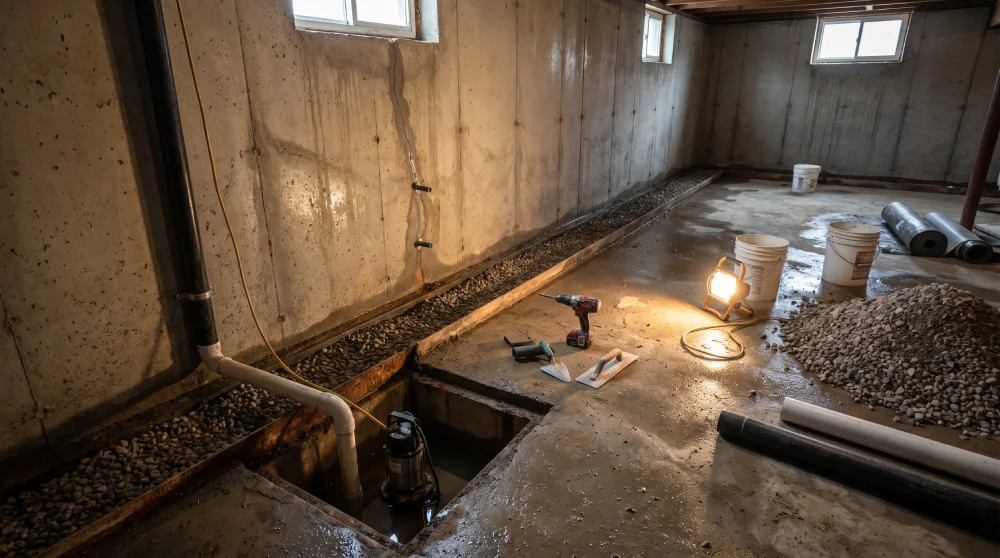
A typical interior system involves cutting a channel around the perimeter of the basement floor, laying a perforated drain pipe (often called a French drain or weeping tile) in gravel, and directing flow to a sump pit with a pump. The floor is then patched with concrete.
Crystalline and Cementitious Coatings
These are hybrid solutions applied to the interior wall surface. Crystalline waterproofing products (brands like Xypex and Kryton are well-known in this category) penetrate the concrete and react with moisture to form crystals that block water movement through capillary pores and cracks. Look for products tested to ASTM D7088 standards for crystalline waterproofing performance — this ensures the material will reliably block capillary moisture movement.
They work well on minor seepage through porous concrete but are not designed to handle hydrostatic pressure through large cracks or a failed wall-floor joint. They’re most effective as a supplemental treatment or on walls with diffuse moisture rather than active water entry.
Basement Waterproofing Methods
Interior Drainage Systems and Sump Pumps
An interior drainage system is the most commonly installed basement waterproofing solution in North America. The perimeter drain collects water from the wall-floor joint and below-slab sources and routes it to a sump pit. A sump pump then ejects that water away from the foundation.
Key specs to know:
- Sump pump capacity: A standard 1/3 HP pump handles most residential situations. 1/2 HP is recommended for high water table areas or larger basements.
- Battery backup: Essential. If a heavy storm causes flooding, power outages are common. A battery backup or water-powered backup pump protects you when it matters most.
- Pit size: A minimum 18-inch diameter pit is standard. Larger pits give the pump more time between cycles, extending its lifespan.
Sump pump installation alone: $800–$2,500. Full interior perimeter drainage system: $3,000–$8,000, depending on linear footage.
Wall Crack Injection
For isolated vertical or diagonal cracks in poured concrete walls, crack injection is often the right targeted fix. There are two main types:
- Polyurethane foam injection — expands to fill the crack, flexible after curing, good for active leaks
- Epoxy injection — rigid after curing, structurally bonds the crack, better for structural repair
The process involves drilling ports into the crack at intervals, injecting material under low pressure from the bottom up, and capping the ports once the product has cured. A trained DIYer can do this with a kit ($80–$200) for a simple crack. A contractor charges $400–$1,000 per crack depending on length and access.
This fix is not appropriate for horizontal cracks (which indicate structural bowing), wall-floor joint leaks, or block walls with widespread seepage.
Interior Waterproofing Membranes
Some contractors install plastic drainage membranes on interior basement walls — essentially a studded plastic sheet that channels water running down the wall into the floor drain system rather than letting it pool. This is not true waterproofing; it’s water management. It can be a reasonable component of a complete interior system, but should not be the only solution if hydrostatic pressure or active cracks are present.
Crawl Space Moisture Control
Crawl spaces are chronically misunderstood. Many older homes have open or vented crawl spaces, a design based on the now-outdated idea that outdoor air ventilation dries them out. In most climates, it does the opposite — especially in summer, when humid air enters, cools against the earth and concrete, and deposits moisture on every surface.
Vapor Barriers
A basic vapor barrier is a polyethylene sheet — minimum 6-mil thickness, though 10–20 mil is more durable — laid across the crawl space floor. It limits ground moisture evaporation into the space but does not seal the space from outside air or address wall infiltration.
This is the minimum treatment. It helps, but it’s not a complete solution in climates with significant humidity or groundwater pressure.
Full Encapsulation
Crawl space encapsulation seals the entire space: the floor, foundation walls, and sometimes the ceiling (underside of the subfloor). A thick reinforced liner (typically 12–20 mil) is used, seams are taped, and the space is made into a semi-conditioned environment.
Most encapsulation systems also include:
- A dehumidifier sized to the space (typically 70–90 pint capacity for a 1,500 sq ft crawl space)
- Sealed foundation vents (in most climates)
- A drainage layer or sump system if groundwater intrusion is present
Encapsulation materially improves energy efficiency, reduces humidity in the living space above, protects floor joists and subfloor from rot, and significantly reduces pest pressure. It’s one of the higher-ROI improvements in a home with a crawl space.
Pro tip: If you’re encapsulating a crawl space in a radon-prone region, coordinate with a radon mitigation specialist. Sealing the space can affect soil gas pressure, and integrated systems prevent future retrofit costs.
Cost: $5,000–$15,000 depending on size, access, prep work required (mold remediation, old insulation removal), and liner grade.
Crawl Space Drainage and Sump Options
If you have standing water in a crawl space, a vapor barrier alone won’t solve it. You need a drainage system — either a perimeter channel that routes water to a sump, or a surface drain if the water source is isolated. A crawl space sump installation runs $1,500–$4,000, depending on depth and access difficulty.
Interior vs. Exterior Waterproofing: Which One Do You Actually Need?
Skip the theory — here’s your decision tree:
- Seeing active water through cracks but walls are structurally sound? → Interior drainage + crack injection ($3k–$8k)
- Foundation walls showing bowing, horizontal cracks, or deterioration? → Exterior excavation ($8k–$20k) + structural engineer assessment
- Crawl space with musty air or >60% RH? → Full encapsulation ($5k–$15k), not just venting
- Minor dampness after heavy rain? → Start with grading + downspout extensions ($0–$500 DIY)
Foundation Waterproofing Cost Breakdown
Cost ranges reflect national averages. Final pricing depends on: soil type (clay vs. sand), foundation depth, accessibility (landscaping/obstacles), regional labor rates, and warranty length. Clay soils with low permeability often require more extensive exterior drainage, increasing excavation costs.
| Method | Average Cost Range | DIY Possible? |
|---|---|---|
| Interior drainage system (perimeter) | $3,000–$8,000 | No (requires concrete cutting) |
| Sump pump installation | $800–$2,500 | Possible with skill |
| Exterior excavation + membrane | $8,000–$20,000+ | No |
| Wall crack injection (per crack) | $400–$1,000 (pro) / $80–$200 (DIY kit) | Yes for poured concrete |
| Crawl space vapor barrier (basic) | $500–$2,000 | Yes |
| Crawl space encapsulation | $5,000–$15,000 | Partial DIY possible |
| Crystalline coating (interior walls) | $300–$1,500 | Yes |
| Drainage board (exterior, if excavating) | Typically included in exterior quote | No |
Costs vary significantly by region, soil conditions, accessibility, and scope. Always get 3 quotes from licensed waterproofing contractors.
DIY vs. Hiring a Contractor
Realistic DIY tasks:
- Applying crystalline or cementitious coatings to interior walls
- Installing a basic vapor barrier in a crawl space
- Polyurethane crack injection on a poured concrete wall
- Improving grading and extending downspouts (often solves minor seepage problems at no cost)
- Installing a dehumidifier in a crawl space or basement
Leave it to a professional:
- Any interior drainage system requiring concrete cutting
- Exterior excavation and membrane installation
- Sump pump installation if you’re not comfortable with basic plumbing and electrical
- Any horizontal cracking in block walls (structural assessment needed first)
- Full crawl space encapsulation in spaces with mold, standing water, or damaged joists
Licensing note: Some states require waterproofing contractors to hold a specific license. Check your local requirements before hiring, and verify the contractor carries liability insurance and offers a written transferable warranty (typically 10–25 years for interior systems). Many regional franchises (like Basement Systems or AquaGuard affiliates) offer transferable warranties — verify whether coverage transfers to future homeowners if you plan to sell.
⚠️ Critical: Before any DIY waterproofing, check local building codes. Some municipalities require permits for sump pump discharge lines or foundation modifications. Improper drainage redirection can violate code or create liability with neighbors.
Common Mistakes That Make Water Problems Worse
- Sealing only the interior without fixing the drainage. Hydraulic cement and surface sealants applied to the interior wall face will eventually fail under sustained hydrostatic pressure. They can buy time, but they are not a long-term fix.
- Ignoring the grading and gutters. A significant percentage of basement water problems can be reduced or eliminated by correcting the slope away from the foundation, cleaning gutters, and extending downspouts 6–10 feet from the house. Do this first, always, before spending money on waterproofing systems.
- Installing a sump pump without a battery backup. The pump is most critical during heavy storms — exactly when power goes out.
- Choosing a contractor based on price alone. Interior waterproofing warranties are only as good as the company backing them. A contractor who goes out of business voids your warranty. Check company history, licensing, and reviews carefully.
- Treating a structural crack as just a waterproofing problem. Horizontal cracks in block or poured walls indicate lateral soil pressure and possible structural failure. Waterproofing over a structurally compromised wall is a serious mistake — get a structural engineer’s assessment first.
- Encapsulating a crawl space with active mold. You cannot seal mold in and expect it to stop growing. Mold remediation must happen before encapsulation.
Maintenance After Waterproofing
Think of your waterproofing system like your car: install it right, then maintain it. Skip the check-ups, and you’ll pay for it later.
- Test your sump pump twice a year by pouring water into the pit. Confirm the float activates and water ejects properly. Replace pumps every 7–10 years proactively; don’t wait for failure.
- Inspect the discharge line every spring to confirm it’s not clogged or frozen.
- Check crawl space dehumidifier drainage and filters quarterly.
- Walk the perimeter of your foundation after major rain events to confirm that grading is still directing water away and gutters are intact.
- Re-inspect crack injections every 2–3 years. Polyurethane repairs can be affected by significant foundation movement.
FAQs
Q. What is the difference between waterproofing and damp-proofing?
Damp-proofing is a basic asphalt-based coating applied to foundation walls during construction. It resists soil moisture but is not designed to handle hydrostatic pressure or standing water. Waterproofing systems — membranes, drain systems, encapsulation — are engineered to handle active water pressure.
Q. How do I know if my leak is from seepage or condensation?
Use the foil tape test described earlier. Condensation is common in summer; seepage is often worse in spring after snowmelt or during extended rain.
Q. How long does basement waterproofing last?
Interior drainage systems typically carry 10–25 year warranties and can last the life of the home with proper sump maintenance. Exterior membranes last 10–20 years, depending on product type. Crystalline coatings can be permanent once they’ve penetrated the concrete matrix.
Q. Does waterproofing add value to a home?
It adds value by removing a deficiency rather than creating an upgrade. A dry basement is not a selling point — a wet one is a deal-killer. Buyers and inspectors will note water intrusion evidence. A documented, warranted waterproofing system removes that liability.
Q. Can I waterproof a basement from the inside only?
Yes, and most professionals do exactly this for existing homes. Interior drainage systems are effective, durable, and the standard approach in the industry for retrofit situations. The limitation is that they don’t protect the wall itself from ongoing moisture contact.
Q. Is crawl space encapsulation worth the cost?
For most homes in humid climates or with any visible moisture issues: yes. The combination of reduced energy bills (conditioned crawl spaces reduce HVAC load), eliminated mold risk, and protected structural framing makes it one of the better-performing investments in home maintenance.
Q. Can I waterproof a basement in winter?
Interior solutions (crack injection, sump pumps, coatings) work year-round. Exterior excavation is possible but challenging in frozen ground — many contractors pause major exterior work Dec–Feb in cold climates. If you have active leaking in winter, start with interior mitigation and schedule exterior work for spring. In regions with deep frost lines, frozen soil complicates excavation and increases project timelines.