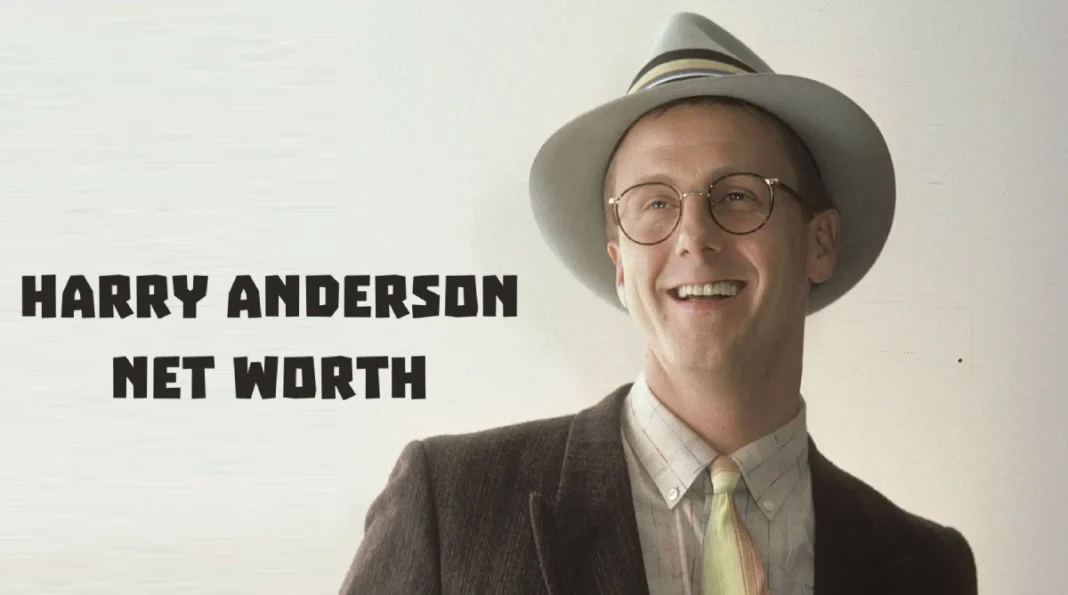
Harry Anderson left behind an estimated net worth of $5 million when he passed away on April 16, 2018. Over four decades, the actor, comedian, and magician built his wealth through an uncommon combination of television stardom, live performance, business ownership, and strategic career diversification — all while remaining one of the most distinctive personalities in American entertainment.
Estimated Net Worth at Time of Death
$5 Million
(April 2018)
What Was Harry Anderson’s Net Worth and Salary?
At the time of his death, Harry Anderson’s net worth was widely estimated at $5 million. The figure reflects decades of television income, live performance fees, real estate holdings, and revenue from business ventures in New Orleans.
The foundation of that wealth was his eight-year run on NBC’s Night Court (1984–1992), where he starred as Judge Harold “Harry” T. Stone across 193 episodes and nine seasons. Industry reports from the 1980s suggest lead actors on hit network sitcoms earned between $25,000–$75,000 per episode at peak, though Anderson’s exact Night Court salary was never publicly disclosed, and syndication deals continued generating residual income long after the original run ended.
Beyond Night Court, Anderson maintained a steady income from live magic and comedy shows, corporate entertainment bookings, a follow-up sitcom, and New Orleans businesses he opened in the 2000s. He was also a co-author of a published book on cons and grifting.
Early Life and the Making of a Magician
Harry Laverne Anderson was born on October 14, 1952, in Newport, Rhode Island. After his parents divorced, he moved with his mother and siblings to Chicago, where he first became drawn to magic. He spent his teenage years performing on the streets of Chicago, New York, St. Louis, and New Orleans before relocating to California at 16 to live with his father.
In Los Angeles, Anderson joined the Dante Magic Club and began working as a street magician in San Francisco at 17. He attended Buena Park High School and later graduated as class valedictorian from North Hollywood High School in 1970 — a detail that contradicts the popular narrative of him as a pure self-taught outsider. He went on to attend Fullerton College.
From 1971 to 1976, Anderson lived in Ashland, Oregon, where he performed magic and worked with the Oregon Shakespeare Festival. The experience sharpened both his performance instincts and his understanding of theatrical timing — qualities that would define his later television work.
Street performing became his primary classroom in those years. Working sidewalk crowds taught him crowd psychology, how to command attention without a stage, and how to build a comedic persona around magic rather than despite it. That combination — magic as comedy, comedy as magic — became his career-defining identity.
Television Career
Breaking In: Saturday Night Live and Cheers (1978–1983)
Anderson made his television debut on The Big Laff Off in 1978. He followed that with appearances on The Mike Douglas Show (1980) and An Evening at the Improv (1981) before landing his most important early platform: Saturday Night Live.
Between 1981 and 1985, Anderson made eight appearances on SNL, including hosting an episode in the show’s tenth season in 1985. Those slots introduced him to a national audience and demonstrated that magic could work as primetime entertainment comedy rather than just a novelty act. He also made 12 appearances on The Tonight Show Starring Johnny Carson — a stamp of approval that opened significant doors.
In 1982, he began a recurring guest role as Harry “The Hat” Gittes on the NBC sitcom Cheers, appearing in six episodes across the show’s run through 1993. The character — a charming, unreliable con man — was a natural fit and gave Anderson a recognizable second identity alongside his own name.
Night Court: The Role That Built His Fortune (1984–1992)
The role of Judge Harold “Harry” T. Stone on NBC’s Night Court was created with Anderson in mind after producers caught his live performances. The character allowed him to incorporate his magic background into storylines naturally, and the show became one of the most-watched sitcoms of the 1980s.
Night Court ran for 193 episodes across nine seasons. Anderson was not only the lead but also contributed as an occasional writer and director — he directed the episodes “Caught Red Handed” (1987) and “A Closer Look” (1990). His involvement behind the camera reflected both his creative ambitions and an understanding that ownership and contribution beyond acting build longer-term career equity.
The show earned Anderson three consecutive Primetime Emmy Award nominations for Outstanding Lead Actor in a Comedy Series — in 1985, 1986, and 1987. He did not win, but the nominations established him among the leading sitcom actors of his era.
Stephen King’s IT, Dave’s World, and Later Work (1990–2014)
In 1990, Anderson stepped outside his comedy wheelhouse to play Richie Tozier in the two-part Stephen King television miniseries It. The production, which aired on ABC and received a People’s Choice Award nomination for Favorite TV Mini-Series, showed he could carry dramatic weight and significantly broadened his audience.
From 1993 to 1997, he starred as real-life humor columnist Dave Barry on the CBS sitcom Dave’s World, which ran for 98 episodes across four seasons. The show was a solid post-Night Court run that kept him in the six-figure annual income bracket throughout the mid-1990s.
Later appearances included a guest role on 30 Rock in 2008 — playing himself in an episode titled “The One with the Cast of Night Court” — and roles on Comedy Bang! Bang! (2013) and Gotham Comedy Live (2014). His final film credit was Professor Kaman in the Christian drama A Matter of Faith (2014).
Emmy Award Nominations
Anderson earned three Primetime Emmy nominations for Outstanding Lead Actor in a Comedy Series for his work on Night Court:
| Year | Category |
| 1985 | Primetime Emmy — Outstanding Lead Actor in a Comedy Series |
| 1986 | Primetime Emmy — Outstanding Lead Actor in a Comedy Series |
| 1987 | Primetime Emmy — Outstanding Lead Actor in a Comedy Series |
Three consecutive nominations are a meaningful benchmark in network television. They confirmed that Anderson’s performance was not incidental to Night Court’s success — he was the engine driving it. That credibility directly supported his salary negotiations and post-Night Court market value.
Income Sources
Television Earnings and Residuals
Night Court was the primary engine of Anderson’s wealth. Over its nine-season run, his per-episode salary grew with the show’s success and audience ratings. Residual payments from the show’s extensive syndication life continued providing income well into the 2000s and beyond — a standard feature of successful network sitcoms from that era.
Dave’s World added four more years of steady network television income from 1993 to 1997. While the show did not reach Night Court’s scale, 98 produced episodes represent substantial total compensation, particularly with syndication added.
Live Performance and Corporate Work
Throughout his career, Anderson continued performing live magic and comedy shows independently of his television work. His name recognition allowed him to command premium booking fees for corporate events, private engagements, and theater performances. Live performers with Anderson’s profile and television credibility typically book corporate events in the range of $20,000 to $50,000 per engagement.
He also produced several television specials built around his magic persona, including Harry Anderson’s Sideshow (1987), Harry Anderson’s Hello Sucker (1986), and Harry Anderson: The Tricks of His Trade (1996). These specials functioned as both income sources and marketing platforms for his live performance brand.
Books and Publications
In 1989, Anderson co-wrote Games You Can’t Lose: A Guide for Suckers with longtime friend Turk Pipkin (ISBN 978-0671647278). The book — a guide to cons, grifts, and games stacked against the player — was reissued in 2001. In 1993, a biographical profile, Harry Anderson: Wise Guy from the Street to the Screen, was published (ISBN 978-0915181254). These titles added modest but consistent royalty income and reinforced his public identity.
Business Ventures in New Orleans
After leaving Pasadena, California, in 2002, Anderson and his second wife, Elizabeth, moved to New Orleans, where they opened a small shop in the French Quarter named Spade & Archer Curiosities by Appointment — later renamed Sideshow — selling magic, curiosities, and unusual collectibles.
In 2005, he opened a separate venture: Oswald’s Speakeasy, a nightclub at 1331 Decatur Street in the French Quarter. Anderson performed a one-man show there called Wise Guy. The speakeasy operated until October 2006, when Anderson sold it following the disruption caused by Hurricane Katrina — an event he later documented in the 2006 film Hexing a Hurricane.
These ventures reflected a pattern of finding income in performance-adjacent businesses rather than passive investment. They also kept Anderson publicly active in a community that suited his sensibility.
Real Estate
Anderson’s real estate portfolio was modest but deliberate. In 2001, he and Elizabeth paid $950,000 for a home in New Orleans, which they sold in 2006 for $895,000 — a slight loss likely accelerated by Hurricane Katrina’s impact on the local market.
Around the same time, they purchased a 3,297 square foot home in Asheville, North Carolina, for $570,000. Asheville became Anderson’s final residence, chosen for its artistic community and slower pace compared to the entertainment industry centers of Los Angeles and New York.
| Property | Detail |
| New Orleans home (purchased) | $950,000 (2001) |
| New Orleans home (sold) | $895,000 (2006) |
| Asheville, NC home | $570,000 — 3,297 sq ft |
Personal Life
Anderson married Leslie Pollack in 1977. They had two children — a daughter, Eva Fay Anderson (born 1981), and a son, Dashiell Anderson (born 1985) — before divorcing in 1999. Eva went on to build her own career as an actress, writer, and producer, known for Comedy Bang! Bang! and You’re the Worst.
He married Elizabeth Morgan in 2000. Elizabeth, whom he met in New Orleans while she was working as a bartender, became his partner in both marriage and business through his New Orleans years and until his death.
One well-documented detail of Anderson’s personal life was his genuine admiration for jazz singer Mel Tormé. His Night Court character, Judge Stone, was also written as a devoted Tormé fan — a coincidence that the show’s creator, Reinhold Weege, confirmed was not planned. Tormé appeared on Night Court six times, and Anderson delivered a eulogy at Tormé’s funeral in 1999.
Illness and Death
In January 2018, Anderson contracted influenza and subsequently suffered a series of strokes. On April 16, 2018, he died in his sleep at his Asheville home at the age of 65. His death certificate lists the immediate cause as a cardioembolic cerebrovascular accident — a stroke caused by a blood clot — with influenza and heart disease identified as underlying causes.
Anderson was 65 years old and had not been publicly ill before the January 2018 diagnosis. His death came as a shock to the entertainment industry and to the audiences who had grown up watching Night Court.
Night Court Reboot and Legacy
In 2023, NBC launched a sequel series to Night Court, centered on Anderson’s character’s daughter, Abby Stone — played by Melissa Rauch — who has followed her father’s path and become the night shift judge. John Larroquette, the only surviving main cast member, reprised his role as Dan Fielding in the reboot.
The revival has introduced Anderson’s legacy to a new generation of viewers, renewing interest in both the original series and the man who led it. For anyone discovering Harry Anderson through the reboot, his background — street magician to Emmy-nominated sitcom lead — remains one of the more unusual origin stories in American television.
Anderson demonstrated throughout his career that financial stability in entertainment is not a product of one big break. It is the result of maintaining multiple income streams simultaneously: television, live performance, business ownership, publishing, and real estate. That architecture allowed him to build and preserve wealth across four decades in an industry that regularly collapses the financial lives of its biggest stars.
He was not the wealthiest entertainer of his generation. But he was one of the more financially consistent — and that, by the standards of show business, is its own kind of achievement.
Harry Anderson — Quick Facts
| Full Name | Harry Laverne Anderson |
| Born | October 14, 1952 — Newport, Rhode Island |
| Died | April 16, 2018 — Asheville, North Carolina (age 65) |
| Cause of Death | Cardioembolic cerebrovascular accident (influenza, heart disease) |
| Estimated Net Worth | $5 million (at time of death) |
| Primary Claim to Fame | Judge Harry T. Stone — Night Court (NBC, 1984–1992) |
| Other Notable Roles | Cheers (Cheers, 1982–1993); Richie Tozier in Stephen King’s IT (1990); Dave Barry in Dave’s World (1993–1997) |
| Emmy Nominations | 3 — Outstanding Lead Actor in a Comedy Series (1985, 1986, 1987) |
| Night Court Episodes | 193 episodes across 9 seasons |
| Books | Games You Can’t Lose: A Guide for Suckers (1989, with Turk Pipkin) |
| Businesses | Spade & Archer Curiosities / Sideshow (2002); Oswald’s Speakeasy (2005–2006) |
| Spouses | Leslie Pollack (1977–1999); Elizabeth Morgan (2000–2018) |
| Children | Eva Fay Anderson (actress/writer); Dashiell Anderson |
Final Words
Harry Anderson’s $5 million net worth at the time of his death wasn’t accidental—it was architectural. While many sitcom stars of the 1980s chased bigger paychecks and flashier roles, Anderson built wealth through diversification: television residuals that kept paying decades later, live performances that leveraged his unique magic-comedy brand, small-business ventures that aligned with his passions, and real estate choices that prioritized lifestyle over speculation.
Today, as Night Court introduces its legacy to a new generation through the 2023 reboot, Anderson’s financial story offers more than nostalgia. It’s a blueprint: sustainable wealth in entertainment isn’t about one massive hit—it’s about creating multiple income streams that outlive the spotlight.
For fans wondering “what happened to Harry Anderson’s money,” the answer is clear: it supported his family, funded his artistic freedom, and preserved his independence. That’s a net worth worth celebrating.