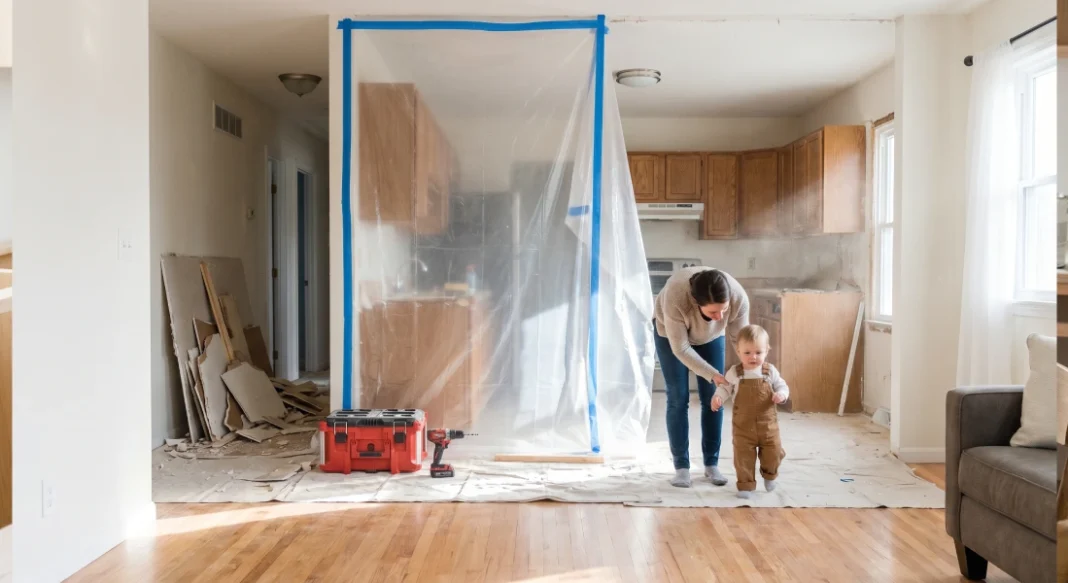
Your kitchen is mid-demo, plastic sheeting blocks the doorway, and your three-year-old has just vanished—this is the reality of childproofing your home during a renovation. Here’s how to take control. You find them poking at a pile of drywall dust near the bathroom.
This is not a worst-case scenario. This is a Tuesday for a lot of families who decide to live through a home renovation.
Yes, you can renovate with kids at home—but only if you plan ahead. Relying on ‘just keeping them away’ isn’t enough when power tools and toxic dust are involved. The real dangers aren’t always the obvious ones, like open stairwells or power tools left on the floor. The invisible ones — lead dust, volatile organic compounds (VOCs), asbestos fibers, and fine construction particles — are what most parents miss entirely.
This guide walks you through a practical, step-by-step plan to keep your children safe from the day demolition starts to the day the last contractor leaves.
Why Renovating With Kids at Home Is More Dangerous Than It Looks
Most parents think childproofing during a renovation means putting up a baby gate. That’s a start, but it’s a fraction of what’s actually needed.
Let’s be real: kids see construction zones as adventure zones. That new drill? It’s a toy to them. That open wall? An invitation to explore. Toddlers and infants are especially vulnerable because they spend a lot of time crawling on the ground, which puts them right at the level of fine dust and particles that settle on floors after construction work.
According to CDC Injury Center data (2023), nearly 2.3 million children are accidentally injured annually in the U.S., and home environments account for the majority of these incidents. An active renovation multiplies that risk significantly.
Beyond physical hazards, the chemical ones are real. Home renovations can expose mold, lead, asbestos, and fumes — all of which are harmful to children and pregnant people, whose developing systems are far more vulnerable to low-level exposure than adults.
Step 1 — Test First: Lead Paint, Asbestos, and Mold
Before anyone picks up a sledgehammer, you need to know what’s inside your walls.
Lead paint is the most urgent concern in older homes. Exposure to lead from disturbed or deteriorated lead paint is the single largest cause of childhood lead poisoning. Although lead-based paint was banned for consumer use in the U.S. in 1978, it remains in millions of structures. Even very low blood lead levels have been shown to reduce a child’s IQ and academic performance.
If your home was built before 1978, assume lead paint is present until proven otherwise. The EPA requires that renovation, repair, or painting projects that disturb lead-based paint in homes, child care facilities, and preschools built before 1978 be performed by Lead-Safe Certified contractors. Renovation and repair work that disturbs more than 6 square feet of lead paint — such as window replacement, interior remodeling, or surface preparation for painting — must be performed by a Lead-Safe Certified firm, with at least one worker on-site who is Renovator-Certified by the EPA. Ask contractors if they follow OSHA 1926.62 protocols for lead containment—this federal standard mandates specific engineering controls and worker training, signaling a higher safety commitment than EPA basics alone.
Always ask your contractor to show their EPA certification before work begins. Keep children and pregnant individuals out of any home undergoing lead-disturbing renovation. Only allow re-entry after a certified inspection confirms the space is hazard-free.
Asbestos is a separate concern. Asbestos can be found in vinyl flooring, ceiling tiles, textured paint, and coverings for hot water and steam pipes. If these materials are in good condition, they are generally safe — but when disturbed during remodeling, asbestos fibers released into the air can cause cancer. A certified asbestos contractor should be hired to handle removal.
Mold matters too. Mold can cause respiratory irritation, eye irritation, and wheezing — especially in children with allergies or asthma. If mold is uncovered during renovation, the source of moisture must be controlled, not just the visible growth.
Testing costs vary by region: a professional lead inspection typically runs $250–$400 for a single-family home in mid-cost U.S. markets (HomeAdvisor 2024 data). Asbestos testing averages $200–$800, depending on sample count. Always get local quotes. These are not optional expenses if you have young children in the house.
Step 2 — Contain the Work Zone Before Demolition Starts
Physical barriers between the construction area and living spaces are your primary line of defense. This needs to happen before work begins, not after the first wall comes down.
Use 6-mil polyethylene plastic sheeting to seal off doorways and vents connecting the work zone to the rest of the house. Tape it thoroughly — gaps let dust travel. Secure construction areas by locking doors or putting up physical barriers like plastic sheeting until work is complete.
Identify areas of your home that will be exposed to risks and block these off with signs, barriers, and tape. Let your household know about any potential risks, and make sure to keep children away from work areas at all times.
Practical containment measures:
- Use zipper-door containment kits (available at most hardware stores for $20–$50) for high-traffic doorways so contractors can pass through without breaking the seal
- Cover HVAC vents in the work zone with plastic to stop dust from traveling through ductwork
- Set up a dedicated entry/exit path for contractors that doesn’t run through the main family living areas
- Mist plastic sheeting with water before removal at the end of each day to prevent dust from becoming airborne again
Step 3 — Manage Dust and Air Quality Daily
Construction dust isn’t just a nuisance. Fine particulate matter from drywall, insulation, and old building materials irritates airways and can trigger asthma attacks in children.
Clean well during and after each work session to prevent construction dust from irritating allergies and asthma. Mopping with a wet mop is best. Don’t forget to clean vents, vent covers, ductwork, and radiators.
Keep the air moving: crack windows in safe rooms and run a HEPA air purifier where kids sleep. Stale, dusty air doesn’t just smell bad—it triggers asthma. Follow NIOSH guidelines for particulate matter: during active sanding or demolition, keep children out of adjacent rooms until air monitoring confirms levels are below recommended exposure limits.
At the end of each day, wipe down surfaces with a damp cloth and vacuum with a HEPA filter. Standard vacuums redistribute fine dust back into the air — a HEPA model captures particles down to 0.3 microns. Expect to spend $150–$400 for a reliable HEPA vacuum, or confirm that your contractor uses one. *See our Renovation Childproofing Checklist for daily air quality tasks.*
If renovation work involves painting, use a brand with low volatile organic compounds (VOCs) and ventilate thoroughly. Choose paints labeled CARB Phase 2 compliant or GreenGuard Gold certified—these meet the strictest standards for low chemical emissions, critical when children are breathing indoor air during renovation. Pregnant people should not be involved in any renovations that are really dusty or involve standard paint fumes.
Step 4 — Store Tools and Chemicals Every Night
One of the most preventable causes of child injury during renovation is tools and chemicals left accessible at the end of a workday.
End-of-day rule: before the kids come home or bedtime hits, unplug every tool, lock up chemicals, and sweep up hardware. No exceptions. Every chemical — paint thinner, adhesives, solvents, cleaning agents — goes into a locked cabinet or a locked contractor storage box.
Specific risks to address each evening:
- Power tools: Unplugged and stored, never left plugged in
- Extension cords: Coiled and placed out of reach, or taped along baseboards if they must remain
- Nails, screws, and hardware: Swept or collected — a nail in a toddler’s foot is an ER visit
- Chemicals and solvents: Locked storage, not just placed on a high shelf
- Ladders: Folded and stored flat against a wall or in a locked space — children climb anything accessible
Consider everything from power points and power leads, unused tools, handbags and tool belts, hot drinks, matches, and lighters as potential dangers to an adventurous child, particularly those under five.
Place dangerous items in locked or childproof cabinets with safety latches. Pay special attention to small objects that could be choking hazards, dangerous chemicals, cleaning supplies, and medications.
Step 5 — Create a Safe Zone That Kids Actually Stay In
This is where planning meets reality. Keeping children out of work zones is only sustainable if you give them somewhere worth staying.
Decide on one room that will be left to last and make that the child’s zone. Make it engaging — install their books, toys, and TV, and fit a safety gate to keep them out of harm’s way. Factor in a quiet place to nap or sleep, too.
That room should be:
- As far from the active work zone as possible
- Sealed from renovation dust with door sweeps or draft stoppers
- Stocked with everything they need, so there’s no reason to wander
- Checked daily for any dust or debris that may have migrated in
If you have a yard, create a contained outdoor play space away from excavations, construction, cars, and roads.
Install hardware-mounted safety gates (ASTM F1004-certified, like the KidCo Auto-Stop) at stairways—they resist climbing better than pressure-mounted options. For temporary doorways, a pressure-mounted gate like the Regalo Easy Step works well. Make sure these are not climbable — children will attempt to scale anything they can get purchase on.
Step 6 — Phase the Work Around How Your Family Lives
Smart phasing reduces the time your children are exposed to hazards and keeps the home functional throughout the project.
The general rule: renovate rooms you use least first, rooms you use most last. Don’t gut the kitchen and the main bathroom simultaneously unless you have a clear temporary plan for both.
A practical phasing approach:
- Start with secondary bedrooms or storage areas — low family impact, good way to identify hidden hazards like mold or lead before tackling main spaces
- Avoid simultaneous work in multiple rooms — dust and chemical exposure multiply quickly when more than one space is open
- Keep the children’s bedroom and bathrooms operational for as long as possible
- Schedule the noisiest, dustiest work (demolition, sanding, drywall) during school hours or when children can be out of the house
- Plan for kitchen and bathroom renovations back-to-back so you have interim eating and washing solutions ready in advance
Talk to your contractor about daily work windows. Setting firm start and end times — say, 7 am to 4 pm — gives you time to air out, clean up, and inspect before your children come home or go to bed.
When You Should Temporarily Leave the Home
Sometimes the right answer is not to stay.
For major structural work, full gut renovations, or any project confirmed to involve lead or asbestos removal, seriously consider a temporary relocation. Keep children and pregnant individuals out of any home undergoing lead-disturbing renovation. Only allow re-entry after a certified inspection confirms the space is hazard-free.
Temporary relocation costs vary widely:
- Staying with family: $0
- Short-term rental or Airbnb: $80–$200/night, depending on location and size
- Extended-stay hotel (weekly rate): $600–$1,500/week
For a two-week kitchen or bathroom gut renovation, budget $1,500–$4,000 for temporary housing if you’re in a mid-cost city. This is a real cost to build into your renovation budget — not an afterthought.
If you cannot leave, at a minimum, ensure children are away from the house during active demolition, sanding, and surface-disturbing work, and do not return until that day’s work area has been sealed and cleaned.
Renovation Childproofing Checklist
Use this before, during, and at the end of each workday.
Before Work Starts:
- Test for lead paint (homes pre-1978)
- Test for asbestos (homes pre-1986)
- Check for mold before opening walls
- Verify contractor’s EPA Lead-Safe Certification
- Seal work zone with plastic sheeting and tape
- Cover HVAC vents in the work zone
- Establish a child-safe zone in a separate part of the home
- Install safety gates on all access points to work areas
Daily During Work:
- Confirm barriers are intact each morning before work begins
- Wet-mop or HEPA-vacuum affected areas at the end of each session
- Store all tools and chemicals before the family occupies the space
- Wipe down hard surfaces in the child-safe zone
- Check that safety gates and barriers are still in place
- Ventilate work zone and adjacent rooms
When Hiring Contractors:
- Ask for EPA Lead-Safe Certification documentation
- Set firm daily work hours in the contract
- Confirm HEPA vacuums will be used on-site
- Confirm containment and cleanup procedures are included in scope
- Get asbestos/lead test documentation in writing if those materials were removed
FAQs
Q. Should kids stay home during a renovation?
It depends on the scope. For minor cosmetic work like painting or flooring in one room with good containment, children can stay in a different part of the house. For anything involving demolition, lead paint disturbance, or asbestos removal, children should not be in the home during active work and should only return after a proper clean-up and inspection.
Q. How dangerous is renovation dust for children?
Very. Fine construction dust irritates airways and can trigger asthma attacks. In older homes, dust may contain lead — and there is no safe blood lead level for children. Even low-level exposure is linked to reduced IQ and learning problems. HEPA filtration and daily wet-mopping are non-negotiable, not optional extras.
Q. What is the EPA lead paint rule for renovations?
The EPA’s Renovation, Repair, and Painting (RRP) Rule requires that any renovation work disturbing more than 6 square feet of paint in a pre-1978 home be performed by a Lead-Safe Certified firm with at least one Renovator-Certified worker on-site. Always ask your contractor for their EPA certification before work starts.
Q. Do I need to test for lead before renovating?
Testing is not legally required, but if lead is not proven absent, contractors must assume it is present and follow all RRP protocols. Testing before the job starts is the smarter and often cheaper approach — it defines exactly where full containment is needed.
Q. At what age is one most at risk from renovation hazards?
Children under five are the most vulnerable. They crawl on floors, put their hands in their mouths, and have developing nervous systems that are far more sensitive to lead, VOCs, and fine particulate matter than older children or adults.
Q. How do I store tools safely with children in the house?
Every power tool should be unplugged and stored at the end of each workday — not left plugged in “out of reach.” Chemicals go in locked containers. Hardware like screws and nails should be swept up, not left loose on the floor. Ladders must be folded and placed flat against a wall or locked away.
Q. How do I contain dust during a remodel?
Use 6-mil plastic sheeting to seal doorways and cover HVAC vents in the work zone. Zipper-door containment kits ($20–$50) make it easier for contractors to pass through without breaking the seal. Wet-mop daily, use a HEPA vacuum, and mist plastic sheeting before removing it to stop dust from going airborne.