You’re driving home on a normal evening when you hear it — a sharp, high-pitched squeal every time you press the brake pedal. You ignore it for a day, maybe two. Then it turns into a low grinding sound. That grinding sound is money leaving your account, and more importantly, it’s your safety margin shrinking.
Brake pads are one of the most replaced parts on any car, but they’re also one of the most ignored until the problem becomes expensive or dangerous. This guide explains exactly what to look for, what it costs, and how long you can realistically wait before it becomes urgent.
What Brake Pads Actually Do
Every time you press the brake pedal, a hydraulic system pushes brake calipers to clamp brake pads against a spinning metal disc (the rotor). The friction between the pad and the rotor is what slows the car down. That friction generates intense heat, and over time, it wears the pad material down.
Most brake pads start at around 10–12mm of friction material. At 3mm, replacement is recommended. At 1–2mm, it’s an emergency.
7 Warning Signs Your Brake Pads Need Replacement
1. Squealing or Screeching Noise
This is the most common early warning. Brake pad manufacturers build a small metal wear indicator into the pad. When the friction material wears thin enough, this metal tab makes contact with the rotor and produces a high-pitched squeal.
It’s deliberately annoying — that’s the point. If you hear it consistently when braking, especially in dry conditions, book a check immediately. Don’t wait for it to “go away on its own,” because it won’t.
2. Grinding Metal-on-Metal Sound
If squealing has progressed to a deep grinding or growling noise, the friction material is fully gone. The metal backing plate of the brake pad is now rubbing directly against the rotor. At this stage, you’re damaging the rotor with every stop, turning a Rs. 3,000–5,000 pad job into a Rs. 15,000–25,000+ rotor replacement as well.
This is an urgent situation. Do not delay.
3. Longer Stopping Distance
If your car takes noticeably longer to stop than it used to — especially at highway speeds — worn brake pads are the most likely cause. Reduced friction material means reduced stopping power. In an emergency stop, that extra half-second of distance can be the difference between a near-miss and an accident.
4. Brake Pedal Feels Soft or Spongy
A soft pedal that requires more pressure than usual, or one that sinks closer to the floor before braking takes effect, often points to worn pads or low brake fluid. Both are serious. If the pedal feels mushy, don’t assume it’ll firm up — get the car inspected that day.
5. Car Pulling to One Side While Braking
If the car drifts left or right when you brake, one side’s pads are likely more worn than the other. This uneven wear creates unequal friction, pulling the car toward the side with more braking force. It can also point to a seized caliper. Either way, it’s a safety issue and a wheel alignment problem waiting to happen.
6. Vibration or Pulsing When Braking
Brake pads that have worn unevenly, or have deposited friction material unevenly onto the rotor, cause the pedal or steering wheel to vibrate when braking. This is often paired with rotor damage (warping) and signals that the window for a “pads only” fix may already be closed.
7. Visual Inspection: Pad Thickness Below 3mm
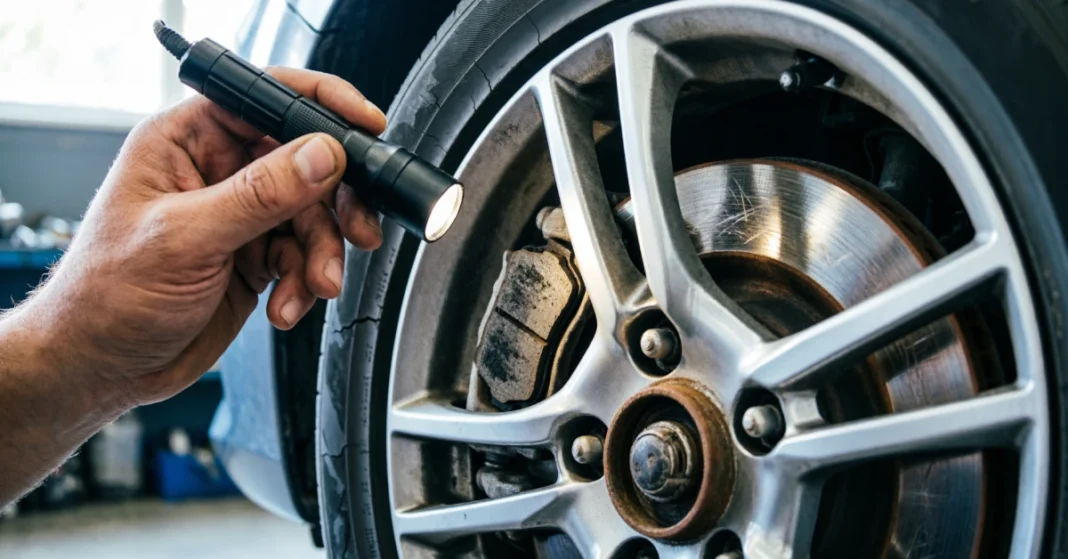
On most cars with alloy wheels, you can see the brake pad through the wheel spokes without removing the wheel. The pad should be pressed against the rotor. If the pad’s friction material appears very thin — less than the thickness of a few coins stacked together — it’s time to replace it.
Many service intervals include a brake inspection. If yours doesn’t, ask for one every 10,000–15,000 km.
How Long Do Brake Pads Last?
There’s no single answer, because driving style and conditions matter more than time or distance alone. That said, here are realistic ranges:
- City driving (stop-and-go traffic): 25,000–40,000 km
- Mixed city and highway: 40,000–60,000 km
- Mostly highway driving: 60,000–80,000 km
Aggressive braking, overloading the vehicle, towing, and driving in hilly terrain all accelerate wear significantly. Budget pads also wear faster than quality ones, which is worth remembering at purchase time.
Rear brake pads typically last longer than front ones. Most braking force — roughly 60–70% on a standard car — goes through the front axle, so the front pads wear down faster.
Brake Pad Replacement Cost: What to Expect
Costs vary by city, vehicle type, and whether you choose dealer or independent service. Here’s a realistic breakdown for the Pakistani market, though the logic applies broadly.
Cost by Vehicle Type
| Vehicle Type | Pad Cost (Parts) | Labour | Total Estimate |
|---|---|---|---|
| Small hatchback (Alto, Mehran) | Rs. 1,500–3,000 | Rs. 1,000–1,500 | Rs. 2,500–4,500 |
| Mid-size sedan (Corolla, Civic) | Rs. 3,000–6,000 | Rs. 1,500–2,500 | Rs. 4,500–8,500 |
| SUV / crossover (Fortuner, Tucson) | Rs. 6,000–14,000 | Rs. 2,000–4,000 | Rs. 8,000–18,000 |
| Luxury / imported vehicles | Rs. 15,000–40,000+ | Rs. 3,000–8,000 | Rs. 18,000–48,000+ |
Note: These are estimates as of 2024–2025. Prices shift with import costs and rupee fluctuations. Always get a written quote.
Dealer vs. Independent Workshop
Dealerships charge 30–50% more on average for the same job. The trade-off is that they use OEM (original equipment manufacturer) parts and provide documented service history, which matters for warranty claims and resale value.
Independent mechanics with a solid reputation can do the same job for significantly less using quality aftermarket parts. The risk is parts quality — some use the cheapest available, which may last half as long.
A practical middle ground: use a trusted independent mechanic, but specify the brand of pad you want installed rather than leaving it up to them.
Parts Cost: Organic vs. Semi-Metallic vs. Ceramic
- Organic pads — cheapest, quieter, softer on rotors, but wear faster. Fine for light city use.
- Semi-metallic pads — more durable, better heat handling, slightly noisier. Good all-rounder for mixed driving.
- Ceramic pads — most expensive, very quiet, long lifespan, low dust. Worth it for SUVs, heavier vehicles, or drivers who want less frequent servicing.
Don’t default to the cheapest option. A Rs. 1,500 pad that wears out in 20,000 km costs more over time than a Rs. 4,000 ceramic pad lasting 60,000 km.
Front vs. Rear Brake Pads — Do You Replace Both?
You should replace both pads on the same axle at the same time — meaning both front left and front right together, or both rear pads together. This ensures even braking force on that axle and prevents the pulling problem described earlier.
You do not need to replace front and rear pads simultaneously unless both are worn. Have a mechanic check all four and replace what’s needed. Replacing pads that still have life left is unnecessary spending.
When Is It Urgent?
Replace within the week:
- Consistent squealing noise in dry conditions
- Visual pad thickness at or below 3mm
- Brake pad warning light on dashboard (many modern cars have this sensor)
Replace today — do not drive far:
- Grinding or metal-on-metal sound
- Pedal travel significantly increased or pedal feels spongy
- Car pulling hard to one side under braking
Park the car and get it towed:
- Complete loss of braking response
- Brake fluid warning light along with soft pedal
- Smoking from wheel area after normal driving
The cost of ignoring worn brakes compounds fast. Damaged rotors cost 3–5x more to fix than pads alone. And a brake failure at speed is a different category of consequence entirely.
DIY or Professional Replacement?
Brake pad replacement is technically straightforward — it’s one of the more accessible DIY jobs on a car. You need a car jack, jack stands, a C-clamp or caliper piston tool, basic sockets, and about 2–3 hours.
However, it’s not a task for guesswork. Mistakes with brake assembly — forgetting to lubricate the caliper slides, incorrectly retracting the piston, or not bedding in the new pads — create exactly the symptoms you were trying to fix.
Go DIY if:
- You’ve done it before or have guidance from someone who has
- You have the right tools including a torque wrench
- You can verify rotor condition yourself
Go professional if:
- It’s your first time
- The rotor may also need attention
- You drive a newer car under warranty
For most people, professional replacement at a trusted independent workshop is the better call given the safety stakes.
Tips to Make Brake Pads Last Longer
- Brake earlier and more gently. Hard, last-second braking generates much more heat and wear than gradual deceleration from a distance.
- Engine braking on descents. Downshift on long downhill stretches instead of riding the brakes. This is especially relevant for hilly cities and mountain roads.
- Reduce unnecessary weight. A car loaded with 200kg of extra weight brakes harder and wears pads faster on every stop.
- Don’t drag the brake pedal. Resting your foot lightly on the pedal while driving applies slight continuous pressure, heating the pads and rotors without actually stopping anything.
- Check brake fluid annually. Old, moisture-contaminated fluid reduces hydraulic efficiency, making the system work harder.
FAQs
Can I drive with worn brake pads?
Short distances to a nearby workshop, yes. Daily commuting or highway driving, no. The risk to your rotors and your safety increases with every kilometer.
How do I know if it’s pads or rotors?
Squealing usually means pads. Grinding usually means both. Vibration under braking typically means rotor damage. A mechanic can confirm by inspecting pad thickness and rotor surface during the same visit.
Should I replace all four brake pads at once?
Only if all four are worn. Replace by axle (both fronts or both rears together), not necessarily all four at once.
Are ceramic pads worth the extra cost?
For SUVs, heavier vehicles, or anyone who wants longer intervals between services — yes. For a small city hatchback with moderate use, semi-metallic pads are sufficient.
How long does brake pad replacement take?
At a competent workshop, 45 minutes to 1.5 hours for a standard two-axle job. Add 30 minutes if rotors need resurfacing or replacement.