You turn the key. The engine groans, struggles, and barely catches. Or worse — nothing happens at all. You’re late, stuck in a parking lot, and suddenly realize you ignored those bad car battery signs your car had been sending for weeks.
Your battery rarely quits on you without sending warning signs first—you just need to know what to listen for. The problem is that most drivers don’t know what to look for until it’s too late.
Below, you’ll find the 7 most common bad car battery signs—plus the science behind each symptom and the exact steps to take before your car leaves you stranded.
Here are the 7 bad car battery signs that demand attention: slow engine cranking, dim/flickering headlights, dashboard battery warning light, rapid clicking when turning the key, erratic electrical accessories, a swollen battery case, and age beyond 3–5 years.
Why Catching Battery Problems Early Matters
Car batteries don’t die at a convenient time. They fail in extreme heat, in cold weather, or in the middle of nowhere. Most standard lead-acid batteries last 3 to 5 years (AGM types can reach 6–7), but expect that lifespan to shrink fast if you mostly take short trips, park in hot sun, or leave accessories drawing power overnight.
The good news: a failing battery gives you signals before it completely quits. You just need to recognize them.
7 Bad Car Battery Signs You Shouldn’t Ignore
1. The Engine Cranks Slowly When You Start the Car
This is the most obvious sign of battery failure symptoms. When you turn the ignition, the starter motor pulls a large burst of current from the battery. A healthy battery delivers that instantly. A weak battery struggles.
You’ll hear the engine turning over slower than normal — almost like it’s fighting to start. In cold weather, this gets worse because a cold battery loses up to 30–40% of its cranking power. Check your battery’s Cold Cranking Amps (CCA) rating—this spec measures starting power at 0°F. If your battery’s CCA has dropped below 75% of its original rating, replacement is likely due.
What to do: Get the battery tested immediately. A slow crank that starts fine after a few tries means the battery is near the end. Don’t wait.
2. Dim or Flickering Headlights
Your headlights run directly off the battery and alternator. When the battery is weak, it can’t maintain steady voltage — especially when other systems are drawing power at the same time (AC, radio, rear defroster).
Dim headlights at idle that get brighter when you rev the engine is a classic sign. Flickering headlights are slightly more urgent — that’s inconsistent voltage delivery, which means the battery is struggling to hold a charge.
What to do: If headlights are dim consistently, don’t assume it’s just a bulb. Check the battery voltage first.
3. The Battery Warning Light Comes On
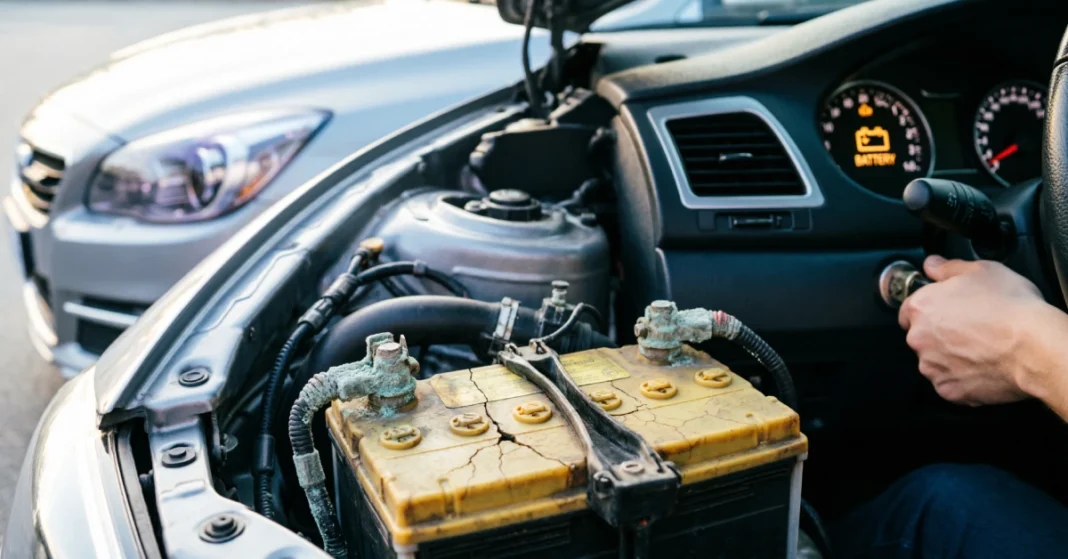
The battery light on your dashboard doesn’t always mean the battery itself is bad — but it always means something in the charging system is wrong. It could be the battery, the alternator, or a loose connection.
Most cars show this as a rectangle with a + and – symbol. When it lights up while driving (not just at startup), the system isn’t charging properly. You might have 20–30 minutes of driving time before the car loses power entirely.
What to do: Don’t ignore this and drive anyway. Pull over safely, check for obvious issues like a loose belt, and get it tested the same day.
4. A Clicking Sound When You Turn the Key
If you turn the key and hear a rapid clicking — but the engine doesn’t start — the battery doesn’t have enough charge to power the starter motor. One slow click usually means the starter is the problem. Rapid clicking almost always points to a weak battery.
This is the most common car-not-starting scenario drivers experience. It’s easy to confuse it with a starter or solenoid issue, but the pattern matters: rapid clicking = battery, single heavy click = starter.
What to do: Jump-start the car. If it starts fine after a jump and dies again shortly after, the battery can’t hold a charge and needs replacement — not just a recharge.
5. Electrical Accessories Acting Strange
Modern cars run almost everything through the battery — windows, mirrors, infotainment, seat adjusters, door locks. When the battery weakens, these systems start behaving oddly. Windows roll slower. The screen flickers or resets. The radio cuts out.
This happens because a low-voltage battery can’t supply consistent power to multiple systems at once. Some cars will even show random error messages or warning lights on the cluster that disappear after a restart.
What to do: If multiple electrical issues appear together with no obvious cause, battery voltage is the first thing to check. Don’t let a mechanic chase individual electrical faults without ruling out the battery first. If voltage checks out but drains persist, request a parasitic drain test—this diagnostic isolates accessories drawing power when the car is off, pinpointing faults like a stuck glovebox light or aftermarket module.
6. The Battery Case Looks Swollen or Bloated
A physically swollen battery is a serious warning sign. It’s caused by excessive heat, overcharging, or internal chemical failure. The battery case should be rectangular and flat on all sides. If any side looks bloated or rounded outward, the battery is damaged internally.
A swollen battery can leak acid, corrode surrounding components, and in rare cases, rupture. It will not recover — no amount of charging fixes this.
What to do: Replace it immediately. Don’t drive with a visibly swollen battery. Also, check what caused it — chronic overcharging usually points to a faulty alternator or voltage regulator.
7. Your Battery Is 3–5 Years Old or More
Age alone isn’t a symptom, but it’s the most overlooked factor. A battery that’s 4 years old and showing any of the above signs is almost certainly near failure. Even a battery with no obvious symptoms but past the 5-year mark is a risk.
Heat is the biggest killer of car batteries in countries like Pakistan. High summer temperatures accelerate internal corrosion and water loss from the electrolyte. A battery that might last 5 years in a cooler climate may last only 2–3 years in consistent heat.
What to do: If your battery is over 3 years old, have it load-tested once a year. This costs nothing at most auto parts shops and tells you the actual health of the battery — not just the voltage.
Battery vs. Alternator Failure: How to Diagnose the Real Culprit
Confusing battery failure with alternator problems is costly. Here’s how to pinpoint which component is failing—before you waste money on the wrong repair.
- Battery problem: Car struggles to start but runs fine once started. Symptoms are worse after the car sits overnight or in the cold.
- Alternator problem: The car starts fine, but dies while driving. The battery warning light comes on while the engine is running. Headlights get dimmer as you drive.
A simple test: jump-start the car, then disconnect the jumper cables while the engine is running. If the car dies immediately, the alternator isn’t charging the battery. If it keeps running, the alternator is likely fine, and the battery is the culprit.
Before you swap in a new battery, have the alternator tested too—a faulty alternator can drain a fresh battery in just a few days, wasting your money and time.
What to Do When You Spot These Signs
- Test the battery voltage with a multimeter — a healthy battery reads 12.4–12.7 volts at rest. Below 12.2V is a concern.
- Get a load test — voltage alone doesn’t tell the full story. A load test checks how the battery performs under real starting conditions.
- Check the terminals — corroded or loose terminals cause many of the same symptoms as a bad battery. Clean them with a wire brush, then apply a thin layer of dielectric grease to block moisture and prevent oxidation—this simple step extends terminal life and ensures reliable electrical contact.
- Jump-start and observe — if the car won’t restart after sitting for a few hours post-jump, the battery isn’t holding a charge.
- Replace if needed — don’t recharge a battery that has failed a load test. It will fail again, usually at the worst possible time.
Pro tip: For vehicles driven less than twice weekly, connect a smart battery maintainer (like a Battery Tender®) when parked—it automatically prevents discharge without overcharging, extending battery life in storage.
How Much Does a Car Battery Replacement Cost?
Prices vary by battery type, vehicle requirements, and region. Below are typical ranges for Pakistan and the USA—including what you gain with premium options:
| Battery Type | Pakistan (PKR) | USA (USD) |
|---|---|---|
| Standard Lead-Acid | 8,000 – 15,000 | $80 – $120 |
| AGM Battery | 18,000 – 28,000 | $150 – $250 |
| Premium (Bosch, Exide) | 20,000 – 35,000 | $180 – $280 |
Labor for battery replacement is usually minimal — most mechanics charge PKR 500–1,000 or nothing if you buy from them. AGM batteries cost more but last longer and handle deep discharge better. When comparing prices, factor in warranty coverage: standard batteries typically include 2–3 years of free replacement, while premium AGM options often extend to 4 years—critical protection if heat shortens lifespan in your region.
FAQs
Q. What’s the average lifespan of a car battery in hot climates like Pakistan?
Most standard batteries last 3–5 years. AGM batteries can reach 6–7. Hot climates shorten this significantly.
Q. Can I recharge a dead battery instead of replacing it?
If the battery has failed a load test, recharging it is a temporary fix at best. A battery that can’t hold a charge under load needs replacement.
Q. Does a bad battery damage the alternator?
Yes. A severely discharged battery forces the alternator to work harder to compensate, which can shorten alternator life over time.
Q. What’s the easiest way to test a car battery at home without special tools?
Use a multimeter set to DC voltage. Touch the red probe to the positive terminal and the black to the negative. 12.6V = fully charged. Below 12.0V = likely dead. For a proper health check, you need a load tester.
A car battery gives you plenty of warning before it dies — slow cranks, dim lights, odd electrical behavior, a swollen case. Most drivers miss these signs because they’re easy to dismiss as minor inconveniences.
Catch any two of these signs together and treat it as a confirmed problem, not a maybe. Get the battery tested, check the alternator, and replace it before it strands you somewhere inconvenient.
If you spot two or more of these bad car battery signs, don’t wait. Visit a trusted auto parts store for a free battery and alternator test today—most take under 10 minutes. Spending on a new battery now costs far less than a midnight tow truck call—or the hours you’ll lose waiting for help with a dead car.