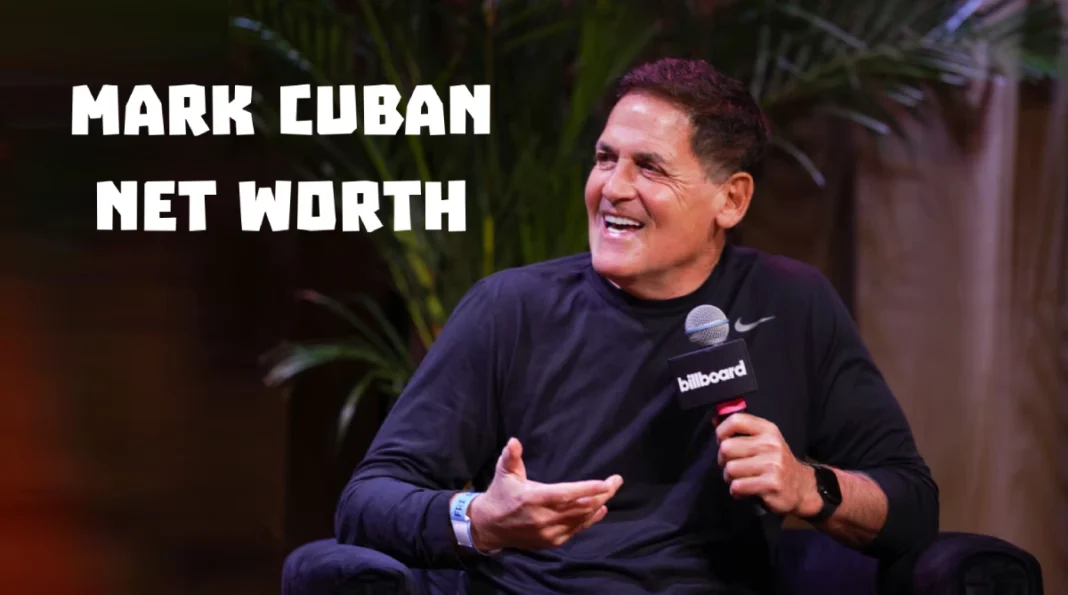
Mark Cuban’s net worth sits at approximately $6 billion, according to Forbes. His path to that number is anything but a straight line — and the story of how he got there is more instructive than the number itself.
Cuban sold a company for $5.7 billion at the peak of the dot-com boom, bought an NBA team, built a pharmaceutical startup from a cold email, and walked away from Uber at a $10 million valuation. This article covers all of it — the wins, the misses, the legal battles, and the financial logic behind why his net worth hasn’t grown as fast as many people expect.
Mark Cuban Net Worth: Quick Snapshot
Cuban’s wealth comes from several sources that have compounded over 25+ years:
- Sale of Broadcast.com to Yahoo for $5.7 billion in stock (1999)
- Long-term ownership and eventual sale of the Dallas Mavericks for approximately $3.5 billion (2023)
- Shark Tank investments and appearance fees since 2011
- Cost Plus Drugs, a generic pharmacy startup, launched in 2022
- Minority stakes in tech companies, media properties, and private ventures
Forbes estimates Mark Cuban’s net worth at approximately $6 billion as of early 2026. Bloomberg’s Billionaires Index places it in the $5.7–$6 billion range, with slight fluctuations due to tech and private investments.
Early Life and Education
Mark Cuban was born on July 31, 1958, in Pittsburgh, Pennsylvania. His father, Norton Cuban, was an automobile upholsterer. He grew up in Mt. Lebanon, a working-class suburb of Pittsburgh, in a Jewish family — his paternal grandfather had changed the family surname from Chabenisky to Cuban after emigrating from the Russian Empire through Ellis Island.
Cuban showed an entrepreneurial instinct early. At 12, he sold garbage bags door-to-door to buy a pair of expensive basketball shoes. At 16, he ran newspapers from Cleveland to Pittsburgh during a Pittsburgh Post-Gazette strike, spotting a supply gap and filling it.
Instead of completing his senior year of high school, he enrolled early as a full-time student at the University of Pittsburgh, then transferred to Indiana University’s Kelley School of Business in Bloomington — not because of its ranking, but because it had the lowest tuition on his top-ten list. While there, he ran a bar, gave disco dance lessons, and operated a chain-letter scheme to cover expenses. He graduated in 1981 with a Bachelor of Science in management.
MicroSolutions: The First Company
After graduating, Cuban returned briefly to Pittsburgh for a job at Mellon Bank, then moved to Dallas in 1982. He found work as a salesperson at Your Business Software, one of the earliest PC software retailers in Dallas. He was fired less than a year later — for taking a client to a meeting to close new business instead of opening the store.
That firing became the foundation. Cuban co-founded MicroSolutions in 1983 with support from some of the same clients he had been working with at his previous job. The company operated as a systems integrator and software reseller, and grew to over $30 million in annual revenue. One of its largest clients was Perot Systems.
In 1990, he sold MicroSolutions to CompuServe — then a subsidiary of H&R Block — for $6 million. After taxes, Cuban walked away with roughly $2 million. That was his first millionaire moment.
Broadcast.com and the Billion-Dollar Sale
Cuban’s defining financial move came through a company he did not actually found. Audionet was created in 1989 by Chris Jaeb, who retained a 10% stake. In 1995, Cuban and fellow Indiana University alumnus Todd Wagner joined the company, combining their interest in webcasting Indiana Hoosiers basketball games with a single server and an ISDN internet line.
The company was renamed Broadcast.com in 1998. By 1999, it had grown to 330 employees and $13.5 million in quarterly revenue. That same year, Broadcast.com helped produce the first-ever live-streamed Victoria’s Secret Fashion Show — one of the defining internet moments of the era.
At the peak of the dot-com bubble in 1999, Yahoo acquired Broadcast.com for $5.7 billion in Yahoo stock. Cuban knew the market was inflated. He used put options to hedge his Yahoo stock position — protecting his wealth against a price drop. That decision saved him. When the dot-com bubble burst shortly after, Yahoo’s stock collapsed, and Broadcast.com was discontinued within a few years. Yahoo’s purchase is now widely considered one of the worst internet acquisitions of all time.
After hedging and taxes, Cuban was left with approximately $1.5 billion in usable capital. He was 41 years old.
Dallas Mavericks: Ownership and Sale
In January 2000, Cuban paid $285 million to buy a majority stake in the Dallas Mavericks from H. Ross Perot Jr. At the time, the Mavericks had won only 40% of their games in the previous two decades and had a playoff record of 21–32.
Cuban’s approach to ownership was unusual. While most NBA owners watched from skyboxes, Cuban sat in the lower bowl wearing team jerseys. He invested in player facilities, upgraded the fan experience, and became known for publicly criticizing NBA referees — a habit that earned him over $1.665 million in fines across 13 documented incidents. In one of the more colorful episodes, he said the league’s manager of officials “wouldn’t be able to manage a Dairy Queen,” prompting the chain to invite him to actually run a Dairy Queen for a day. He accepted.
The on-court results followed. In the 10 years after Cuban bought the team, the Mavericks won 69% of their regular-season games and made the playoffs every season but one. They won their first NBA Championship in 2011, defeating the Miami Heat. In 2011, H. Ross Perot Jr. — who retained 5% ownership — filed a lawsuit claiming the franchise was insolvent. The case was dismissed after the championship victory.
In December 2023, the NBA approved the sale of a 73% controlling interest in the Mavericks to Miriam Adelson and Patrick Dumont for approximately $3.5 billion. Cuban retained a minority stake and control of basketball operations. In March 2026, Cuban said publicly that he did not regret selling, but added, “I regret who I sold to. I made a lot of mistakes in the process, and I’ll leave it at that.”
Shark Tank
Cuban joined the ABC reality program Shark Tank in season two (2011) and became a regular investor through season 16. He announced his departure from the show in November 2023.
As of 2015, Cuban had invested in 85 deals across 111 episodes for a total of approximately $19.9 million. His three largest individual deals were Ten Thirty One Productions (Halloween entertainment), Rugged Maniac Obstacle Race, and BeatBox Beverages. In 2022, Cuban stated publicly that his Shark Tank portfolio as a whole had made a net loss, saying simply: “I’ve gotten beat.”
During his tenure, the show won four Primetime Emmy Awards for Outstanding Structured Reality Program (2014–2017), plus two additional Emmy awards before that category existed. Cuban entered Shark Tank as its wealthiest investor ($2.8B net worth in 2011) and remained the highest-net-worth regular shark through season 14.
Cost Plus Drugs: A Pharmacy Built From a Cold Email
Cost Plus Drugs started with a cold email—from radiologist Alex Oshmyansky to Mark Cuban. Cuban didn’t pitch the idea; he recognized it. In January 2022, he launched the company after receiving a cold email from Alex Oshmyansky, a radiologist who pitched the concept of a transparent, direct-to-consumer online pharmacy for generic medications.
The company charges just 15% above manufacturing cost plus pharmacy fees. It does not accept insurance — but its prices are frequently lower than insurance copays. Cuban has framed Cost Plus Drugs as a direct critique of pharmacy benefit managers and the broader US healthcare pricing structure, offering transparent pricing instead of the layered markups most patients never see.
In 2025, Cost Plus Drugs announced partnerships with both TrumpRx and Humana, significantly expanding its potential reach. While not yet Cuban’s most profitable business, it is arguably his most visible recent venture — and the one he says gives him the most satisfaction.
Key Startup Investments
The Red Swoosh / Uber Story
In 2005, Cuban invested $1.7 million in Red Swoosh, a file-sharing company co-founded by Travis Kalanick. Akamai acquired Red Swoosh for $19 million in 2007. In 2009, Kalanick approached Cuban again — this time to invest in his next venture, Uber, at a $10 million valuation. Cuban countered at a $5 million valuation. He never heard back. Uber’s eventual valuation reached over $80 billion.
Other Notable Investments
Cuban’s broader portfolio spans many sectors. Through 2929 Entertainment — his media company co-founded with Todd Wagner — he owns Magnolia Pictures and Landmark Theatres (a 58-location arthouse cinema chain acquired in 2003). AXS TV (formerly HDNet) launched in 2001 as one of the first HD cable networks.
Additional investments include:
- IceRocket (a blog search engine)
- Weblogs Inc. (acquired by AOL)
- ZenBusiness (a $200 million Series C round in 2021)
- Veldskoen Shoes (acquired 50% of the US business in 2019 alongside Ashton Kutcher)
- Injective Protocol (a blockchain protocol).
In 2021, Cuban also purchased the entire town of Mustang, Texas — 77 acres in Navarro County — saying he was not sure what, if anything, he would do with it.
He invested in cryptocurrency, including Dogecoin, and accepted both Bitcoin and Dogecoin as payment for Mavericks tickets and merchandise. In September 2023, Cuban’s MetaMask wallet was drained by scammers, resulting in a loss of approximately $870,000 in tokens.
Failed Sports Acquisition Attempts
Cuban has repeatedly sought to expand his sports portfolio beyond basketball — with limited success. He submitted a $1.3 billion bid for the Chicago Cubs in 2008, but was eliminated before the final round. He bid approximately $600 million for the Texas Rangers in 2010 but lost the deal. He placed an initial bid for the Los Angeles Dodgers in 2012 but dropped out when bidding exceeded what he considered the franchise’s rational value.
He also expressed interest in the New York Mets and tried unsuccessfully to buy his hometown Pittsburgh Pirates in 2005. In 2006, he joined a group including Dan Marino and attempted to acquire the NHL’s Pittsburgh Penguins — rejected when team owners Mario Lemieux and Ronald Burkle took the offer. In 2015, Cuban invested in the esports betting platform Unikrn, and in 2016, he purchased a principal ownership stake in the Professional Futsal League.
Real Estate and Personal Assets
Cuban’s main residence is a 24,000-square-foot mansion in the Preston Hollow neighborhood of Dallas, purchased in 1999 for approximately $13 million. He also owns an oceanfront vacation home in Laguna Beach, California — purchased in 2018 for approximately $19 million — spanning over 7,800 square feet.
He owns a Gulfstream V private jet, purchased online in October 1999 for $40 million. That transaction earned a Guinness World Record for the largest single e-commerce transaction at the time.
Why Hasn’t Mark Cuban’s Wealth Grown More?
This is a legitimate question. Cuban received roughly $1.5 billion in usable capital after the Broadcast.com sale in 1999. If he had invested that amount in an S&P 500 index fund returning a historical average of ~10% per year, the math looks like this:
$1.5 billion × (1.10)²⁴ ≈ $15.6 billion
That is more than double his current net worth. The gap exists for several reasons. Cuban concentrated capital in non-indexed, illiquid assets — sports franchises, private startups, media properties, real estate — which are harder to exit and rarely compound at index-fund rates. The Mavericks’ sale generated roughly $3.5 billion in 2023, but that capital was tied up for 23 years. Many of his startup investments failed outright. His Shark Tank portfolio, by his own admission, has made a net loss.
This does not mean his strategy was wrong. His ownership of the Mavericks generated significant brand value, personal satisfaction, and non-financial returns. Cost Plus Drugs may turn out to be a major asset over the next decade. But for anyone studying compounding, Cuban’s trajectory is a clear illustration that active investing in private companies routinely underperforms passive index investing — especially when the investor also spends significant capital on fines, lifestyle, and failed acquisitions.
Legal Issues and Controversies
SEC Insider Trading Case
In November 2008, the US Securities and Exchange Commission filed a civil suit against Cuban, alleging insider trading in the shares of Mamma.com (now Copernic). The SEC alleged that Cuban sold his stake after receiving confidential information about an upcoming stock dilution — avoiding a $750,000 loss. Cuban denied agreeing to keep the information confidential and called the investigation “a product of gross abuse of prosecutorial discretion” on his blog.
A federal district court initially dismissed the charges in 2009. The SEC appealed. In September 2010, an appeals court reversed the dismissal and sent the case back for trial. On October 16, 2013, a federal jury in Texas found in Cuban’s favor after deliberating for three and a half hours.
NBA Fines
Cuban has been fined by the NBA at least $1.665 million across 13 documented incidents — primarily for criticizing referees and league management. Notable fines include $250,000 after the 2006 NBA Finals, $100,000 for comments about LeBron James in 2010, and $600,000 in 2018 for publicly suggesting the Mavericks should tank for the remainder of the season. Commissioner Adam Silver called that last fine a sanction for “public statements detrimental to the NBA.” Cuban’s standard practice was to match each fine with an equal charitable donation.
Sexual Harassment Allegation
In March 2018, Willamette Week reported an alleged incident from April 2011 involving Cuban and a woman at a bar in Portland, Oregon. The woman reported to Portland police that Cuban had groped her while posing for photos. Cuban denied the allegations. Portland’s District Attorney declined to prosecute, citing insufficient evidence and the woman’s preference not to proceed with charges.
Personal Life
Cuban married Tiffany Stewart in a private ceremony in Barbados in September 2002. They have three children: two daughters, born in 2003 and 2006, and a son, born in 2009. The family lives in the 24,000-square-foot Preston Hollow mansion in Dallas.
Cuban is Jewish, a pescatarian, and a Pittsburgh Steelers fan. He has two brothers — Brian Cuban, a lawyer and author who runs the Mark Cuban Foundation, and Jeff Cuban.
Philanthropy
Cuban founded the Fallen Patriot Fund in 2003 to support families of US military personnel killed or injured during the Iraq War, personally matching the first $1 million in contributions.
In 2015, he donated $5 million to Indiana University Bloomington for the Mark Cuban Center for Sports Media and Technology, located inside Assembly Hall. In 2024, he donated $6 million to the school’s rugby program, with an additional undisclosed donation to Indiana athletics in 2025.
In 2020, Cuban personally picked up former NBA player Delonte West from a gas station in Dallas, paid for a hotel room, and funded his admission to a drug rehabilitation center. The Mark Cuban Foundation also runs a free artificial intelligence boot camp for underserved high school students.
Rather than creating a traditional foundation, Cubans generally give directly — and tend to use business structures (like Cost Plus Drugs) to address social problems rather than charitable ones.
Mark Cuban Wealth Timeline
| Year | Event |
| 1983 | Founded MicroSolutions after being fired from a sales job |
| 1990 | Sold MicroSolutions to CompuServe for $6 million (~$2M after taxes) |
| 1995 | Joined Audionet (later Broadcast.com) with Todd Wagner |
| 1999 | Yahoo acquired Broadcast.com for $5.7 billion; Cuban hedged Yahoo stock, protecting wealth |
| 2000 | Purchased the Dallas Mavericks majority stake for $285 million |
| 2005 | Invested $1.7M in Red Swoosh (Travis Kalanick); sold to Akamai for $19M in 2007 |
| 2009 | Turned down Uber investment at $10M valuation |
| 2011 | Joined Shark Tank; Mavericks win first NBA Championship |
| 2013 | Won SEC insider trading case after jury trial |
| 2021 | Bought the town of Mustang, Texas; ZenBusiness Series C investment |
| 2022 | Launched Cost Plus Drugs with co-founder Alex Oshmyansky |
| 2023 | Sold 73% of Mavericks to Miriam Adelson and Patrick Dumont for ~$3.5 billion |
| 2024 | Included in Time 100 Most Influential People |
| 2026 | Net worth estimated at ~$6 billion (Forbes); Cost Plus Drugs expands via Humana and TrumpRx partnerships |
Awards and Recognition
- Guinness World Record: Largest single e-commerce transaction ($40M Gulfstream V jet purchase, 1999)
- D Magazine CEO of the Year (2011)
- NBA Champion as Mavericks owner (2011)
- Kelley School of Business Distinguished Entrepreneur Award (1998)
- Texas Business Hall of Fame inductee (2020/2021)
- Time 100 Most Influential People (2024)
The Takeaway
Cuban’s $6 billion net worth is real, but it is not the product of passive compounding. It is the result of one extraordinary exit — Broadcast.com — followed by 25 years of active, uneven bets across sports, media, startups, and healthcare. Some failed. One (the Mavericks) was held for 23 years and returned multiples. One (Cost Plus Drugs) may still be in its early stages.
What separates Cuban from most investors is not intelligence alone — it is the willingness to make large, asymmetric bets early (internet radio in 1995, pharmaceutical transparency in 2022) and to protect wealth on the downside when everyone else is euphoric. The Yahoo stock hedge in 1999 is the single best financial decision he ever made. Without it, there is no $6 billion story to tell.