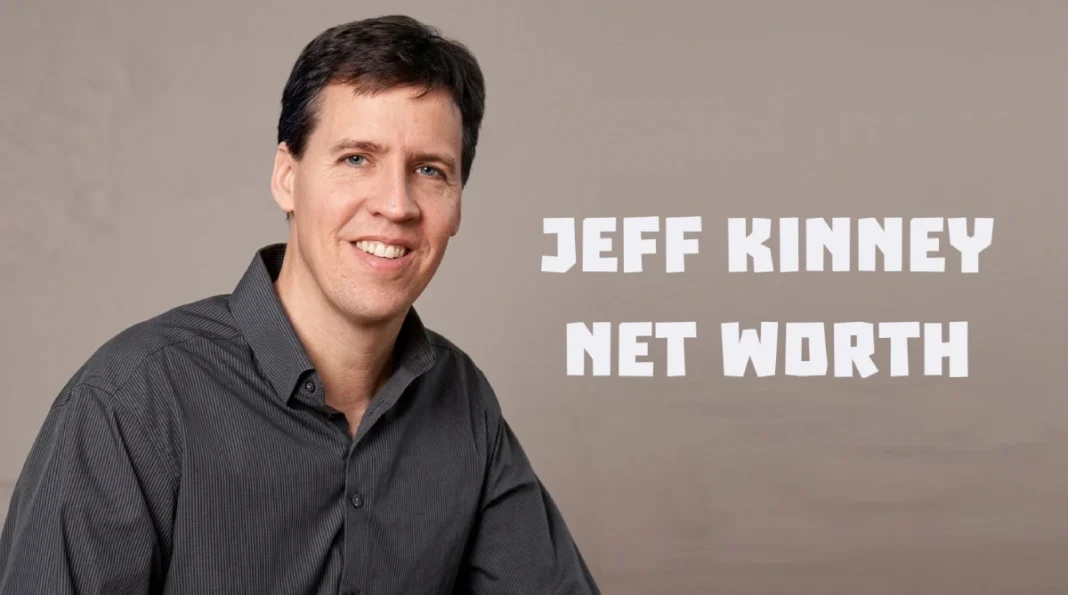
Jeff Kinney’s estimated net worth is $80 million, built almost entirely from a single creative idea: a middle-school kid named Greg Heffley and his illustrated diary. What started as a web comic in 2004 became one of the best-selling children’s book series in history, generating income across books, films, merchandise, digital platforms, and a second major property — the online game Poptropica.
This article breaks down where that money comes from, how publishing royalties actually work for a bestselling author, and what Kinney’s financial picture looks like beyond the books.
How Much Does Jeff Kinney Make Per Year?
Jeff Kinney earns an estimated $20 million per year. That figure combines book advances, ongoing royalties from existing titles, film and merchandise licensing, speaking fees, and educational platform agreements. It makes him one of the highest-paid authors in the world in any given year — and he achieves that from a single franchise rather than multiple series.
Early Life and Education
Jeff Kinney was born on February 19, 1971, in Fort Washington, Maryland. He grew up with three siblings — one younger brother and an older brother and sister — in a household that, by his own account, gave him plenty of material for a story about sibling rivalry and social awkwardness.
He attended Potomac Landing Elementary School and Bishop McNamara High School, graduating in 1989. He then enrolled at the University of Maryland, College Park, where he created a popular comic strip for the student newspaper called Igdoof. That strip — about a hapless college student — was his first real experiment with the cartoon-plus-text format he would later perfect in Diary of a Wimpy Kid.
Kinney graduated in 1993 with a bachelor’s degree in criminal justice. He never planned to become a children’s author. His original ambition was to get Igdoof nationally syndicated, but that never materialized. Instead, he moved into game development — a pivot that would eventually shape how he built the Wimpy Kid universe.
From Game Developer to Publishing Phenomenon
Kinney first came up with the idea of Greg Heffley in early 1998. He spent years developing the character’s voice and illustrating his stories before the concept found a home online. In 2004, he launched Diary of a Wimpy Kid as a web comic on Funbrain.com, an educational website. The response was immediate — millions of readers started following Greg’s misadventures online and demanding a physical version.
In early 2006, at New York Comic Con, Kinney signed a multi-book deal with Abrams Books (Harry N. Abrams, Inc.). The first printed Diary of a Wimpy Kid book was published in April 2007 and became an instant bestseller. Kinney was named one of Time magazine’s 100 Most Influential People in 2009, 2010, 2011, 2012, 2014, 2015, and 2016 — a recognition that very few children’s authors have received.
The Diary of a Wimpy Kid Series
The series now spans 20 main installments, with Partypooper (Book 20) releasing in October 2025, with individual titles including Rodrick Rules, Dog Days, The Long Haul, The Getaway, The Deep End, and Diper Överlöde, among others. The books have sold over 300 million copies worldwide as of late 2025 and have been translated into more than 65 languages. The series won the Nickelodeon Kids’ Choice Award for Favorite Book in 2016 and has held positions on the New York Times bestseller list for years.
What made the series succeed where other children’s books struggled is the format. Kinney combined Greg’s handwritten-style narration with simple stick-figure cartoons, creating something that felt accessible to reluctant readers — kids who found traditional novels intimidating. That combination turned into a publishing format now widely imitated but rarely matched.
Spinoffs and Supplementary Books
In 2019, Kinney expanded the franchise with a spinoff series built around Greg’s best friend, Rowley Jefferson. Diary of an Awesome Friendly Kid: Rowley Jefferson’s Journal is written from Rowley’s perspective, presenting Greg in an entirely different light. Two further Rowley books followed: Rowley Jefferson’s Awesome Friendly Adventure and Rowley Jefferson’s Awesome Friendly Spooky Stories. These spinoffs broadened the franchise’s audience and opened a second revenue stream within the same creative universe.
Kinney has also published supplementary titles tied to the films, including The Wimpy Kid Movie Diary and The Wimpy Kid Do-It-Yourself Book — companion pieces that extend reader engagement between main installments.
Main Income Sources
1. Book Advances and Royalties
Publishing is the core of Kinney’s income. Bestselling authors at his level typically receive seven-figure advances per book. Once a book “earns out” its advance through sales, royalties begin flowing on every copy sold. With 16+ main series books plus spinoffs and supplementary titles, Kinney has an unusually large portfolio generating passive royalty income at the same time.
| Format | Royalty Rate | Example Earnings |
| Hardcover | 10–15% | ~$1.67 per book at 12% |
| Paperback | 7–10% | ~$0.90 per book at 9% |
| E-book | 25% | ~$2.50 per book at $9.99 |
For a $13.95 hardcover Wimpy Kid book at a 12% royalty rate, Kinney earns roughly $1.67 per copy. On one million sales, that is $1.67 million. Scaled across 16+ books, the cumulative royalty base is substantial — particularly as backlist titles continue selling year after year.
Experienced authors also negotiate escalator clauses, which increase royalty percentages once a book surpasses certain sales thresholds. For a series that consistently sells millions per title, these clauses can significantly increase per-book earnings beyond the standard rate.
2. Film and TV Adaptations
Four live-action films (2010–2017) plus four animated Disney+ adaptations (2021–2025) bring the total to eight film adaptations. The first three films (2010–2012) starred Zachary Gordon as Greg Heffley, with supporting performances from Steve Zahn and Rachael Harris. The 2017 adaptation of The Long Haul featured a new cast, including Alicia Silverstone and Tom Everett Scott.
Collectively, the film series grossed well over $265 million at the global box office. As the original creator, Kinney received both upfront payment for the film rights and backend participation in the profits.
More recently, Disney+ has released animated film adaptations of the series, introducing Greg Heffley to a new generation of viewers. These streaming deals create a fresh licensing agreement on top of the existing theatrical income.
3. Merchandise and Licensing
The Wimpy Kid brand extends well beyond books. Backpacks, lunch boxes, clothing, toys, games, and school supplies all carry the franchise’s imagery. Each licensed product generates royalties for Kinney, typically 5–10% of wholesale prices. During back-to-school seasons and around film releases, merchandise revenue can rival or exceed book royalty income in a given period.
4. Poptropica — His Second Major Creation
Before most readers had heard of Greg Heffley, Kinney was already working on a second major property. In 2007, he co-created Poptropica with Pearson Education’s Family Education Network. The game is an online, problem-solving role-playing experience where players navigate a series of islands, each with its own quest.
Poptropica grew quickly. By 2012, it had over 75 million registered users, making it one of the largest children’s online platforms in the world. In 2015, Pearson sold the game to Sandbox Partners, an education-technology investment group. The sale and licensing arrangement from that period added meaningfully to Kinney’s earnings during Wimpy Kid’s peak commercial years.
5. An Unlikely Story Bookstore
In 2015, Kinney opened An Unlikely Story, an independent bookstore and community space in his hometown of Plainville, Massachusetts. While An Unlikely Story operates at a six-figure annual loss, Kinney views it as a community investment that strengthens brand loyalty and drives local engagement — it doubles as a community hub, hosting author events, school visits, and local gatherings. That said, it provides a presence in the physical retail world and keeps its brand locally anchored in a way that generates goodwill and ongoing visibility.
6. Speaking Engagements
As one of the most recognized names in children’s literature, Industry sources estimate Kinney’s speaking fees between $30,000–$75,000, with premium rates for international tours and corporate literacy events. School tours, author festivals, and literary conferences supplement his passive income while keeping the franchise in front of new readers.
7. Educational Platform Licensing
Educational platforms like Epic!, Raz-Kids, and school district licensing programs pay annual fees for digital reading services, pay licensing fees to publishers and rights-holders for access to popular children’s titles. Kinney’s books are among the most-requested titles on these platforms because of their proven ability to engage reluctant readers — a quality schools actively seek. These institutional arrangements typically involve annual licensing payments or per-student access fees, providing a revenue stream that runs parallel to consumer book sales.
Understanding Publishing Royalties at This Level
Most people understand that authors make money from book sales, but the mechanics behind that are less familiar. Here is how it actually works for a bestselling author like Kinney.
Publishers pay an advance against future royalties before a book is released. This can be a seven-figure sum for a major series installment. The author receives no additional royalty income until cumulative sales revenue surpasses that advance amount — known as “earning out.” For established bestsellers, earning out is typically fast, after which royalties flow on every copy sold.
Key insight: International rights are sold separately to foreign publishers in each country. With the Wimpy Kid series translated into more than 65 languages, Kinney receives separate royalty streams from publishers in markets including Japan, Germany, the UK, and dozens of others — each negotiated independently and adding to the cumulative total.
E-books carry a higher royalty percentage (typically 25%) but lower retail prices. A $9.99 e-book at 25% generates $2.50 per sale — more per unit than many hardcover arrangements once you account for the lower cover price on paper editions.
Assets and Net Worth Breakdown
Net worth is simply what someone owns minus what they owe. For Kinney, the asset side of that equation includes:
- Primary residence in Plainville, Massachusetts, estimated at approximately $2.5 million
- An Unlikely Story bookstore — real estate and business value
- Ongoing royalty rights to the Wimpy Kid intellectual property
- Investment portfolio, likely including stock holdings and real estate
- Residual income rights from the Poptropica sale arrangement
What distinguishes Kinney’s financial position from many authors of comparable income is the quality and durability of his primary asset: the Wimpy Kid IP itself. Unlike physical real estate or stock holdings, intellectual property with this level of global brand recognition generates income continuously without depreciation. New readers discover the series every year, backlist titles keep selling, and each new installment or adaptation reactivates the entire catalogue.
How Jeff Kinney Spends His Money
By the standards of someone earning $20 million a year, Kinney lives unusually modestly. He has mentioned in multiple interviews that he still takes his kids to school, keeps regular working hours, and avoids the kind of conspicuous spending associated with celebrity wealth.
His spending priorities center on his family, his community in Plainville, and his creative work rather than on personal luxury. The bookstore is the clearest expression of this — he could have invested that capital in something more financially productive. Instead, he chose a community institution that employs residents and creates a cultural presence in a small Massachusetts town.
He has not collected a portfolio of luxury properties or high-profile assets. His primary home is comfortable but not extravagant by the standards of someone worth $80 million. This grounded approach appears to be a deliberate choice rather than a constraint.
Jeff Kinney vs Other Top-Earning Authors
Put in context, Kinney’s $80 million sits well below the wealthiest authors in the world. But the comparison tells a different story when you look at how quickly he built that figure and with what:
| Author | Net Worth | Primary Source |
| J.K. Rowling | $1 billion+ | Harry Potter franchise |
| James Patterson | $800 million | Alex Cross, multiple series |
| Stephen King | $500 million | Horror novels, film adaptations |
| John Grisham | $400 million | Legal thrillers |
| Jeff Kinney | $80 million | Diary of a Wimpy Kid |
Kinney built $80 million from a single middle-grade series in under 20 years, starting from a web comic. His books target a younger audience at lower price points than adult fiction. He has not diversified across multiple series or genres. By those measures, the financial outcome is remarkable.
The ceiling on his wealth is also not fixed. Each new Wimpy Kid installment reactivates the backlist. Each new adaptation introduces the series to a new audience. Authors like Rowling and Patterson built their fortunes over decades and across multiple properties — Kinney is still in the middle of his career.
Awards and Public Recognition
Kinney’s public recognition extends well beyond book sales figures:
- Named one of Time magazine’s 100 Most Influential People in the World in 2010, 2011, 2012, 2014, and 2015
- Time named Poptropica one of its 50 Best Websites
- Six Nickelodeon Kids’ Choice Awards, including Favorite Book in 2016
- Goodreads Choice Award recognition in the Middle Grade and Children’s category
- Guest host on the 10th season of WGBH Boston’s High School Quiz Show
These recognitions matter financially as well as reputationally. High-profile awards drive sales spikes, reinforce the brand with institutional buyers (schools, libraries), and support the speaking fee rates Kinney commands at events.
Personal Life
Kinney married his wife Julie in late 2003. Together, they have two sons. The family lives in Plainville, Massachusetts, the same town where Kinney opened An Unlikely Story. His decision to remain rooted in a small community rather than relocate to a major city is consistent with the image he has maintained throughout his public career — accessible, local, and deliberately ordinary despite his commercial success.
Conclusion
Jeff Kinney’s $80 million net worth and $20 million annual income are the product of one unusually durable creative idea, executed consistently across books, films, merchandise, digital platforms, and a second major IP in Poptropica. He did not build a financial empire through diversification or calculated commercial strategy in the traditional sense. He built it by creating something that genuinely connected with readers — and then protecting and extending that connection through new formats and partnerships for nearly two decades.
For anyone researching how authors build lasting wealth, Kinney’s model is worth studying. The royalty math is straightforward once you understand how escalator clauses, international rights, and backlist sales interact. The more important lesson is that the durability of intellectual property at this level compounds in ways that physical assets cannot match.