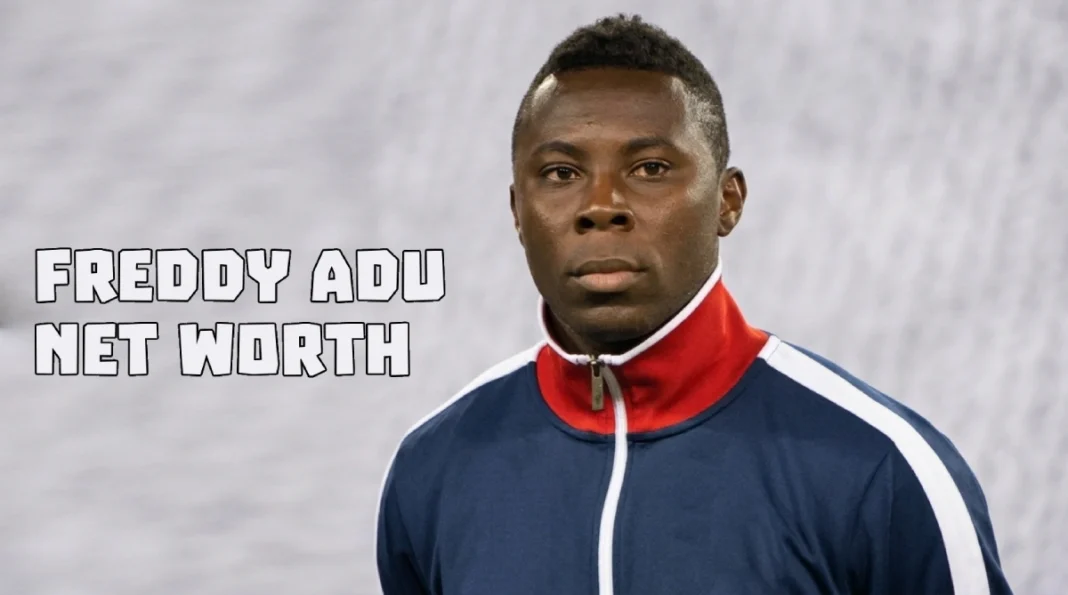
Freddy Adu arrived in professional soccer like no player before him — signed at 14, labeled “the next Pelé”, and handed a Nike sponsorship deal before he had even sat a high school exam. Decades later, his estimated net worth of $4 million reflects a career that produced remarkable early earnings but never fulfilled the stratospheric financial ceiling many had projected.
- Where did Freddy Adu’s money actually come from?
- What derailed a career that started with so much promise?
- What is he up to now?
Let’s break it down.
Who Is Freddy Adu?
Fredua Koranteng “Freddy” Adu (born June 2, 1989, in Tema, Ghana) is a former professional soccer player who competed as an attacking midfielder. He moved to the United States at age eight after his mother, Emelia Adu, won a green card through the Diversity Immigrant Visa lottery, and the family settled in Rockville, Maryland. Adu became a U.S. citizen in February 2003 and attended The Heights School, a private school in Potomac, Maryland.
From childhood, his talent set him apart. He regularly played against men many years older than him while still in grade school. At 12, he enrolled at IMG Academy in Florida, where elite coaching sharpened abilities that Italian clubs — including Juventus and Lazio — had already tried to recruit when he was just 10. His mother declined those six-figure offers, a decision that ultimately kept him on an American developmental path.
Career Overview
D.C. United — The Record-Breaking Debut (2004–2006)
At 14, Adu was selected first overall by D.C. United in the 2004 MLS SuperDraft, becoming the youngest American ever to sign a major league professional contract in any team sport. His opening-season salary of $500,000 per year made him one of the league’s highest-paid players at the time — an extraordinary fact for a player still of school age.
He made his MLS debut on April 3, 2004, against the San Jose Earthquakes, and two weeks later scored his first professional goal against the MetroStars at 14 years and 320 days old — the youngest scorer in MLS history at the time. Both those age records have since been surpassed: Maximo Carrizo broke the youngest-contract record, and Cavan Sullivan became the youngest player to appear in an MLS game in 2024.
That first season ended with an MLS Cup title, though Adu contributed primarily as a substitute after D.C. United acquired central midfielder Christian Gómez mid-season. Over three seasons with the club, he was selected to the MLS All-Star team twice and was nominated for the FIFPRO Young Player of the Year award in 2005. In November 2006, he spent two weeks on trial at Manchester United, but was unable to secure a work permit and returned without playing a competitive game.
Real Salt Lake and the Move to Europe (2007)
In December 2006, D.C. United traded Adu and goalkeeper Nick Rimando to Real Salt Lake in exchange for a major allocation and other considerations. His time in Utah was brief but significant. As captain of the U.S. Under-20 team at the 2007 FIFA U-20 World Cup in Canada, Adu delivered the standout performance of his career, scoring a hat-trick against Poland in a 6–1 victory and assisting both goals — scored by Jozy Altidore — in a 2–1 win over Brazil. He became the first player in history to score a hat-trick in both the U-17 and U-20 World Cups.
That tournament form prompted Portuguese giants Benfica to pay MLS a $2 million transfer fee for his rights — a landmark deal for an American player at the time.
Benfica and European Loans (2007–2011)
Adu made his Benfica debut in a UEFA Champions League qualifying match against FC Copenhagen in August 2007. However, consistent first-team minutes proved elusive. Over four years at the club, he was loaned out four times: to AS Monaco (Ligue 1, 2008–09), Belenenses in Portugal (2009–10, cut short by injury), Aris in Greece (January 2010), and Çaykur Rizespor in the Turkish second division (2011). His contract with Benfica expired in August 2011 without him having established himself as a regular starter at any of those clubs.
Return to MLS and the Journeyman Years (2011–2021)
Adu returned to MLS by signing with Philadelphia Union under coach Piotr Nowak, who had previously managed him at D.C. United. He earned a reported $519,000 in 2012, his last well-paid season. A move to Bahia in Brazil in 2013 ended with his release the same year. What followed was a difficult period of trials that produced no contracts: Blackpool, Stabæk (under former U.S. coach Bob Bradley), AZ Alkmaar, FK Jagodina, KuPS in Finland, the Tampa Bay Rowdies, Portland Timbers, and Las Vegas Lights.
In October 2020, after a two-year hiatus working as a youth coach in Maryland, Adu joined Österlen FF in the third tier of Swedish football. The club terminated his contract just one month later, citing fitness concerns. That spell effectively marked the end of his professional career. In total, he played for 15 clubs across 9 countries: the United States, Portugal, France, Greece, Turkey, Brazil, Serbia, Finland, and Sweden.
International Career
Adu represented the United States across five youth tournaments, including the 2003 FIFA U-17 World Championship and three editions of the U-20 World Cup — only the second player in history to appear in three FIFA U-20 tournaments. He also helped the U-23 team qualify for the 2008 Summer Olympics in Beijing, where he played in two group-stage matches.
At the senior level, he earned 17 caps for the United States national team between 2006 and 2011, scoring two international goals. Notable contributions include an assist on Eddie Lewis’s goal in a 2010 World Cup qualifier against Barbados, a key pass that freed Landon Donovan for the assist on Clint Dempsey’s winning goal in the 2011 CONCACAF Gold Cup semi-final against Panama, and a starting role in the Gold Cup final against Mexico.
His international honors include a 2009 FIFA Confederations Cup runner-up medal and CONCACAF Gold Cup runner-up appearances in both 2009 and 2011.
Freddy Adu’s Net Worth
Freddy Adu’s net worth is estimated at $4 million. That figure is significant by any general standard, though it sits well below what analysts once projected for a player who commanded headline contracts and major endorsements before he was old enough to drive. The difference between what people expected and what actually happened? Adu’s career hit its peak—both in paychecks and performance—before he was even old enough to vote.
How Did Freddy Adu Make His Money?
Professional Salaries
Soccer contracts formed the core of his earnings. His first MLS deal with D.C. United paid $500,000 annually — more than most league veterans at the time. After joining Benfica for a $2 million transfer fee (paid to MLS, not directly to Adu), his European contracts added to his career total. Back in MLS, his reported $519,000 salary at Philadelphia Union in 2012 was his last major club paycheck. By the time Adu was playing in lower-division leagues across Serbia, Finland, and Sweden, those contracts barely moved the needle on his overall earnings.
Endorsements
At 13, Adu signed a $1 million Nike endorsement deal — one of the largest sponsorship agreements ever made with an American soccer player at that time. He also secured deals with Pepsi, Campbell’s Soup, and Sierra Mist during the early peak of his fame. These deals collectively brought in substantial income before his 16th birthday and represent a significant portion of his lifetime earnings.
Post-Career Activities
Since stepping back from professional play, Adu has stayed connected to the game through youth coaching, soccer training camps, and private skills sessions. Media appearances — as a podcast guest, occasional analyst, and social media partner — have provided supplemental income in recent years. None of these activities approaches the scale of his playing-era earnings, but they form a steady post-career revenue base.
Property and Investments
Adu purchased real estate in the Maryland area, where he spent his formative years. Real estate in the Maryland area—where Adu bought property early—has gained significant value over the years, adding a quiet but steady boost to his net worth. Like many athletes who earned significant money young, the discipline with which early career earnings were invested will largely determine his long-term financial position — a fact his career trajectory makes particularly relevant.
What Is Freddy Adu Doing Today?
Following the end of his playing career, Adu has remained active in the soccer world as a coach and mentor. He has run youth training programs in Maryland and made periodic media appearances reflecting on his career — often with a candor that younger fans find refreshing. He has spoken publicly about the weight of early expectations and the difficulty of adapting to so many different clubs, coaches, and cultures in a short time.
On social media, he maintains a presence that keeps him connected to the game’s fan community. He has also expressed interest in music production and DJing — creative pursuits that reflect a side of him that existed largely out of public view during his playing days.
Why Didn’t Freddy Adu Reach His Potential?
This question has been debated for nearly two decades, and the honest answer involves several overlapping factors rather than one single cause.
- Entering the professional game at 14 meant Adu skipped a developmental phase that most elite players go through in their late teens. His physical maturation had to happen in public, in professional competition, with full scrutiny.
- Being labeled “the next Pelé” at 14 creates a standard no player — including Pelé himself at that age — could realistically meet. That narrative followed him to every club and made modest success feel like failure.
- Playing for 15 clubs in 9 countries across roughly 17 years left him unable to build the consistent confidence and familiarity that turns talented players into reliable ones. Each transfer reset his development clock.
- The MLS of 2004 was not structured to develop elite young talent in the way European academies were. His move to Benfica came at the right age but perhaps to the wrong club — one that loaned him out repeatedly rather than committing to his development.
Personal Life
Adu was born in Tema, a city roughly 16 miles east of Accra, Ghana. He moved to Rockville, Maryland, at age eight and has primarily lived in the United States since. He has spoken about maintaining a connection to his Ghanaian roots, and early in his career was recruited by the Ghana national team before ultimately choosing to represent the United States.
Romantically, he was reported to have dated singer Joanna “JoJo” Levesque between 2005 and 2007. He later began a relationship with actress Shadia Simmons, with whom he has reportedly maintained a long-term partnership.
By the standards of his earning level and public profile, Adu has led a comparatively understated life. He has not been associated with the financial recklessness that ends many athletes’ post-career security, which is itself a meaningful achievement given how young his income peak occurred.
Conclusion
Freddy Adu’s $4 million net worth is the financial record of a career that was extraordinary in its beginning and genuinely complicated in everything that followed. He earned more money before his 16th birthday than most professional athletes earn in a career — and he did so without the institutional support, agent experience, or emotional infrastructure that older players have when they sign their first contracts.
If there’s one takeaway from Adu’s journey for young athletes and their families, it’s this: the money you earn early won’t last forever, but the financial habits you build? Those stick with you. The endorsements, the contracts, and the transfer fees were real — but they came inside a narrow window that closed faster than anyone expected in 2004.
What makes Adu’s story worth revisiting is not the gap between promise and outcome. It is the fact that, by almost any measure outside of what was unfairly predicted for him, he built a life and a financial foundation that most people who ever kicked a soccer ball will never come close to.