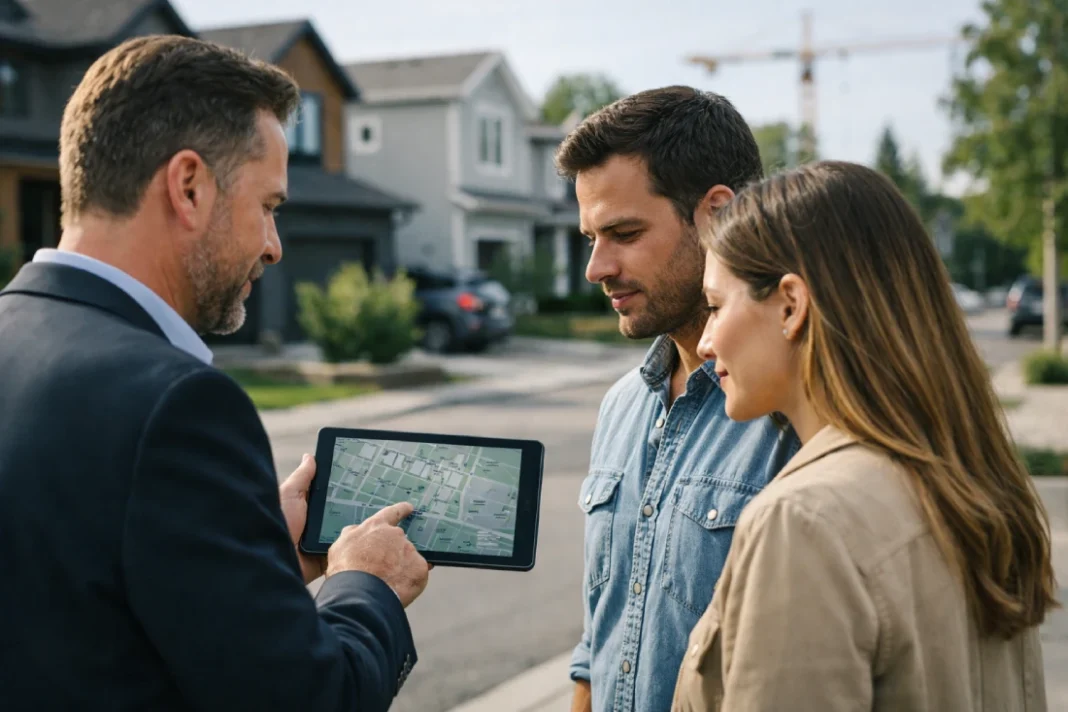
You found the perfect house—great price, solid bones, renovated kitchen. But skip these 10 neighborhood checks, and you could face rising insurance, declining schools, or unwanted development within months. Here’s your due diligence checklist.
This is the most common form of buyer’s remorse in real estate — not the property, but the location. And it’s almost entirely preventable.
This checklist gives you a repeatable, field-tested process to evaluate any neighborhood—so you commit with confidence, not hope. It goes deeper than a crime map and a school rating. Work through all 10 points, and you’ll have a clear picture of whether a neighborhood is worth buying into — and what risks you’re taking if you do.
Why Most Buyers Get This Wrong
The standard advice is: check safety, check schools, visit on a weekend. That’s not due diligence — that’s a first impression.
The real problem is that most buyers spend weeks analyzing a property and a few hours analyzing its surroundings. But location is the one thing you cannot change after purchase. A bad roof can be fixed. A neighborhood in structural decline cannot.
What you actually need: a simple framework that evaluates a neighborhood on three timelines—what it is today, where it’s been, and where it’s headed.
Point 1 — Safety: Go Beyond the Crime Map
Crime statistics are a starting point, not a conclusion. A neighborhood with higher reported crime but an active community watch program and declining year-over-year numbers is a different situation from one with lower reported crime but zero community infrastructure.
What to actually do:
- Access your municipality’s open-data crime portal or police department’s public statistics dashboard to analyze 3–5 year trend lines—not just snapshot numbers. Look at trends, not just current numbers — is crime rising, flat, or falling over 3–5 years?
- Distinguish between property crime (theft, vandalism) and violent crime. High property crime affects your insurance costs and quality of life. Violent crime affects resale potential more severely.
- Visit the neighborhood at night and on a weekday morning. A street that looks quiet on a Saturday afternoon can look completely different at 11 pm on a Tuesday.
- Talk to people who live there. Neighbors will tell you things no data source will.
Cross-reference police data with platforms like NeighborhoodScout to layer crime trends, school boundaries, and demographic shifts in one dashboard—giving you a 360° view of neighborhood trajectory. One number on a crime index tells you nothing about direction. Direction is what matters for a long-term purchase.
Point 2 — School District Ratings (Even If You Don’t Have Kids)
This is one of the most consistent drivers of residential property value, regardless of whether you personally care about schools. Buyers with children actively filter by school district, which creates structural demand — and price support — in highly rated areas.
Check ratings on GreatSchools.org (or your national education database), then cross-reference with our guide to school district boundary changes to spot upcoming rezoning risks. Look at ratings for elementary, middle, and high schools that serve the address. A strong elementary feeder school in a neighborhood signals consistent long-term buyer demand.
More importantly, check whether ratings are improving or declining. A district with a 7/10 rating trending upward is a better signal than one at 8/10 trending down. Declining school performance is one of the clearest early indicators of neighborhood deterioration.
If you’re buying in a country without standardized school ratings, look at school inspection reports, enrollment trends, and local news coverage.
Point 3 — Walkability and Daily Convenience
Walkability score (available on Walk Score, Google Maps, and similar tools) measures how easily residents can reach daily essentials, such as grocery stores, pharmacies, public transit, and restaurants without a car.
High walkability correlates with higher property demand and, in most urban markets, a measurable price premium. Properties in walkable areas also tend to retain value better during downturns because the buyer pool stays broader.
Beyond the score, ask practical questions:
- Is there a grocery store within a reasonable distance, or does every errand require a 20-minute drive?
- What is the public transit situation? Is there a bus or rail connection, and how frequently does it run?
- Are there parks, green spaces, or recreation areas nearby?
For families, proximity to pediatric clinics, schools, and parks matters. For young professionals, transit access and restaurant density matter more. Know your buyer profile, both yourself and the eventual buyer, when you sell.
Point 4 — Infrastructure and Development Pipeline
This is the most under-researched factor in neighborhood evaluation, and it has massive implications for property value in both directions.
Planned infrastructure investment — a new metro line, a highway interchange, a commercial retail hub — can significantly increase property values in surrounding areas. Buying before that development is announced or completed is how many buyers capture appreciation.
But the reverse is also true. A planned logistics warehouse, a new highway cutting through a residential corridor, or a large-scale commercial rezoning near your street can suppress values or make a neighborhood less desirable to live in.
How to check:
- Visit your city or municipality’s planning department website. Most publish development applications, rezoning requests, and approved projects.
- Search for any environmental impact assessments filed for land near the property.
- Check if the area falls under any urban development or renewal plans — these often indicate either investment or displacement risk.
- Ask your real estate agent specifically about known upcoming projects. A good agent will know. A bad one will give you a vague answer.
Do this research before you fall in love with a property—because emotions make great memories, but terrible due diligence.
Point 5 — Property Value Trends (Past 5–10 Years)
Historical price data tells you whether a neighborhood has been gaining value, holding steady, or sliding. You want to understand the long-term direction of the market you’re entering.
Pull sold price data for comparable properties (same type, similar size) in the neighborhood over the past 5–10 years. This is available through your country’s property registry, real estate listing platforms, or a licensed agent’s access to the MLS database.
What you’re looking for:
- Consistent appreciation: Values rising steadily over time, indicating sustained demand.
- Stagnation: Values flat for years, often a signal of low demand or population decline.
- Volatility: Sharp spikes followed by drops, which may indicate speculative activity rather than genuine demand — a risk for buyers who may need to sell within a few years.
Use Zillow’s Neighborhood Insights tab to compare your target area’s 5-year appreciation rate against the metro average—this reveals whether you’re buying into momentum or stagnation. Also, compare the neighborhood’s growth rate against the broader city average. A neighborhood appreciating at 3% annually while the city averages 7% is quietly underperforming, even if the raw numbers look positive.
Point 6 — Property Tax History and Trajectory
Buyers routinely ignore this, and it’s a real mistake. Property taxes are a recurring cost that compounds over time. In many jurisdictions, tax assessments are periodically revised upward as property values rise — sometimes aggressively.
Request the tax history for the specific property you’re considering. Then check whether the municipality has recently increased its tax rate or announced plans to do so. Local government budget documents and news coverage are your best sources here.
Some neighborhoods — particularly those undergoing rapid improvement — see property taxes rise faster than the benefits materialize for existing owners. If you’re buying in an area that’s “up and coming,” factor in the probability of a tax reassessment within 3–5 years and model what that does to your carrying costs.
Point 7 — Flood Zones, Environmental Risks, and Zoning
Environmental risk is financially material — it affects insurance costs, mortgage eligibility, and resale potential. Many buyers discover this only after signing.
Key checks:
- Flood maps: In the US, FEMA’s flood map service is the standard reference. In other countries, national geological or environmental agencies publish equivalent data. Check whether the property falls in a flood zone and what insurance implications it carries. For industrial history checks, search the property address in the EPA’s EnviroMapper tool to uncover nearby Superfund sites or historical contamination reports that could affect future resale value.
- Soil and contamination: If the area has an industrial history, check for brownfield designations or known contamination sites. These can affect both property values and future development potential.
- Zoning classification: Confirm what the land is currently zoned for, and whether any adjacent parcels have been rezoned or have pending rezoning applications. A residential neighbor lot rezoned for commercial use changes the character of your street.
- Wildfire, earthquake, or coastal risk: Relevant depending on your geography. These directly affect insurance availability and cost.
Your title company, a local attorney, or a qualified property inspector can help you navigate this — don’t skip it.
Point 8 — Neighborhood Demographics and Stability
Demographic data — population growth, income levels, age distribution, owner-to-renter ratio — gives you a picture of neighborhood stability and demand trajectory.
Areas with growing populations, rising median incomes, and high owner-occupancy rates tend to see stronger property value support. High renter concentration isn’t inherently negative, but very high vacancy rates or a sharp decline in owner-occupancy can signal instability.
Where to find this data:
- National census bureau data (US Census, UK ONS, Statistics Canada, etc.)
- Local planning department reports
- Commercial data providers like Esri or PolicyMap aggregate this into usable neighborhood profiles
Look specifically at trends, not just current snapshots. A neighborhood seeing consistent population growth and income improvement is on a different trajectory than one that peaked a decade ago.
Point 9 — Rental Demand and Vacancy Rates
Even if you’re buying as a primary residence, rental demand is a useful indicator of neighborhood desirability — and it becomes directly relevant if you ever need to rent the property out.
High rental demand relative to supply means the neighborhood attracts tenants, which signals it also attracts buyers. Low vacancy rates indicate steady demand. High vacancy is a warning sign worth understanding before you proceed.
For investment buyers, check current gross rental yields for comparable properties in the area. A property priced at $400,000 renting for $2,000/month delivers a 6% gross yield — before taxes, maintenance, insurance, and vacancy. Net yield is typically 1–2 percentage points lower. Compare this against the local market average to assess whether you’re getting fair value for the risk.
In most cities, a gross rental yield of 4–6% in a stable neighborhood is a reasonable benchmark. Yields above 8% often signal higher risk — either the price is low for a reason, or the rental income is unsustainable.
Point 10 — The Multi-Visit Test
No amount of data replaces direct observation — but observation has to be done right. A single Saturday afternoon visit is nearly worthless as due diligence.
Visit the neighborhood at a minimum of three times across different conditions:
- Weekday morning — see the commute behavior, school drop-off activity, and general day-to-day rhythm
- Weekend evening — assess noise levels, foot traffic, and how residents use public spaces
- Rainy day or bad weather — check drainage, road conditions, and whether any chronic flooding patterns become visible
While you’re there, observe the condition of surrounding properties. Homes with deferred maintenance, abandoned yards, or boarded windows signal disinvestment. Homes being renovated, new businesses opening, and fresh streetscaping signal the opposite.
Talk to at least two or three residents. Join the neighborhood’s Nextdoor group before visiting—you’ll spot recurring concerns about parking, noise, or development plans that won’t appear in official municipal reports. Ask what they like about the area and what they’d change. People who live there will give you information that no data source will surface.
How to Score and Compare Neighborhoods
Once you’ve worked through all 10 points, you need a way to compare multiple options. A simple scoring method works well.
Rate each of the 10 factors on a scale of 1–5. Weigh the factors that matter most to your specific situation — if you have school-age children, school district quality might be worth double. If you’re buying purely as an investment, rental yield and value trajectory deserve more weight.
Total the scores. Any neighborhood scoring below 25/50 on this framework deserves serious scrutiny before you proceed. A score in the 35–50 range across all factors, with no single factor rated below 2, is the profile you want.
This isn’t a precise formula — it’s a forcing mechanism to make sure you’ve thought through every dimension before you commit.
Final Word: What the Data Can’t Tell You
Neighborhood evaluation is mostly a research problem, but not entirely. Data shows you what’s already happened. But it won’t tell you about the young family moving in next door, the community center hiring a dynamic new director, or the local entrepreneur about to open the coffee shop that becomes the block’s heartbeat.
What good due diligence does is reduce your exposure to the risks you can see and quantify. It won’t eliminate uncertainty — it will make sure you’re not buying on false assumptions.
Buyers who regret their neighborhood choice rarely got unlucky—they just did the bare minimum. And minimal research almost always delivers minimal results.
FAQs
Q1: How long should neighborhood research take before making an offer?
For a serious purchase, budget 10–15 hours of focused research spread across multiple visits and data sources. This isn’t a weekend task — it’s a structured process. Rushing it because you feel competitive pressure on a property is one of the most common ways buyers end up with regret that has nothing to do with the house itself.
Q2: What’s the single most important factor when evaluating a neighborhood?
There isn’t one — and anyone who tells you otherwise is oversimplifying. Safety, school ratings, and value trends are the three factors that most consistently affect both livability and resale value. But the weight of each depends on your situation. A single investor buying a rental property has a completely different priority order than a family with two school-age children buying a forever home.
Q3: How do I check if a neighborhood is improving or declining?
Look at four things together — not in isolation:
- Property value trend over 5–10 years vs. the city average
- School district ratings year-over-year
- Owner-to-renter ratio over time (rising renter concentration can signal declining owner investment)
- Physical observation — are properties being maintained and renovated, or showing signs of neglect?
A neighborhood in genuine recovery will show positive signals across most of these, not just one.
Q4: Is a high walkability score always better?
Not automatically. High walkability correlates with stronger demand and a broader buyer pool, which supports property values. But a high walkability score in a high-crime area doesn’t offset the safety problem — it just means more people are exposed to it on foot. Use walkability as one signal within the full checklist, not as a standalone quality indicator.
Q5: Should I avoid buying in a neighborhood with a high renter concentration?
Not necessarily, but it deserves scrutiny. High renter concentration alone isn’t a red flag — many stable, desirable urban neighborhoods are majority-renter. The concern is when high renter concentration is combined with high vacancy rates and declining property values. That combination points to weak owner demand, which directly affects your ability to sell at a good price later.
Q6: How do I find out about planned developments near a property?
Start with your city or municipality’s planning department website — most publish pending rezoning applications, approved development permits, and long-range infrastructure plans. You can also search for environmental impact assessments filed for nearby parcels. A good local real estate agent will know about major projects in the pipeline. If they don’t, that’s useful information about the agent.
Q7: Do school district ratings matter if I don’t have children and don’t plan to?
Yes — because your future buyer might. School district quality is one of the most consistent drivers of residential demand. Strong school districts attract a larger and more reliable buyer pool, which supports prices during downturns and accelerates appreciation during strong markets. Buying in a weak school district area means your eventual exit depends on a narrower set of buyers, which reduces your negotiating position when you sell.
Q8: How do I assess flood risk for a specific address?
In the US, FEMA’s Flood Map Service Center (msc.fema.gov) lets you check any address against official flood zone designations. Outside the US, your national geological survey, environmental agency, or municipal planning office will have equivalent mapping tools. Also, ask your insurance broker for a quote before you’re under contract — the premium itself tells you a lot about how insurers assess the risk at that address.
Q9: What’s a reasonable property tax increase to budget for?
This varies heavily by jurisdiction, but a useful rule of thumb: if you’re buying in a neighborhood with rapidly rising property values, assume your tax assessment will be revised upward within 3–5 years. In many US municipalities, annual increases of 2–5% are common in appreciating areas. In some cities, reassessments after a sale trigger a jump to the current market value immediately. Check your local rules specifically — this can add hundreds or thousands of dollars annually to your carrying costs if you’re not prepared for it.
Q10: Can a neighborhood look good on paper but still be a bad buy?
Yes. Data captures what’s measurable and what’s already happened. It doesn’t capture a major employer about to relocate, a longtime anchor business closing, or a local government losing the budget to maintain infrastructure. This is why the multi-visit test and direct conversations with residents matter — they surface things that no database will show you. Good data reduces your risk. It doesn’t eliminate it.