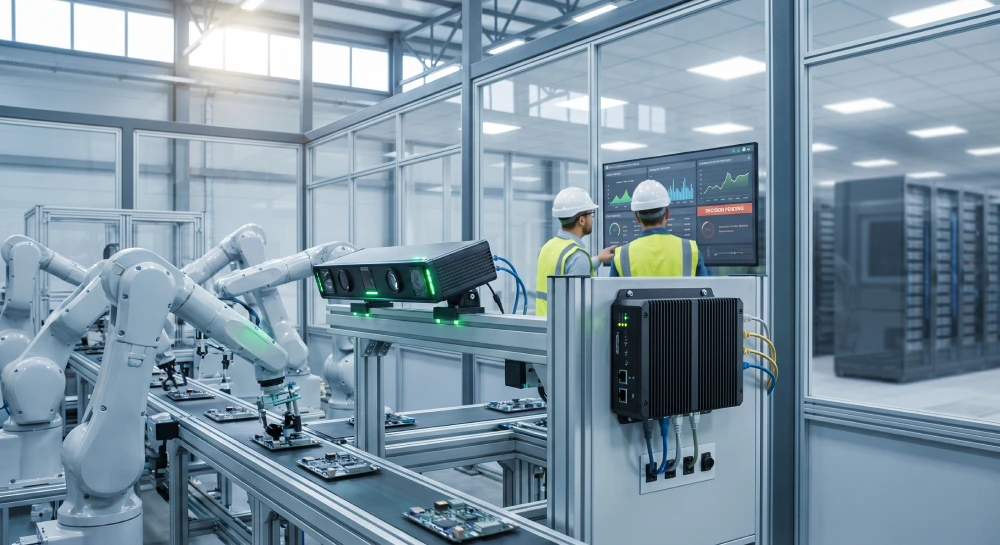
A Stuttgart factory was losing 3+ defective units per minute—not from poor cameras, but from 200ms of cloud latency. The fix? Move processing to the edge.
When that system ran on a cloud server in Frankfurt, the round-trip delay was just under 200 milliseconds. That’s nothing in human terms. But on a line producing 800 units per minute, 200ms meant defective parts were already three stations ahead before the system reacted. The fix wasn’t faster internet. It was moving the processing closer to the machine.
That’s edge computing in one sentence: put the processing where the data is generated, not somewhere else.
But before you start rearchitecting your infrastructure, here’s the honest reality — edge computing isn’t a replacement for cloud. It’s a different tool for a different problem. Knowing which one your business actually needs starts with understanding what each does well and where each one falls short.
What Is Cloud Computing? (A Quick Baseline)
Cloud computing delivers infrastructure (IaaS, like AWS EC2), platforms (PaaS like Azure Functions), or software (SaaS like Salesforce) on demand from remote data centers—so you pay only for what you use. Your data travels from wherever it’s generated, over the internet, to a data center, gets processed, and a response comes back.
This model became the default for good reasons:
- No hardware to buy or maintain — you pay for what you use
- Near-unlimited scale — spin up more capacity in minutes
- Global access — anyone with internet can connect
- Managed services — databases, machine learning, analytics, all pre-built
Cloud infrastructure excels at handling business analytics, CRM platforms, SaaS apps, content delivery, and team collaboration—any workload where a few hundred milliseconds of delay won’t impact your users. Most businesses built in the last decade run almost entirely on cloud infrastructure, and for the majority of them, that’s the right call.
Here’s the hard constraint: physics. Data can’t travel instantly. Even at light speed, every mile between your device and a data center adds unavoidable delay. In most business applications, that latency is irrelevant. In some, it’s a dealbreaker.
What Is Edge Computing, and Why Is It Getting Attention?
Edge computing moves processing out of centralized data centers and closer to the point where data originates — a device, a sensor, a vehicle, a machine. “The edge” refers to that proximity: the physical location near the data source, rather than a distant server.
Instead of sending raw data to the cloud, an edge device running AWS IoT Greengrass or Azure IoT Edge processes it locally—sending only alerts or summaries upstream.
The term gets used loosely, which creates confusion. A smart thermostat that adjusts temperature based on local sensors without checking a cloud server is running edge logic. A self-driving car making braking decisions in milliseconds is doing edge processing. A retail store running local fraud detection at a POS terminal before the transaction clears is using edge architecture.
What these share: the processing happens where the action is, not in a data center hundreds of miles away.
Cloud vs. Edge Latency: The Difference That Changes Everything
Latency is the gap between an event happening and a system responding to it. For most applications, the 50–200ms round-trip to a cloud server is invisible and harmless. For others, it’s the entire problem.
Here’s a concrete comparison:
| Scenario | Cloud Latency | Edge Latency |
|---|---|---|
| Loading a dashboard | 80–150ms | Not relevant |
| Detecting a factory defect | Too slow at 150ms+ | 1–5ms locally |
| Autonomous vehicle decision | Physically dangerous | Sub-10ms required |
| Real-time video analytics | Bandwidth-intensive, delayed | Processed on-site |
| Mobile app sync | Acceptable | Not required |
The latency advantage of edge computing only matters when:
- A decision needs to happen in under 50–100ms
- A network outage would stop operations entirely
- The bandwidth costs of sending raw data to the cloud are too high
If none of those apply to your use case, you’re probably optimizing for a problem you don’t have.
Edge Computing Use Cases: Where It Actually Makes Sense
Edge computing has genuine, well-documented value in specific scenarios. Here’s where it earns its keep:
- Industrial IoT and Manufacturing: Machines generate enormous amounts of sensor data. Sending all of it to the cloud is expensive and unnecessary. Processing it at the edge — detecting anomalies, predicting failures, controlling actuators — reduces bandwidth costs and enables real-time response. A turbine that can detect a vibration pattern and shut down in 3ms doesn’t need to ask the cloud first.
- Autonomous Vehicles: A car traveling at highway speed covers roughly 30 meters per second. Decisions about braking, steering, and collision avoidance cannot wait for a cloud round-trip. All safety-critical processing happens on board. Cloud is used for map updates, fleet analytics, and training data — not real-time control.
- Healthcare devices, wearables, and bedside monitors need to detect anomalies instantly. Sending raw patient data to a cloud server creates latency, privacy exposure, and dependency on reliable connectivity. Edge processing keeps sensitive data local and enables faster alerts.
- Retail and Point-of-Sale: In-store systems that process payments, detect theft patterns, or analyze foot traffic locally remain functional even if the internet connection drops. Cloud handles reporting and inventory sync when the connection is restored.
- Remote Locations: Oil rigs, mining sites, ships, and agricultural equipment operate in areas with limited or expensive connectivity. Edge computing lets these operations run autonomously, syncing with central systems when connectivity is available.
Cloud Computing Use Cases: Where It Still Wins
Don’t let the edge computing conversation mislead you — cloud remains the dominant choice for the vast majority of business workloads.
- Business Applications and SaaS CRM, ERP, HR platforms, email, project management — all of these work perfectly in the cloud. No latency concern, straightforward access control, and easy collaboration across locations.
- Data Analytics and Reporting: Analyzing historical data, running business intelligence reports, or training machine learning models requires serious computing power that isn’t practical to run on-site. Cloud gives you that on demand.
- Unpredictable Scale If your traffic spikes — a product launch, a seasonal rush, a viral moment — cloud scales horizontally in minutes. Edge hardware has a fixed capacity that takes months to expand.
- Collaboration and Remote Access Cloud-hosted systems are accessible from anywhere with internet. Edge systems are local by design, which creates access limitations for distributed teams.
- Disaster Recovery and Backup Cloud is the standard choice for data redundancy and recovery. Replicating data across multiple cloud regions costs a fraction of maintaining equivalent on-premise hardware.
Cost Comparison: Cloud vs. Edge
This is where most comparisons get dishonest. The real cost picture is more complicated than “cloud has no upfront cost.”
Cloud costs:
- Monthly compute and storage fees that scale with usage
- Bandwidth charges for data transfer (significant for high-volume IoT)
- Vendor lock-in risk — migrating later is expensive
- Ongoing subscription costs that grow with your data volume
Edge costs:
- Hardware procurement and installation (upfront capital expense)
- Local power and cooling
- Maintenance and physical security
- Local IT staff or managed edge services
Run a TCO analysis that factors in hardware depreciation, bandwidth savings, and cloud egress fees—generic comparisons miss your unique break-even point. A business sending terabytes of raw sensor data to the cloud per day might find that edge hardware pays for itself within 12–18 months purely from bandwidth savings. A business running a 10-person SaaS company will never need edge, and adding it would create costs with no return.
Bottom line: Model your own data volume, latency needs, and compliance rules—generic advice won’t tell you what your infrastructure actually requires.
Data Privacy and Compliance: A Factor Most Guides Skip
Most guides skip this, but where your data lives—and which laws apply to it—can make or break your compliance strategy.
When data travels to a cloud data center, it crosses jurisdictions. Depending on where your provider’s servers are located, your data may be subject to laws in those countries — including government access laws. For businesses handling medical records, financial data, or customer personal information, this creates real compliance exposure.
Edge computing keeps data local. A hospital running patient data analysis on local edge servers avoids transmitting sensitive records to an external cloud. A financial institution processing transaction data on-site maintains clearer data sovereignty.
This is relevant to:
- GDPR compliance for European user data
- HIPAA for US healthcare data
- Data residency requirements in countries like India, Russia, and China, where regulations mandate local storage
- Industry-specific regulations in finance, defense, and critical infrastructure
If your business operates under any of these frameworks, the location of your data processing is a compliance question, not just a performance one.
Do You Need to Choose? The Case for Hybrid Architecture
Most mature enterprise implementations don’t use one or the other — they use both, deliberately.
A common pattern:
- Edge layer: Handles real-time decisions, local data filtering, and immediate response (e.g., defect detection, anomaly alerts)
- Cloud layer: Handles aggregated analytics, model training, long-term storage, and reporting (e.g., trend analysis, historical reports, ML model updates)
In this setup, Kubernetes or K3s orchestrates workloads across edge nodes and cloud clusters—processing 90% of data locally while using the cloud for model retraining and historical analytics. The result is lower latency where it matters, lower bandwidth costs, and cloud scalability for the jobs that need it.
This isn’t a compromise — it’s often the architecturally correct answer. The question isn’t edge or cloud; it’s what belongs at the edge and what belongs in the cloud.
How to Decide: A Practical Framework for Your Business
Run through these questions. They will tell you more than any comparison chart.
1. Does your application need sub-100ms response times?
If yes, edge is likely required for those specific workloads. If no, the cloud handles it.
2. What happens if your internet connection drops?
If your operations stop, you have a continuity risk that Edge can address. If it’s just inconvenient, the cloud is fine.
3. How much raw data are you generating per day?
If you’re talking gigabytes or terabytes of sensor/device data, bandwidth costs in the cloud can be significant. Edge processing can reduce what you actually send.
4. Are there data privacy or compliance requirements tied to data location?
If yes, local edge processing may be required regardless of performance needs.
5. How distributed are your operations?
Many locations with local processing needs point toward the edge. Centralized operations with an internet access point toward the cloud.
6. What’s your IT team’s capacity?
Edge hardware requires local management. If you don’t have the team to support it, managed cloud services may be the realistic path, even if the edge would perform better technically.
FAQs
Q. Is edge computing replacing cloud computing?
No. Edge computing addresses specific scenarios where latency, bandwidth, or data locality matter. Cloud remains the right choice for the majority of business workloads. Most serious implementations use both.
Q. What is the main advantage of edge computing over the cloud?
Lower latency and the ability to operate without a reliable internet connection. Edge processes data at or near the source, which removes the round-trip delay to a remote server.
Q. Is edge computing more expensive than cloud?
It depends on your use case. Edge has higher upfront hardware costs but can reduce ongoing bandwidth expenses for high-volume data. Cloud has lower startup costs but monthly fees that scale with usage. Neither is universally cheaper.
Q. What industries benefit most from edge computing?
Manufacturing, healthcare, autonomous vehicles, retail, agriculture, energy, and defense are the clearest use cases. Common threads are real-time decisions, remote locations, or strict data privacy requirements.
Q. Can small businesses use edge computing?
Sometimes. Point-of-sale systems, local security cameras with on-device analytics, and standalone equipment are all edge use cases available to smaller operations. But the overhead of managing edge infrastructure makes cloud the practical default for most small businesses.
Q. What is fog computing?
Fog computing is a layer between edge devices and the cloud — local network nodes that aggregate and process data from multiple edge sources before sending summaries to the cloud. It’s an architectural pattern rather than a separate technology.