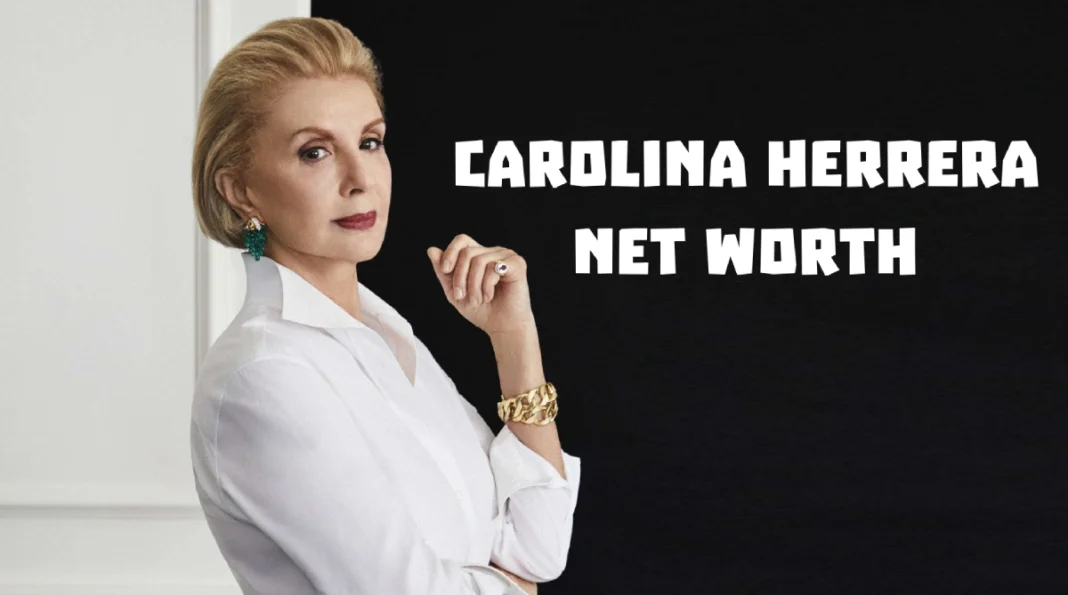
Carolina Herrera is one of the few designers who built a lasting fashion business — not just a label. Born into Venezuelan high society and propelled by genuine design talent, she launched her brand at 42 and turned it into a billion-dollar operation without ever losing the identity that made it worth building in the first place.
Her personal net worth sits at approximately $130 million in 2026 — a figure that exists entirely separately from the brand’s $1.2 billion in annual revenue. Understanding the gap between those two numbers is the key to understanding her story.
This article covers her net worth sources, full career timeline, the business model that has kept her relevant for four decades, and who now leads the brand she created.
Key Facts at a Glance
| Full Birth Name | María Carolina Josefina Pacanins y Niño |
| Date of Birth | January 8, 1939 |
| Birthplace | Caracas, Venezuela |
| Net Worth (2026) | ~$130 million (personal) |
| Brand Revenue | $1.2 billion+ annually |
| Brand Founded | 1981 |
| Acquired by Puig | 1995 |
| Current Creative Director | Wes Gordon (since 2018) |
| Nationality | Venezuelan-American (U.S. citizen since 2009) |
What Is Carolina Herrera’s Net Worth in 2026?
Carolina Herrera’s personal net worth is estimated at approximately $130 million as of 2026. This figure comes from her ownership stake and royalty arrangements with Puig — the Spanish conglomerate that acquired her fashion business in 1995 — combined with decades of accumulated earnings from licensing deals, fragrance royalties, and investment income.
It is worth being precise about one thing: her net worth and her brand’s revenue are not the same thing. The Carolina Herrera brand generates over $1 billion in annual retail sales. Herrera herself does not own all of that — Puig does. Her $130 million represents her personal share of the financial legacy she built before and after the acquisition.
Where Does Her Money Come From?
Her wealth draws from three main sources:
- Fragrance royalties — The perfume business, particularly the ‘Good Girl’ line, generates consistent revenue year-round and is estimated to account for roughly 30% of the brand’s total income. Herrera receives royalties from these sales.
- Ready-to-wear and accessories — Her clothing collections, sold across 280 stores in more than 100 countries, continue to drive revenue at the premium end of the luxury market.
- Licensing income — Eyewear, accessories, and home goods categories operate under licensing arrangements that produce passive income without requiring direct production involvement.
Early Life: From Caracas to New York
Carolina Herrera was born María Carolina Josefina Pacanins y Niño on January 8, 1939, in Caracas, Venezuela. Her father, Guillermo Pacanins Acevedo, served as an Air Force officer and as governor of Caracas. Her mother was María Cristina Niño Passios.
Fashion entered her life early, through her maternal grandmother. As a child, Herrera was taken to Balenciaga runway shows in Paris and dressed in clothing from Dior and Lanvin. These weren’t casual outings — they were an education in what craftsmanship and presentation actually meant, delivered before she was old enough to articulate why it mattered.
She made her debut in Caracas society as a teenager and was first featured on the International Best Dressed List in 1972. Eight years later, she was inducted into its Hall of Fame — a recognition of personal style that preceded her design career by nearly a decade.
Career Timeline: How She Built the Brand
The Launch (1981)
Herrera was 42 years old when she held her first runway show at Manhattan’s Metropolitan Club in 1981 — a fact worth noting because the fashion industry disproportionately rewards youth, and she succeeded without it. Her friend Diana Vreeland, who had stepped down as editor of Vogue in 1971 and was by then a consulting curator at the Metropolitan Museum’s Costume Institute, was an early advocate who encouraged her to translate her personal style into a commercial collection.
The debut was immediately picked up by publications including Women’s Wear Daily and Tatler. Park Avenue boutique Martha’s agreed to display her clothing in its windows — a significant early retail endorsement. One of the models who walked that first show was Iman, later one of the world’s most recognized supermodels.
Expanding into Fragrance (1988)
In 1988, Puig — a Spanish fragrance and fashion conglomerate — began licensing the Carolina Herrera name for a perfume line. This was not yet an acquisition; it was a licensing deal that gave Puig the right to use her name on fragrances while she retained ownership of the fashion business. That arrangement proved lucrative for both sides.
The Puig Acquisition (1995)
Puig acquired the Carolina Herrera fashion business in 1995, keeping Herrera on as Creative Director. This transition gave her access to Puig’s manufacturing infrastructure, global distribution network, and retail relationships — resources that would have been prohibitively expensive to build independently. In exchange, she gave up majority ownership of the company bearing her name.
By 2016, the brand had exceeded $1 billion in retail sales — a milestone that validated the post-acquisition strategy.
The Creative Handover (2018)
In 2018, Carolina Herrera stepped back from the creative director role. She did not retire — she was emphatic about that publicly, telling The New York Times: ‘Just don’t say I am retiring. I am not retiring. I am moving forward.’
Her successor, Wes Gordon, was appointed to the role. The transition was not abrupt; Gordon had been consulting for the brand before stepping into the top creative position.
Wes Gordon: Who Is Leading the Brand Today?
Wes Gordon has been the Creative Director of Carolina Herrera since 2018. Anyone researching this brand in 2026 will encounter his name immediately — which makes him a critical part of understanding where the label stands today.
Gordon studied at Central Saint Martins and developed his design skills working under Oscar de la Renta and at Tom Ford before launching his own small collection, which he ran for nearly eight years. His consultation work for Carolina Herrera led directly to the Creative Director appointment when Herrera stepped back.
His mandate has been to preserve the brand’s core identity — the white shirts, the vibrant color combinations, the precisely tailored silhouettes — while adapting the aesthetic to attract younger luxury consumers who were not yet shopping the brand. By most accounts, he has managed that without diluting what made the label recognizable.
Notable Clients
A significant part of Herrera’s authority in fashion derives from who she has dressed. This is not simply a prestige point — it reflects real commercial value. When a designer dresses a head of state or a globally recognized public figure, it functions as a form of validation that no advertising campaign can fully replicate.
Among her most notable clients:
- Jacqueline Kennedy Onassis — Herrera designed the wedding gown for her daughter Caroline Kennedy’s 1986 marriage to Edwin Schlossberg.
- Michelle Obama — Former First Lady of the United States, one of the most photographed women in the world during her time in the White House.
- Renée Zellweger — Academy Award-winning actress and long-time client.
- Duchess Diana de Melo — Herrera designed her gown for her wedding to Prince Charles-Philippe of Orléans, Duke of Anjou.
Beyond individual clients, Carolina Herrera has appeared on the cover of Vogue magazine seven times — a benchmark of cultural relevance in the fashion industry, not just commercial success.
The Business Model: Why It Still Works?
Tiered Pricing Strategy
The brand operates on a deliberate pricing tier. Ready-to-wear collections sit at the upper-middle luxury range, accessible to wealthy consumers without entering the rarefied territory of true haute couture. Fragrances and accessories extend the brand’s reach further down the price scale, allowing consumers who cannot afford a dress to own a perfume or a pair of sunglasses — and to feel connected to the brand’s identity.
This tiered approach maximizes revenue across income brackets without undermining the brand’s premium perception. It is one of the cleaner examples of luxury brand architecture in American fashion.
Evolution Over Reinvention
The brand updates its aesthetic each season without abandoning its core visual language. Herrera’s signature elements — structured tailoring, bold use of color, the iconic white blouse — have evolved rather than been replaced. This consistency reduces design risk while building a recognizable brand vocabulary that customers return to because it is familiar and trustworthy, not because it is new.
Fragrance as a Revenue Stabilizer
Fragrance revenues function as a financial buffer against the seasonal volatility of clothing sales. Perfume does not go out of style on a six-month cycle, and the ‘Good Girl’ bottle — instantly recognizable by its stiletto shape — has become a retail staple globally. Approximately 30% of the brand’s total revenue is estimated to come from the fragrance division, which means a weak clothing season does not destabilize the whole business.
The Puig Infrastructure Advantage
Most independent designers face a fundamental scaling problem: they can design well, but they cannot manufacture, distribute, and retail at a global scale without enormous capital investment. Puig solved this for Herrera. The acquisition gave the brand access to manufacturing facilities, established retail relationships across more than 100 countries, and the kind of supply chain efficiency that keeps margins viable at volume. This structural advantage is part of why the brand has lasted when many of its contemporaries have not.
How Carolina Herrera Has Maintained Her $130 Million Fortune
Herrera’s wealth did not accumulate by accident. Several deliberate decisions over her career have protected and grown it.
- Intellectual property control — By retaining her name rights and negotiating carefully during the Puig acquisition, Herrera ensured continuing royalty income even as her direct design involvement evolved. Many designers lose this leverage in acquisition negotiations and end up with a lump sum but no ongoing income.
- Brand positioning — Targeting the upper-middle luxury tier rather than the top end means the brand reaches a larger addressable market without the extreme fragility of ultra-high-luxury positioning, which is far more sensitive to economic downturns.
- Diversification — The spread across clothing, fragrance, eyewear, accessories, and licensing means no single category can sink the business. When clothing demand softens in one region, fragrance and accessories often compensate.
- Long-term brand identity — Herrera built a brand concept that outlasts any single designer’s active career. She did not position herself as the sole source of the brand’s value, which is why the 2018 handover to Wes Gordon did not produce the brand collapse that successor transitions sometimes cause.
Carolina Herrera’s Personal Life
First Marriage
Herrera married Venezuelan landowner Guillermo Behrens Tello in 1957, at age 18. The marriage produced two daughters, Mercedes and Ana Luisa, before the couple divorced in 1964.
Second Marriage
In 1968, she married Reinaldo Herrera Guevara, the 5th Marquis of Torre Casa, whose family name she took and has carried throughout her career. Reinaldo Herrera has worked as a special-projects editor at Vanity Fair magazine. The marriage has lasted over five decades — a notable fact in an industry defined by volatility and public persona management.
Upon their marriage, Carolina received the title of Marquise consort of Torre Casa, though this was retracted in 1992 under succession rules. She and Reinaldo have two daughters together: Carolina Adriana and Patricia Cristina.
Herrera became a naturalized United States citizen in 2009. She has maintained residences in New York, where the brand is based, alongside connections to her Venezuelan heritage, which has visibly shaped her design aesthetic — particularly her use of vibrant color and bold silhouettes.
Awards and Recognition
Herrera’s list of formal recognition is extensive. The most significant include:
- Council of Fashion Designers of America (CFDA) Women’s Wear Designer of the Year — 2004
- CFDA Geoffrey Beene Lifetime Achievement Award — 2008
- Couture Council Award for Artistry of Fashion — 2014
- American Academy of Achievement Golden Plate Award — 2005
- Fashion Group International Superstar Award
- Style Awards Designer of the Year — 2012
- Spain’s Gold Medal for Merit in the Fine Arts
- Gold Medal of the Queen Sofía Spanish Institute
- Award of Excellence, The International Center in New York
She has been a member of the CFDA board since 1999 and has served on jewelry designer Mimi So’s board of directors since 2004. These institutional affiliations reflect the degree to which she became embedded in the formal structures of the fashion industry, not just a successful designer operating at the edges of it.
The Brand in Today’s Market
Digital Presence
The Carolina Herrera brand has adapted to digital retail without abandoning its luxury positioning. Its website ranked among the top 1,500 fashion and apparel destinations globally in early 2026 — a meaningful position given the sheer volume of competing fashion sites. The brand maintains a curated social media presence that favors quality over volume, consistent with how luxury brands generally approach online visibility.
E-commerce growth has reshaped how the brand reaches customers outside of its 280 physical store locations. The shift required careful management: luxury brands face a genuine tension between the accessibility that e-commerce creates and the exclusivity that luxury positioning requires. The Herrera brand has managed this without significant discounting or brand dilution.
Geographic Expansion
The brand’s current growth focus includes Asia-Pacific markets, responding to the eastward shift in luxury spending, particularly among younger consumers in China, South Korea, and Southeast Asia. Traffic analytics suggest this regional push is already producing results. This matters for the long-term financial picture because North American and European luxury markets are mature — meaningful growth will increasingly come from newer wealth concentrations elsewhere.
Conclusion
Carolina Herrera’s $130 million net worth is the product of specific decisions made over four decades: starting at 42 when most designers have already peaked, positioning the brand in a tier accessible enough to scale but exclusive enough to hold value, bringing in Puig’s infrastructure at the right moment, negotiating intellectual property terms that kept income flowing after the acquisition, and building a brand identity strong enough to survive a creative director transition.
The business she created is now run by someone else. The collections come out twice a year under a different designer’s creative lead. Yet the brand still commands premium prices, still attracts influential clients, and still generates over a billion dollars a year in revenue. That is a harder achievement than the original launch — and it is the real measure of what Carolina Herrera built.
For anyone studying how creative talent translates into lasting financial independence, her career is one of the more instructive examples in modern fashion.