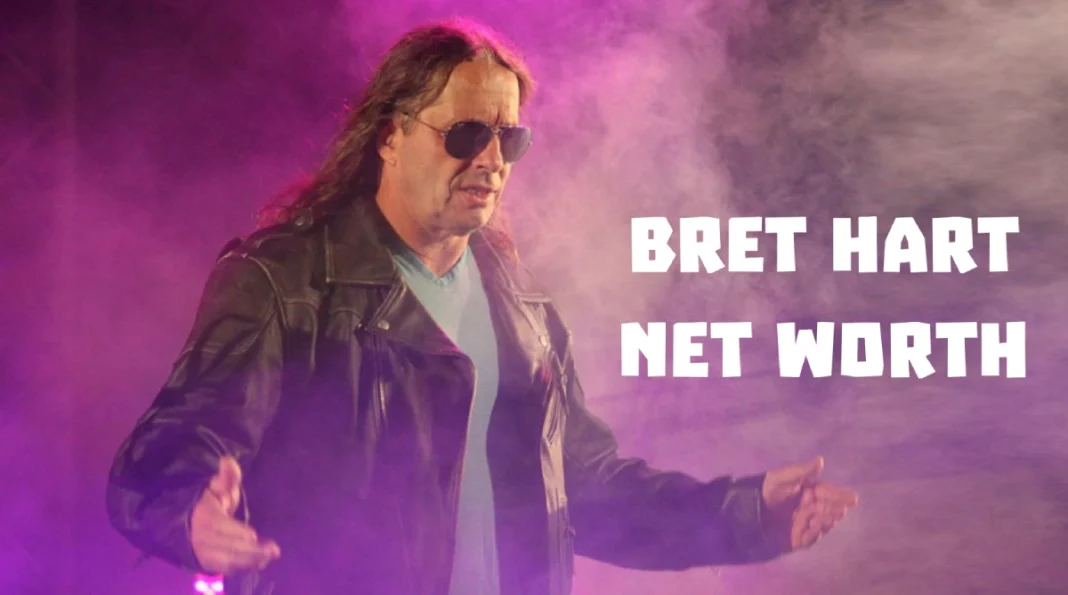
Bret “The Hitman” Hart is one of the most technically gifted professional wrestlers in the history of the sport. Across three decades in the ring — from the regional Stampede Wrestling circuit in Calgary to the global stages of WWF and WCW — he built a career that was as disciplined financially as it was athletically.
But what does that career actually translate to in dollar terms? And how has Hart managed his wealth since hanging up his boots? Here is a complete, up-to-date breakdown.
Quick Facts
| Category | Detail |
| Full Name | Bret Sergeant Hart |
| Date of Birth | July 2, 1957 |
| Nationality | Canadian-American |
| Estimated Net Worth (2025) | $7 Million |
| Primary Income Sources | WWE Legends deal, endorsements, media, royalties |
| WWE Legends Annual Earnings | ~$1.2 Million |
| Championships Won | 5× WWF Champion, 2× WCW World Heavyweight Champion, 2× Intercontinental Champion, 2× WWF Tag Team Champion, plus regional titles across Stampede Wrestling and international promotions |
| Hall of Fame Inductions | 2016 (individual), 2019 (Hart Foundation) |
| Current Residence | Calgary, Alberta, Canada |
What Is Bret Hart’s Net Worth?
Bret Hart’s net worth is estimated at approximately $7 million, a figure that has remained consistently cited by financial tracking outlets, including Celebrity Net Worth. This wealth is the product of a career spanning 35 years, followed by a post-retirement income structure built on royalties, brand deals, and media work.
Unlike some celebrities whose net worth fluctuates dramatically with market-tied assets, Hart’s financial base is relatively stable. According to multiple industry reports, Hart’s WWE Legends contract generates approximately $1.2 million annually, covering merchandise royalties, video game appearances, and selective appearance fees. Combined with endorsements, publishing royalties, and selective public appearances, Hart’s wealth is built to last.
It is worth noting that Hart’s peak active earnings were significantly higher than his current net worth suggests. A three-year WCW contract worth $3 million per year, five WWF Championships, and years of merchandise and pay-per-view bonuses generated enormous income. The gap between peak earnings and current net worth reflects the realities of career-ending injuries, a decade-long income freeze following his WWE departure, and the personal costs of two divorces.
Early Life and the Hart Wrestling Dynasty
Born on July 2, 1957, in Calgary, Alberta, Bret Hart was the eighth of twelve children born to wrestling patriarch Stu Hart and his wife Helen. He is of Greek and Irish descent. All seven of his brothers — Smith, Bruce, Keith, Wayne, Dean, Ross, and Owen — went on to become professional wrestlers, making the Hart family one of the most prominent dynasties in the sport’s history.
Bret’s introduction to wrestling came naturally. Growing up in the Hart family home — a large Calgary estate that housed the Hart Dungeon, a legendary basement training facility where his father trained generations of wrestlers — he was embedded in the business from childhood. As a young boy, he pulled raffle tickets and sold programs at his father’s Stampede Wrestling shows.
His formal athletic career began as an amateur wrestler at Ernest Manning High School in Calgary, where he won multiple provincial championships, including the 1974 city title. He continued at the post-secondary level, becoming the collegiate champion at Mount Royal College in 1977. That background in amateur wrestling gave Hart the technical foundation that would later define his professional style and separate him from contemporaries who relied more heavily on showmanship than ring craft.
He transitioned to professional wrestling through his father’s Stampede Wrestling promotion, beginning as a referee before making his in-ring debut in 1978 — launching a career that would span over three decades.
Wrestling Career and Earnings
Stampede Wrestling — The Foundation Years
Stampede Wrestling, based in Calgary and run by Stu Hart, was a well-respected regional promotion but not a major financial operation. Pay was modest, but the experience was invaluable. Bret refined his technical skills and storytelling ability in Stampede rings throughout the late 1970s and early 1980s, building the foundation for everything that followed.
WWF Career (1985–1997) — Peak Earning Years
Hart’s move to the WWF marked the beginning of his major earnings period. In 1985, he joined his brother-in-law Jim Neidhart to form the Hart Foundation tag team, originally managed by Jimmy Hart (no relation). The team won the WWF Tag Team Championship twice and established Bret as a credible in-ring performer at the national level.
His singles career took off in the early 1990s. He won the Intercontinental Championship twice (1991 and 1992) before capturing his first WWF Championship in 1992. Over the following five years, he would hold the title five times in total, feuding with marquee opponents including Shawn Michaels, Stone Cold Steve Austin, and Owen Hart. These rivalries produced some of the most technically polished matches of the era.
During his WWF peak years (roughly 1992 to 1997), Hart was among the company’s highest-paid performers. While exact contract figures were never publicly disclosed, top WWF talent in that period typically earned between $500,000 and $1 million annually in base salary, with significant additional income from:
- Pay-per-view event bonuses (wrestlers received a percentage of PPV buy rates)
- Merchandise revenue — Hart’s signature sunglasses, t-shirts, and action figures were consistent bestsellers
- Live event (house show) gate percentages for top-of-card performers
- International tour fees
His iconic pink-and-black colour scheme made his gear instantly identifiable and drove merchandise volume throughout his tenure. By the mid-1990s, Bret Hart merchandise was among the most recognisable product lines in the WWF’s retail catalogue.
WCW and the Post-Montreal Years (1997–2000)
Hart’s departure from WWF followed one of professional wrestling’s most controversial moments: the Montreal Screwjob. During a November 1997 pay-per-view match against Shawn Michaels, WWF owner Vince McMahon instructed the referee to call the match in Michaels’ favour without Hart’s knowledge, stripping him of the title he was set to relinquish on his own terms. Hart left the WWF immediately afterward.
He signed with rival promotion World Championship Wrestling under a contract reported at $3 million per year — at the time, one of the most lucrative deals in wrestling history. Financially, it was the right move. Creatively, it was a difficult three years.
Hart won multiple titles during his WCW run, including two WCW World Heavyweight Championships and four WCW United States Championships. However, his in-ring career was cut short by a career-ending concussion sustained during a match with Goldberg in December 1999. He officially retired from wrestling in October 2000. The injury didn’t just end his career — it ended the most financially lucrative phase of it.
WWE Return, Final Appearances, and Hall of Fame (2006–2011)
Hart’s 2006 reconciliation with WWE — triggered in part by the death of fellow wrestler Eddie Guerrero and the broader passage of time — ended nearly a decade of estrangement. His WWE Hall of Fame induction in 2006 reopened merchandise and royalty streams that had been frozen since 1997.
He came out of retirement in late 2009 and made sporadic in-ring appearances through 2011, including headlining SummerSlam 2010 and winning a final championship. He also served as General Manager of Raw during this period.
In 2016, he received a second Hall of Fame induction as an individual honouree. In 2019, the Hart Foundation was inducted as a group, earning him a third recognition. These inductions each triggered new merchandise pushes and legacy content deals with WWE.
Key Income Sources Beyond the Ring
WWE Legends Deal
Hart’s single most consistent post-retirement income source is his WWE Legends contract, signed in 2022. The deal is reported to generate approximately $1.2 million per year and covers:
- Royalties from merchandise bearing his name and likeness
- Appearance fees for WWE-affiliated content and productions
- Likeness rights for WWE video games, including appearances in the popular 2K wrestling game series
- Royalties from WWE Network and streaming content featuring his matches and career retrospectives
His most recent on-screen WWE appearance was in 2024. The deal is structured to be largely passive — Hart receives income without needing to maintain a heavy travel or performance schedule, which suits both his age and his health history.
Endorsements and Brand Partnerships
Hart has built a meaningful roster of brand endorsements, particularly with companies that align with his Canadian identity and wrestling legacy. Active and recent sponsorships include:
| Brand | Category |
| Gold Standard Grading | Sports card/memorabilia grading |
| Roots of Fight | Combat sports apparel |
| Hitman’s Bar | Hospitality |
| BIG SHOTS | Sports entertainment/events |
| South Country Co-op Liquor | Retail / beverages |
| Romero Distilling Co. | Spirits |
| Alberta Food & Beverage Expo | Trade events |
Most of these partnerships skew toward Canadian markets, which keeps Hart’s brand concentrated and relevant in his home country rather than diluted across global markets. With close to 950,000 Instagram followers and over one million followers on X (formerly Twitter) as of early 2025, he retains a social media reach that justifies commercial partnerships without requiring constant content production.
Autobiography and Publishing Revenue
Hart’s 2007 autobiography, “Hitman: My Real Life in the Cartoon World of Wrestling,” was both a critical success and a commercial one. Published first in Canada and released in the United States in 2008, the book earned Hart a publisher’s advance plus ongoing royalties. More than a commercial product, it established him as a candid, articulate voice on wrestling’s behind-the-scenes realities — increasing his perceived authority and opening doors to further media work.
The book’s continued sales through digital platforms and its reputation as one of wrestling’s most honest memoirs mean it still generates modest but consistent passive royalty income.
Calgary Sun Newspaper Column (1991–2004)
A less-publicised but noteworthy income stream during the middle years of his career was Hart’s column in the Calgary Sun, which he wrote from 1991 to 2004. This gave him an additional professional identity beyond wrestling and contributed to his income during a period that included his post-WWE career limbo. It also demonstrated a writing ability that eventually led to his autobiography deal.
Television, Film, and Media Appearances
Hart has appeared in a range of television productions outside wrestling, contributing to both his public profile and his income across different periods of his career. Notable appearances include:
| Title | Year | Role / Notes |
| Lonesome Dove: The Series | 1994–1995 | Series regular, played Luther Root |
| The Adventures of Sinbad | 1996 | Guest appearance |
| The Simpsons | 1997 | Guest voice appearance |
| Honey, I Shrunk the Kids: The TV Show | 1997 | Guest appearance |
| MADtv | 1997, 1999, 2000 | Multiple guest spots |
| The Immortal | 2000 | Guest appearance |
| Jacob Two-Two | 2003 | Guest appearance |
| Hitman Hart: Wrestling with Shadows | 1998 | Documentary subject |
| Bret Hart: Survival of the Hitman | 2010 | Documentary subject |
Beyond these scripted appearances, Hart has generated income through wrestling conventions and fan events, podcast and interview appearances, and personalised video messages. His selective approach to media — declining most low-value invitations — has preserved the premium attached to his time and name.
The Hart House and Real Estate
Hart previously owned the historic Hart House in Calgary—a 5,600-square-foot mansion with the legendary ‘Hart Dungeon’ training basement. While the property sold in 2010 for nearly $5 million, Hart maintains strong ties to Calgary and continues to reference the home’s legacy in interviews. The property spans approximately 5,600 square feet across 2.17 acres and includes 22 rooms, four fireplaces, and a mentor house on the grounds.
This is not a speculative investment property — it is the Hart family home, with decades of occupancy history and cultural significance to professional wrestling. Its value has appreciated considerably with the broader Calgary real estate market, making it a meaningful asset even without active management. Hart’s approach to property has been ownership over time rather than active portfolio building.
Health Challenges and Their Impact on Earnings
Bret Hart’s post-retirement life has been shaped significantly by two serious health events, both of which have directly influenced his earning capacity, public schedule, and philanthropic focus.
In 2002, Hart suffered a stroke after sustaining a head injury in a bicycle accident. The recovery was lengthy and physically demanding, limiting his public appearances for a sustained period and contributing to the reduced activity in the years following his 2000 retirement. The experience drew him toward advocacy for stroke awareness and recovery.
In 2016, Hart announced that he had been diagnosed with prostate cancer. He underwent treatment and spoke publicly about the experience, channelling the diagnosis into charitable fundraising and awareness campaigns. His recovery from both events has been remarkable, but the cumulative effect on his ability to maintain a high-frequency public schedule has been real — which partly explains why his appearances command premium pricing through scarcity.
Charity and Foundation Work
Hart has used his public profile consistently to raise funds and awareness for causes connected to his personal experiences and his Canadian identity. Key charitable involvements include:
| Organisation | Focus Area | Notable Contribution |
| Water First Foundation | Clean water access for Indigenous communities in Canada | Split $10,000 Canada Walk of Fame donation with SN7 youth program |
| Calgary Prostate Cancer Centre | Prostate cancer treatment and research | Donated $16,300 alongside the Calgary Hitmen hockey team |
| American Association for Cancer Research (AACR) | The world’s largest cancer research organisation | Active fundraising and public advocacy |
| Canada Walk of Fame | Canadian cultural recognition | Inductee: charitable donation upon recognition |
| SN7 Youth Program (Siksika Nation) | Indigenous youth development | Co-recipient of the Walk of Fame donation |
These contributions reflect Hart’s genuine engagement with the causes rather than performative philanthropy. His cancer diagnosis gave him direct personal motivation to support the AACR and the Calgary Prostate Cancer Centre, while his Canadian roots drive his Water First involvement. The specific dollar amounts and partnerships add credibility to his charitable record.
WWE Disputes, Reconciliation, and the Cost of a Lost Decade
Hart’s departure from WWE following the Montreal Screwjob was not just a professional and personal rupture — it was a financial one. For nearly a decade (1997 to 2006), Hart was effectively shut out of the WWE ecosystem, which meant:
- No royalties from merchandise featuring his likeness or name
- No income from WWE Network content or home video releases of his matches
- Exclusion from WWE Legends appearances, conventions, and brand events
- Delayed Hall of Fame induction and the merchandise push that accompanies it
The financial cost of this estrangement is difficult to calculate precisely, but industry observers generally agree it represents millions in lost passive income over those nine years. By the time Hart reconciled with WWE in 2006, a full generation of fans had grown up without his name being actively marketed to them.
The second relevant legal matter — the wrongful death lawsuit filed by Martha Hart following Owen Hart’s death during a 1999 WWE pay-per-view event — had a more indirect financial effect on Bret. While he was not a party to the lawsuit (which settled for $18 million), the family division it created complicated potential joint ventures and legacy projects involving the Hart family brand for years afterward.
Business Acumen: What Hart Got Right Financially
Not every wrestler from Bret Hart’s generation retained their wealth. Several contemporaries of comparable fame have faced bankruptcy, financial mismanagement, or the consequences of poor contract advice. Hart avoided most of these pitfalls through a consistent set of financial behaviours:
- He prioritised guaranteed money over upside-only deals. His WCW contract’s guaranteed $3 million per year structure meant he was paid in full even as his career-ending injury cut his active work short.
- He carried proper insurance throughout a high-risk career, protecting himself against the exact kind of income loss that ultimately came when his in-ring career ended prematurely.
- He diversified his income early — the Calgary Sun column, acting roles, and merchandise strategy all provided income streams outside the variable pay structure of live wrestling.
- He invested consistently rather than spending at the scale that his peak earnings would have permitted. His lifestyle — Calgary-based, with modest hobbies including drawing and art — is notably understated for someone whose career peak earnings matched those of A-list athletes.
- He negotiated the 2022 WWE Legends deal to include ongoing royalties across merchandise, games, and streaming — a deal structure that improves over time as WWE’s media catalogue becomes more valuable to streaming platforms.
Much like his in-ring persona as “The Excellence of Execution,” Hart’s financial approach has been defined by precision and discipline over flash. He has not chased speculative ventures or high-risk investments. The result is a net worth that has proved durable across decades of career transitions, health setbacks, and family difficulties.
Conclusion
Bret “The Hitman” Hart’s financial story is one of earned wealth, tested durability, and considered management. His $7 million net worth in 2025 does not reflect the scale of his peak earnings — a WCW contract alone paid him $9 million over three years — but it does reflect the outcome of sensible decisions made across a career full of disruptions: a career-ending concussion, a decade of industry exile, serious health challenges, and two divorces.
What distinguishes Hart from many wrestlers of his era is not the size of his fortune but the fact that he still has one. By prioritising guaranteed income, diversifying early, and structuring post-retirement deals with passive royalty income at their core, he built financial security that has outlasted both his health challenges and his public controversies.
For fans and observers, the Hitman’s financial legacy mirrors his in-ring legacy: technically sound, built for longevity, and more impressive on closer inspection than it appears from a distance.